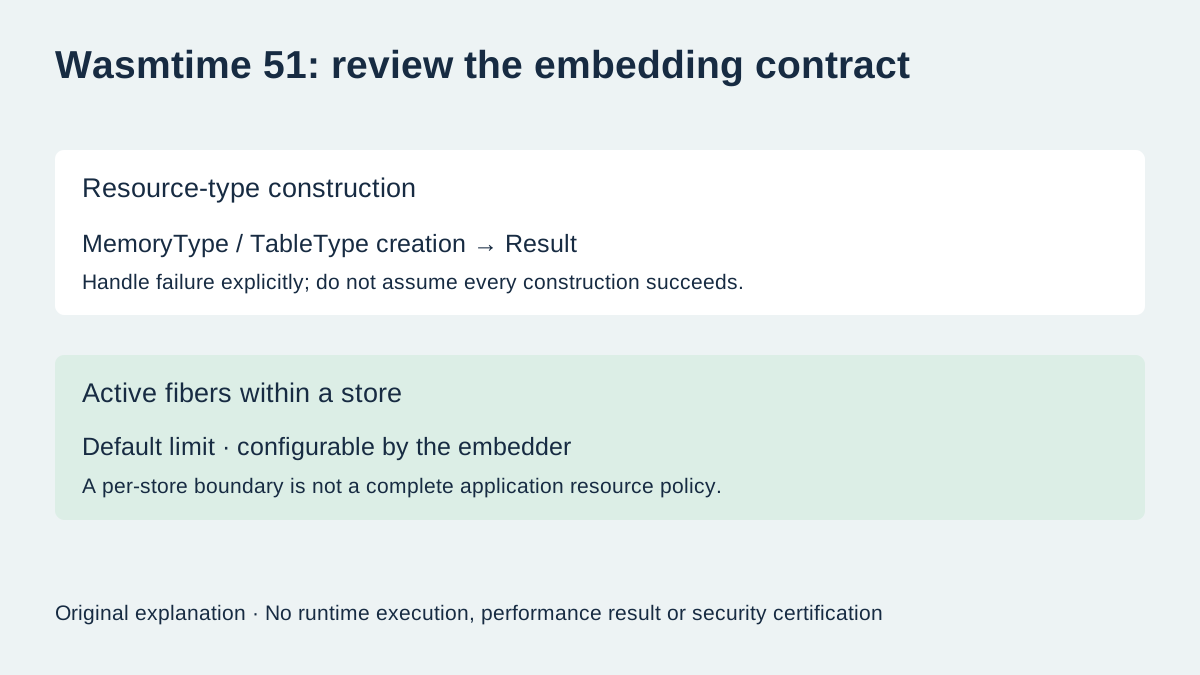

Wasmtime 51.0.0, released November 20, changes several contracts for applications that embed the WebAssembly runtime. Resource-type constructors now return a fallible result, and stores acquire a default limit on active fibers that embedders can configure.
The release also includes compiler, component-model and host-interaction changes. The practical question for an embedding application is which of those changes affects its own call paths and error handling, rather than whether the version number alone promises a faster or safer application.
Handle a construction failure explicitly
The constructor change makes the MemoryType and TableType creation APIs return Result. Callers need to account for failure instead of assuming construction cannot fail or relying on a panic.
This is a source-level integration change. A wrapper, example or downstream binding written around the older signature should be checked against the version it actually compiles with. A successful upgrade of one dependency does not establish that every surrounding assumption remains correct.
Our analysis: an error contract is part of the runtime interface
Returning an error gives the caller a place to decide what happens next. That is useful only if the application actually handles the error in a way consistent with the task. Replacing a panic with an ignored failure would leave the surrounding workflow difficult to reason about.
A meaningful migration check therefore exercises invalid inputs as well as the usual successful case. It should establish what the user sees, what state remains and whether the application can continue appropriately. We did not execute such a check for this report.
A per-store limit is one boundary, not every boundary
The fiber change introduces a configurable default bound on active fibers within a store. It should not be read as a complete limit on all memory, CPU time or activity across an entire application.
That distinction is important when a host manages many workloads. An application needs a clear picture of which resource a limit covers, where it is enforced and what happens when it is reached. One bounded resource can coexist with a different bottleneck elsewhere.
The release notes also list security advisories and numerous asynchronous-component fixes. Readers assessing those issues should use the full upstream notes and their exact deployment configuration; this article does not certify that a deployment is secure.
Our Wasmtime repository profile links the source under Apache-2.0 with the LLVM exception. We did not install the runtime, compile an application, reproduce an advisory or measure performance.
EXPLORE THE SOURCE
Projects in this story
GitHub repositories
- bytecodealliance/wasmtime ↗View project details
Primary-source reporting and original editorial analysis. No installation, model inference, paid service call, security test or independent benchmark performed.