GnuPG has released GPGME 2.3.1 to address a critical double-free flaw, CVE-2026-129975, in the library applications use to work with GnuPG. The public advisory appeared November 20; the release notes inside it are dated November 19.
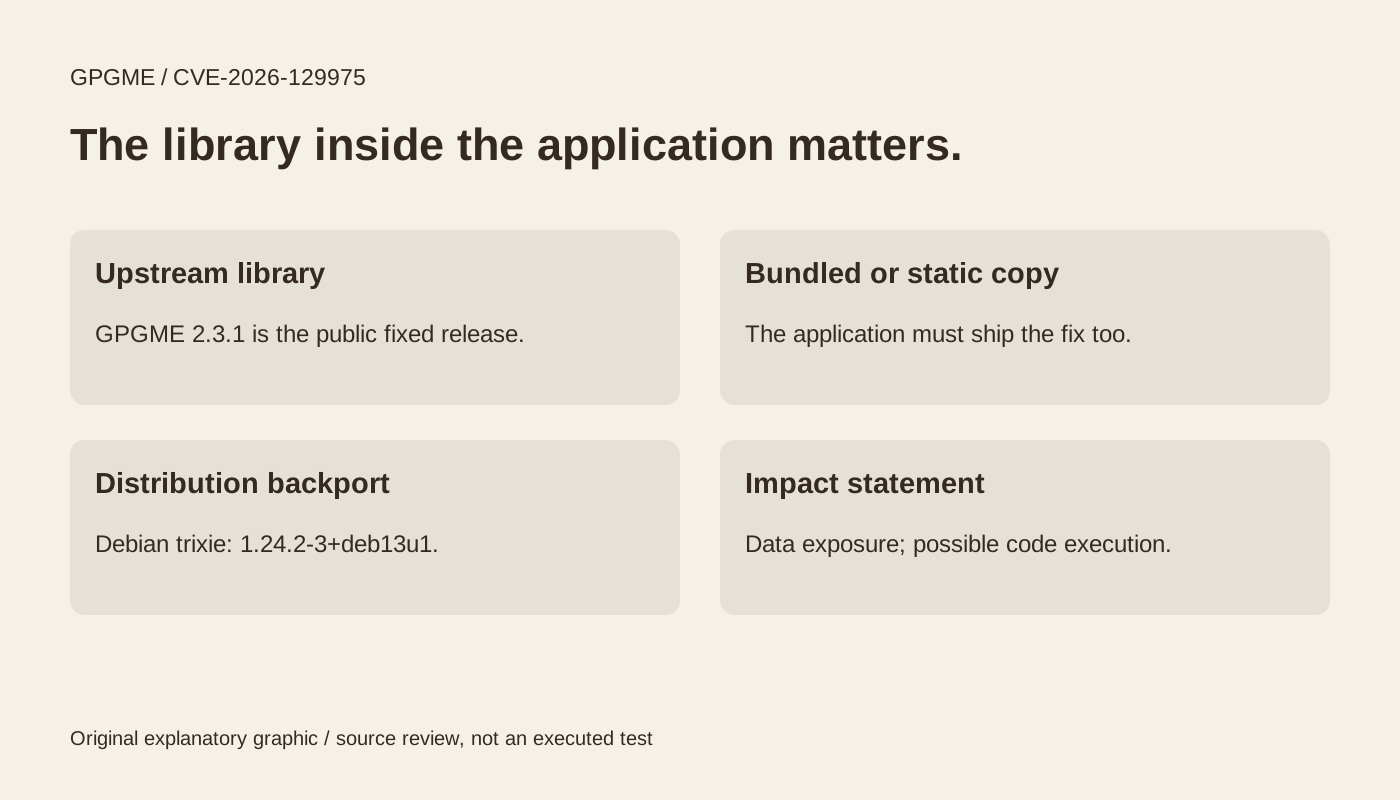
The project says a specially crafted, unusually long OpenPGP user ID can trigger the bug. It warns of application-data exposure and says remote code execution cannot be ruled out. Those statements should retain their different levels of certainty: possible code execution is not a report that it has been demonstrated on every affected application.
Check the library shipped with the application
The advisory covers applications using GPGME as a shared library, a Windows DLL or a statically linked component. Updating the command-line GnuPG program alone does not establish which library copy another application loads.
Upstream directs users to GPGME 2.3.1 and says static applications must be rebuilt against the fixed library. It also identifies Gpg4win 5.1.2 as a Windows package containing the repair. This is guidance from the publisher, not an installation we performed.
Why an older version number can still contain the repair
The Debian security advisory identifies 1.24.2-3+deb13u1 as the fixed package for stable trixie. That is a distribution backport, not an assertion that the upstream 1.24.2 release was already safe.
There is a potentially confusing boundary in the upstream announcement: its impact section names versions before 2.3.0, while its introduction calls prior releases affected. The same announcement explains that 2.3.0 was never publicly available. The public upstream update it recommends is 2.3.1; users should not hunt for an unpublished intermediate release.
Our analysis: inventory the dependency, not just the product name
A security update can be present in one package and absent from another copy of the same dependency. Bundled and static components make that distinction particularly important. An application vendor's release or a distribution's security status is more informative than comparing an upstream version string in isolation.
The advisory describes a memory-lifetime error in status and key-listing processing. That is an implementation failure, not evidence that OpenPGP cryptography has been broken. We have not submitted malicious keys, inspected local application libraries or measured exploitability.
Our GPGME source profile links the project and its GitHub mirror. The library's LGPL terms and the licenses of other components should be reviewed separately.
Original primary-source reporting and labelled editorial analysis. No installation, model download, inference, exploit attempt, upstream test suite or independent benchmark performed.