
TRL 1.18.2, released November 19, corrects how its BEMA callback updates a running model when some parameters are frozen. It also recognizes a changed chat template used by Muse Glimmer.
The fixes concern training infrastructure and compatibility. They do not introduce a foundation model or establish a measured improvement in model quality.
Frozen parameters expose a positional assumption
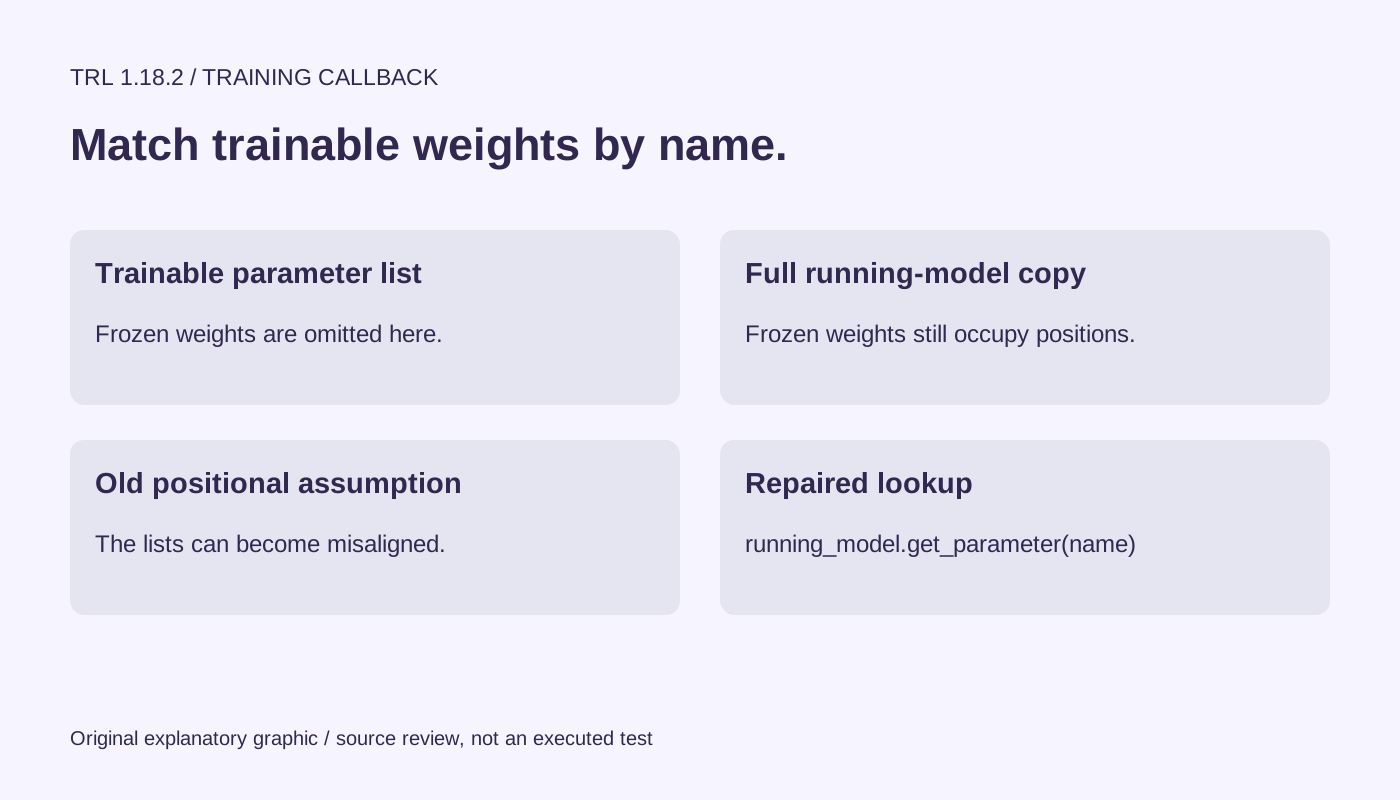
The BEMA repair addresses a mismatch between a list containing trainable parameters and a running-model copy that also contains frozen parameters. Matching those lists by position can point an update at the wrong tensor.
In the tagged implementation, the callback iterates through the names it already collected and resolves each destination with running_model.get_parameter(name). The contributor's regression test freezes embedding weights and checks that they remain unchanged in the saved BEMA model. We reviewed that change without running the test or training a checkpoint.
A template revision is a separate compatibility event
The second repair registers the Muse Glimmer template revision that adds a system-message line for a JSON-schema response format. TRL's exact-match recognition otherwise failed to substitute the corresponding training template for assistant-only loss.
The patch adds a matching training variant while preserving the response-format rendering. The upstream model name, a chat-template edit and a newly released checkpoint are distinct things; this article reports the library change.
Our analysis: partial training needs an explicit mapping
Freezing part of a model changes which weights participate in an update without removing those weights from the complete model. A callback that assumes the two collections always have the same ordering can fail even when the training configuration is intentional.
Parameter names make the association visible. They do not prove that every checkpoint layout, distributed configuration or callback combination has been tested. Likewise, recognizing a template revision is a compatibility repair rather than a guarantee that generated JSON is correct.
The existing TRL repository profile links the Apache-2.0 source. No weights, dependencies or training data were downloaded for this review.
EXPLORE THE SOURCE
Projects in this story
GitHub repositories
- huggingface/trl ↗View project details
Original primary-source reporting and labelled editorial analysis. No installation, model download, inference, exploit attempt, upstream test suite or independent benchmark performed.