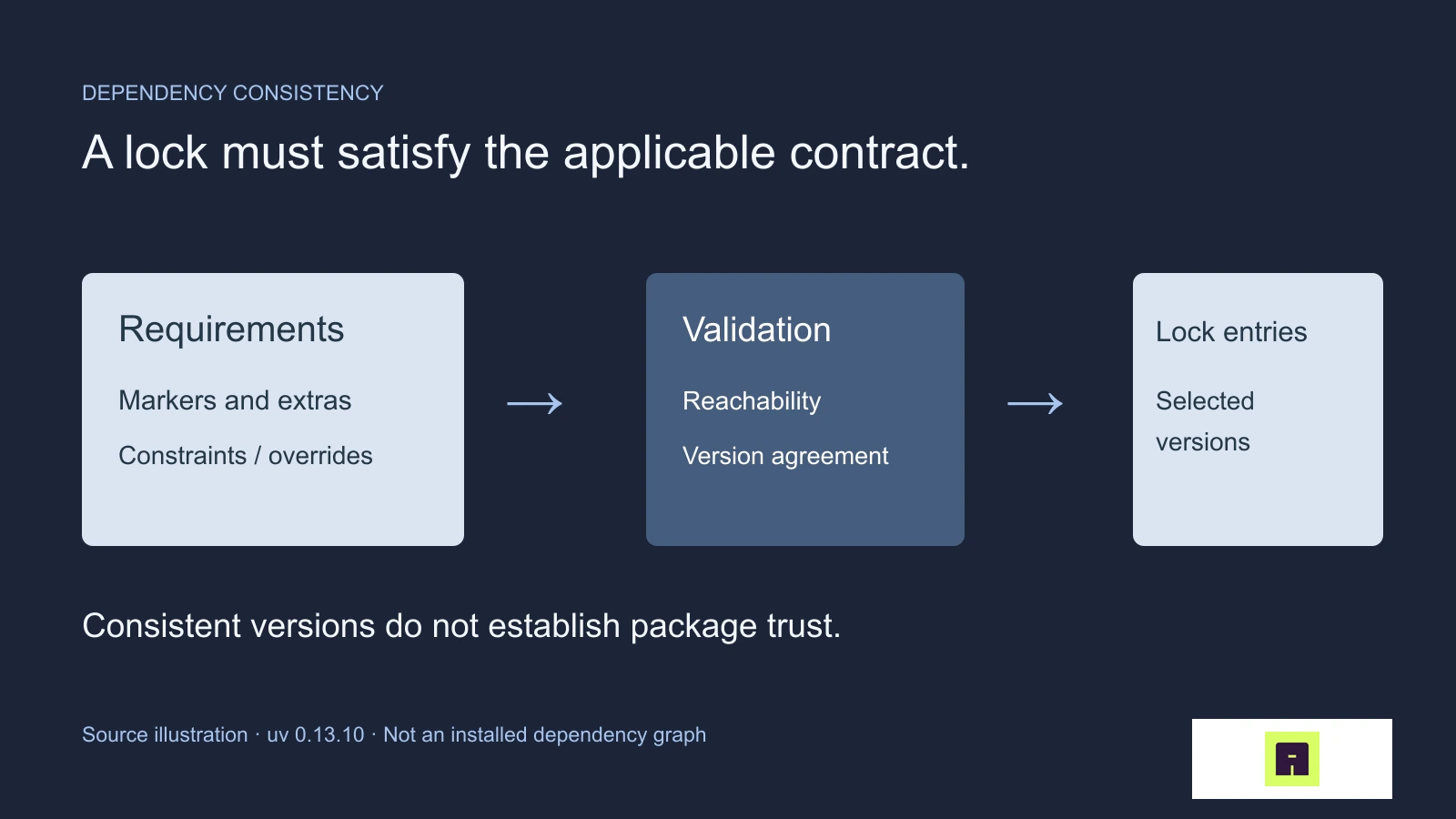

uv 0.13.10, released November 24, adds validation that dependency requirements in a lockfile agree with the package versions recorded there. It addresses the distinction between having a readable lockfile and having one whose recorded selections satisfy the requirements it describes.
The merged change explains that a simple version comparison is not sufficient. Constraints and overrides can alter the requirement that should apply, while environment markers and optional extras determine which dependency edges are relevant.
A universal lock contains conditional choices
A project can need different package selections in different supported environments. A requirement active only under one platform or extra should not automatically invalidate a selection used through another path. The release-tag implementation tracks reachability and dependency context so it can assess versions under the conditions where they are used.
The source also distinguishes whether the lock entry identifies which extra introduced a dependency. Where that provenance is unknown, applying an assumption about a particular extra can reject a valid lock. This is why the validation is more involved than comparing every package in a list against every requirement with the same name.
Overrides and constraints need similar care: validation has to consider the configured dependency modifiers rather than judging a lock against a requirement that the project deliberately replaced. The useful check is consistency with the applicable dependency contract, not enforcement of an unrelated global version rule.
Better diagnostics are part of the upgrade
The release also includes clearer explanations when locked mode rejects a lockfile and reports dependencies whose package entries are missing. Those messages help distinguish a lock requiring an update from an installation failure occurring later in a build.
This does not mean a newly accepted lockfile contains trustworthy code. Version consistency, package provenance, source integrity and whether the application works are different questions. A dependency graph can satisfy its declared constraints and still contain an unsuitable or defective package.
Our analysis: reproducibility benefits when the tool can explain what its recorded graph promises. Checking conditional requirements makes that promise more precise, especially for projects supporting multiple Python versions or platforms. It also makes it easier to identify a meaningful dependency change instead of treating every failed install as an opaque resolver problem.
We reviewed the exact tagged validation source, the merged implementation and regression-test additions. We did not run a resolver, alter a project lockfile, install packages or reproduce the upstream test suite. This article focuses on the documented lock-consistency work and makes no claim about an independently verified vulnerability or exploitation.
The project has MIT and Apache 2.0 license files. Our uv repository profile links the source and release. No local or VPS Python environment was changed for this review.
EXPLORE THE SOURCE
Projects in this story
GitHub repositories
- astral-sh/uv ↗View project details
Original primary-source-reviewed reporting. No software installation, model/VM download, inference, training, upstream tests or independent benchmarks performed.