
Deep Agents 0.7.42, published November 26 UTC, fixes two file-tool behaviors: graph-control signals can propagate out of glob, and shared storage helpers normalize text that cannot be encoded as valid UTF-8. Both changes concern what happens around a tool call, rather than a new language model.
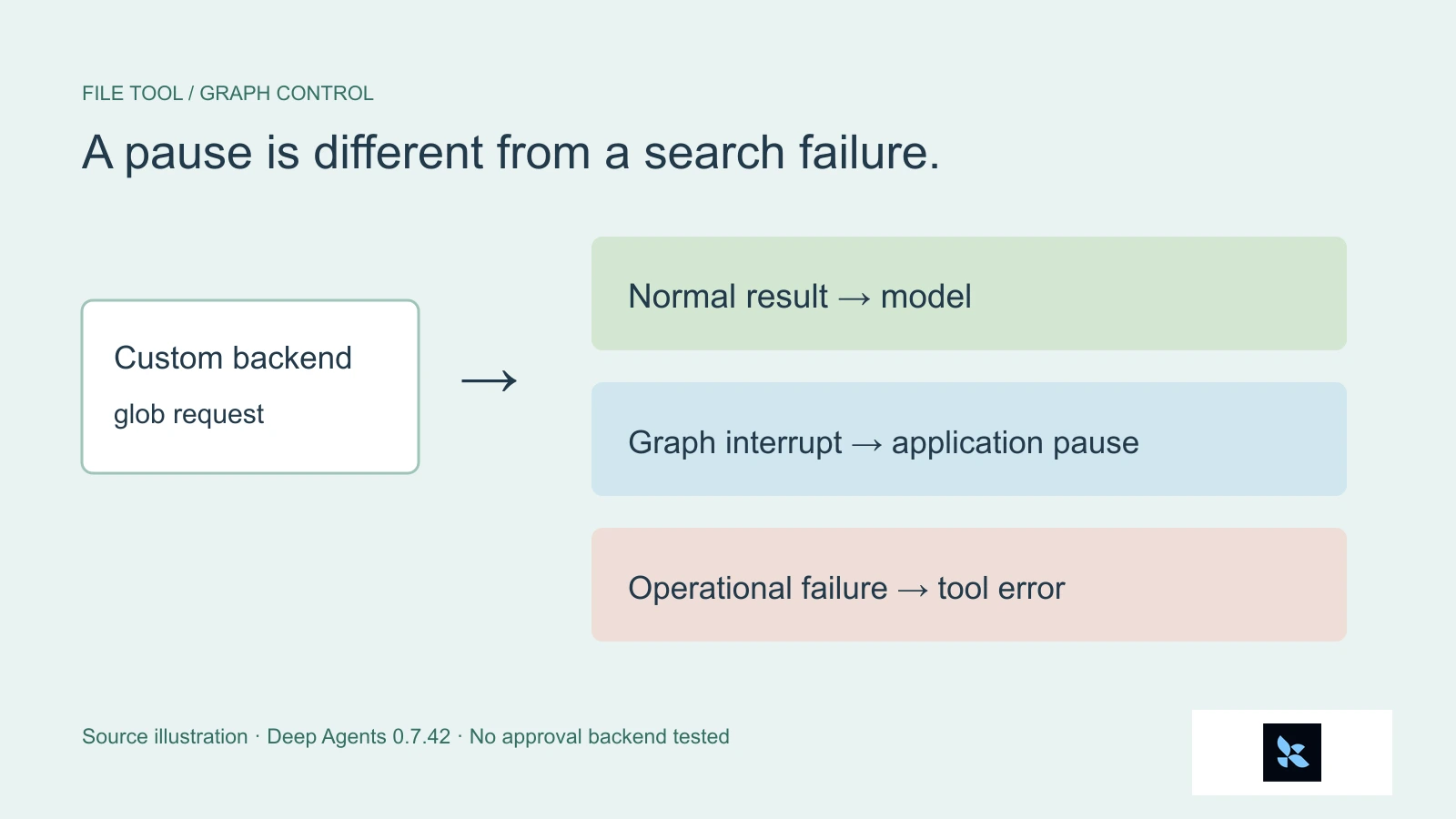
The glob change addresses custom file backends that deliberately pause a graph, for example to request a person's approval before searching. Previously, the tool could catch that control signal and turn it into a generic search error returned to the model. The intended pause then never reached the graph runtime.
Preserve the control signal without inventing an approval system
The patch lets interrupts and commands intended for a parent graph pass through both synchronous and asynchronous glob paths. Ordinary search failures still return as tool errors. The change does not add approval support to every built-in backend, nor does it define an application's access policy.
That distinction is important for developers composing tools with their own orchestration. A backend may need to return a file-search result, report an operational failure or temporarily hand control back to the surrounding application. Treating all three as one error string loses information the application needs to behave correctly.
Malformed text is normalized at storage time
A separate Unicode fix concerns lone surrogate code points, which can result when a JavaScript string is sliced through half of a paired character. Python can retain such a value in a string but fail when a later operation tries to encode it as UTF-8.
The reviewed helper rejoins valid surrogate pairs represented as separate code points and replaces an unmatched half with the replacement character. Text already encodable as UTF-8 is retained. The change applies through shared create and update helpers used by state, store and context-hub backends.
Filesystem and sandbox backends handle encoding separately and are not changed by that patch. Normalization also is not recovery of information that was already lost: replacing an unmatched half makes the stored text encodable, but does not reconstruct the intended original character.
Our analysis: tool reliability depends on preserving distinctions. A graph interrupt is not an ordinary search failure, just as malformed Unicode is not evidence that a filename search itself failed. Handling those cases at their actual boundaries makes the resulting behavior easier to reason about.
The upstream changes include regression tests, and we inspected the exact tagged filesystem middleware and storage utilities. We did not execute those tests, build a custom approval backend or write malformed text to a live application.
The project license is MIT. Our Deep Agents repository profile links the source. No installed agent, file store, sandbox or permission configuration was modified for this article.
EXPLORE THE SOURCE
Projects in this story
GitHub repositories
- langchain-ai/deepagents ↗View project details
Original primary-source-reviewed reporting. No weights, software installation, inference, upstream tests, robotics simulation or independent benchmarks performed.