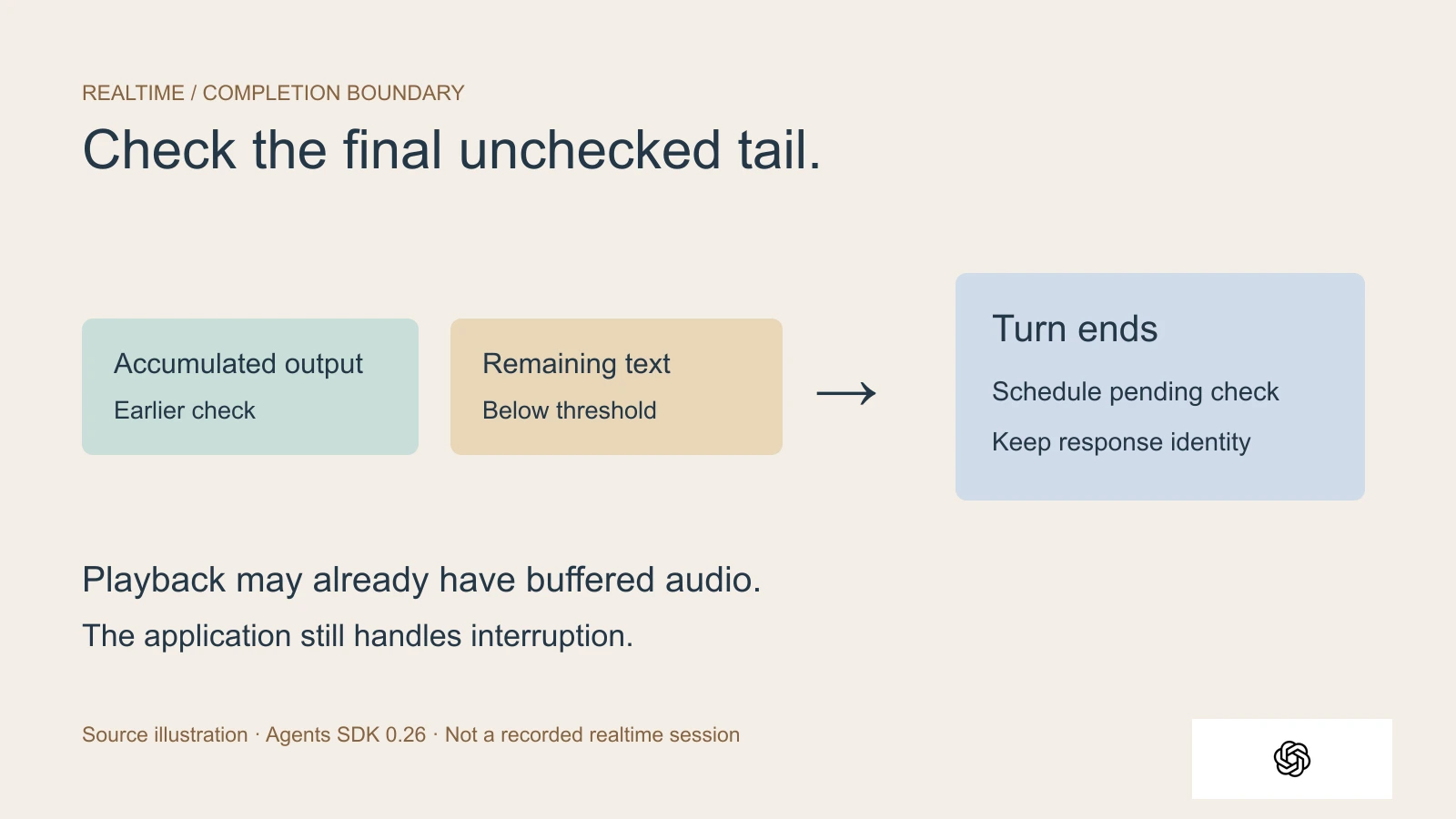

OpenAI Agents Python SDK 0.26.0, published November 24 UTC, updates realtime output-guardrail scheduling. Configured checks now cover unchecked output when a turn ends, including short responses below the normal debounce threshold and text remaining after an earlier check.
The implementation change records pending output alongside its response identifier, agent snapshot and output generation. At a turn-end event, it schedules any remaining unchecked material before retiring that response's guardrail lifecycle.
Debouncing needs a completion boundary
Realtime output arrives as partial text or audio-transcript deltas. Checking every fragment can be expensive, so the SDK debounces configured checks over accumulated output. Without a completion path, a short message or the final unchecked tail can miss a threshold-based check.
The reviewed regression cases cover below-threshold output, output ending exactly at a threshold and a trailing delta after a prior check. They also exercise a late completion event after a newer turn. We inspected these tests and the tagged session source; we did not execute a realtime conversation.
Keeping the originating response and agent snapshot matters when events arrive asynchronously. A check finishing later should remain associated with the output that caused it rather than being treated as a verdict on an unrelated newer response.
A streamed guardrail is not an absolute delivery barrier
The tagged realtime guide describes output guardrails as checks over accumulated text and transcript deltas. Audio may already be buffered when a tripwire fires, and the player still needs to stop local playback when it receives the interruption event.
A turn-end check therefore should not be marketed as proof that every unwanted fragment is blocked before a user hears or sees it. Its result also depends on the guardrails the application actually configures. Custom transports have their own obligation to honor the response-scoped interruption contract.
Tracing follows the global setting
A separate change consults the trace provider's disabled state before sending realtime tracing configuration. Legacy custom providers default to reporting tracing disabled until they implement the new state query. This is a specific SDK control-path change, not a general statement about every form of service logging or data retention.
Our analysis: realtime systems need explicit boundaries for both completion and interruption. Associating pending checks with the original response is a more precise contract than relying only on the size of incoming deltas, but it does not replace an application's policy or playback behavior.
The SDK is MIT-licensed. Our repository profile links the source. No API key, realtime connection, audio stream, tracing configuration or installed service was created or changed for this article.
EXPLORE THE SOURCE
Projects in this story
GitHub repositories
- openai/openai-agents-python ↗View project details
Original primary-source-reviewed reporting. No software installation, model/VM download, inference, training, upstream tests or independent benchmarks performed.