
llama.cpp 1.1.0, published November 26, adds automatic per-tensor quantization targeting a requested file size or global bits-per-weight budget. It gives model packagers a more flexible objective than selecting one familiar preset and accepting the resulting size.
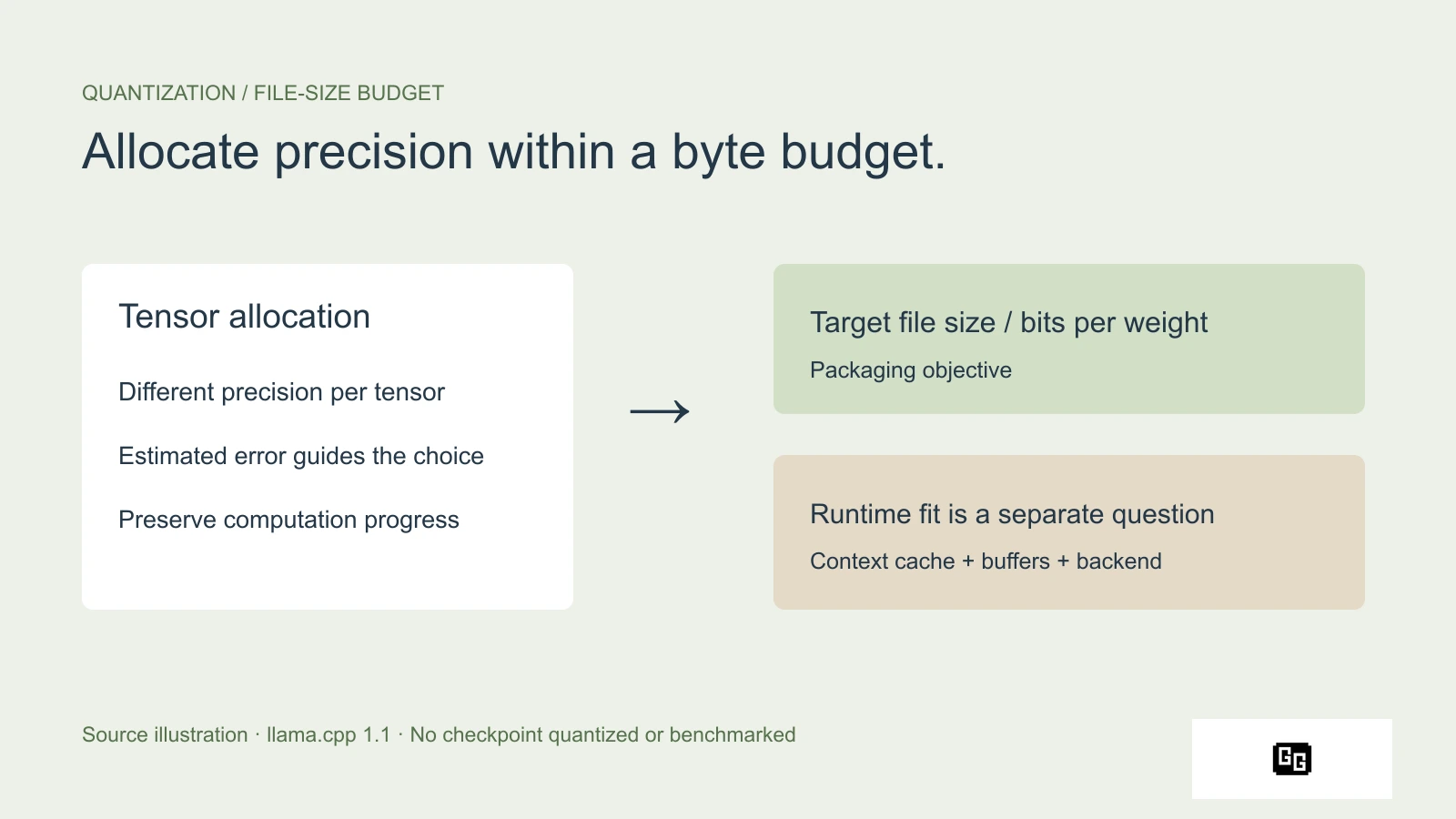
The merged implementation estimates how quantizing individual tensors affects error, then allocates precision within an overall budget. Different tensors can receive different formats. The aim is to spend limited bytes where the estimated reduction in quantization error is most useful.
A budget is an optimization target
The exact release-tag command source exposes target-size and target-bpw options, while the public quantization structure includes target file bytes, bits per weight, excluded formats and resumable state. A configured state file can retain target-computation progress if the operation is interrupted.
The upstream description explains sampling-based error estimation, per-tensor candidate filtering and constrained optimization. Its reported quality comparisons are contributor measurements, rather than independent tests from OpenSourceCoder.com. An error objective used during quantization should not be silently equated with correctness on every coding, retrieval or reasoning workload.
This matters because file size is only one part of deployment. Runtime buffers, a context cache, additional components and the inference backend can consume memory beyond the checkpoint itself. Targeting a file slightly below a device's advertised VRAM does not prove that a chosen model and context configuration will run on it.
The input and evaluation still matter
The quantizer's help also warns that requantizing already quantized tensors can severely reduce quality compared with starting from higher-precision weights. A new budget control does not restore information that a previous quantization discarded.
Packagers therefore still need to record the original model revision, input precision, quantization configuration and relevant evaluation. A file-size match can verify a packaging objective without demonstrating that the resulting artifact retains the behavior users need. That distinction applies even when the mixed-precision allocation improves an upstream numerical metric.
Our analysis: the useful shift is from a fixed preset toward an explicit constraint. It lets a packager investigate a particular quality-size tradeoff, but the tradeoff remains something to measure. The appropriate budget is a property of the complete intended setup, not just the number printed on a graphics card.
The release also deprecates the older batch API in favor of its extended replacement, a separate compatibility consideration for bindings. This article focuses on the reviewed quantization path rather than asserting that every application can adopt the release unchanged.
The tagged project is MIT-licensed. Our llama.cpp repository profile links the source. No model was downloaded or quantized, and the shared VPS inference service was not upgraded or restarted.
EXPLORE THE SOURCE
Projects in this story
GitHub repositories
- ggml-org/llama.cpp ↗View project details
Original primary-source-reviewed reporting. No software installation, model/VM download, inference, training, upstream tests or independent benchmarks performed.