
TRL 1.19.0, released November 25, extends DistillationTrainer with multiple teachers and stateful environments for agent training. The features expand how a student receives teaching signals; they do not establish that combining more teachers automatically produces a better model.
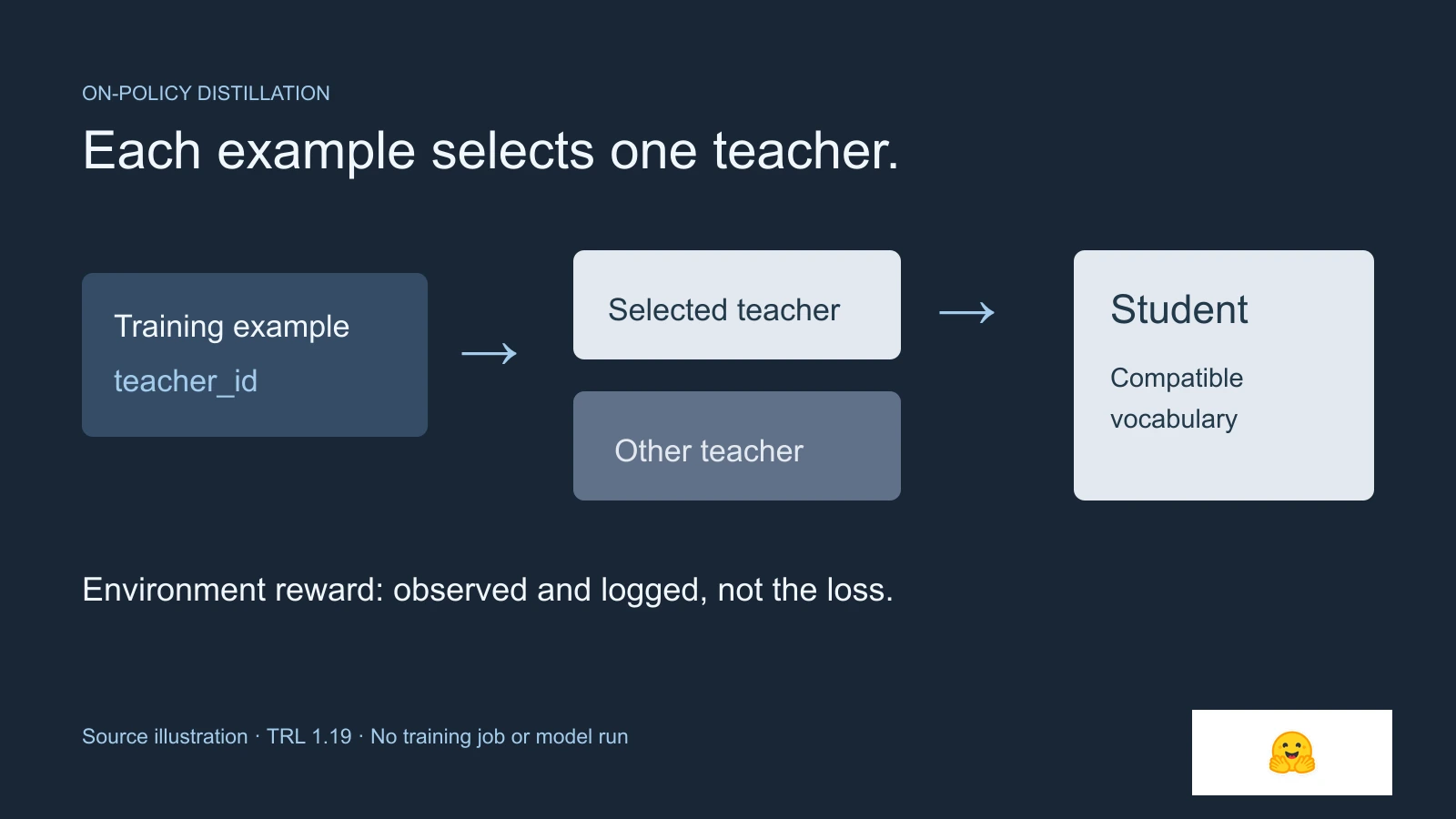
The multi-teacher implementation accepts a mapping of teacher identifiers to frozen models. Each dataset example selects a teacher through its teacher_id column. That teacher scores the completion for that example: this is routing, rather than averaging every teacher's answer or predictions for each token.
Multiple experts still need compatible interfaces
The tagged documentation requires each teacher to share the student's vocabulary. It also states that FSDP is not supported with a teacher mapping and that vision-language students retain a single teacher. Those limits are more informative for planning a run than treating the release as arbitrary cross-model knowledge merging.
Every completion token carries the same weight in the loss regardless of which teacher scored it. Per-teacher logs include divergence and token fraction, which can help inspect how training data and generated tokens are distributed. Such logs describe a run; they are not independent evidence that its teacher mixture was appropriate.
Stateful tools change the training setup
The environment addition provides an environment instance for each rollout. Its reset method receives dataset values, and public methods can become tools. Reserved reset and reward methods and private methods are not exposed as tools through that contract.
The student can then run a multi-turn episode against the environment. The teacher sees tool results as context, while the tool-result tokens are masked out of the loss so the student is trained on its own generated tokens. When an environment provides a reward, the trainer logs it for observation; the documented distillation path does not use that reward as its loss.
The tagged guide requires Transformers 5.2 or later for environments and warns about concurrency: an environment server must support the rollout instances the configured training batch creates. This is a resource-planning requirement, not a security sandbox or a promise of unlimited server capacity. Asynchronous tools are not supported in the documented tool path.
Our analysis: the release separates three choices that are easy to conflate: which teacher scores an example, what interaction state the student sees, and what measurement indicates task success. Keeping those choices explicit makes an experiment easier to diagnose than attributing every improvement to having more teachers.
The exact release-tag guide documents the restrictions and examples. TRL code is Apache 2.0, while teacher, student, dataset and environment artifacts require their own license review.
Our TRL repository profile links the project. We reviewed the release and trainer code; no training job, environment service or model download was started.
EXPLORE THE SOURCE
Projects in this story
GitHub repositories
- huggingface/trl ↗View project details
Original primary-source-reviewed reporting. No weights, software installation, inference, upstream tests, robotics simulation or independent benchmarks performed.