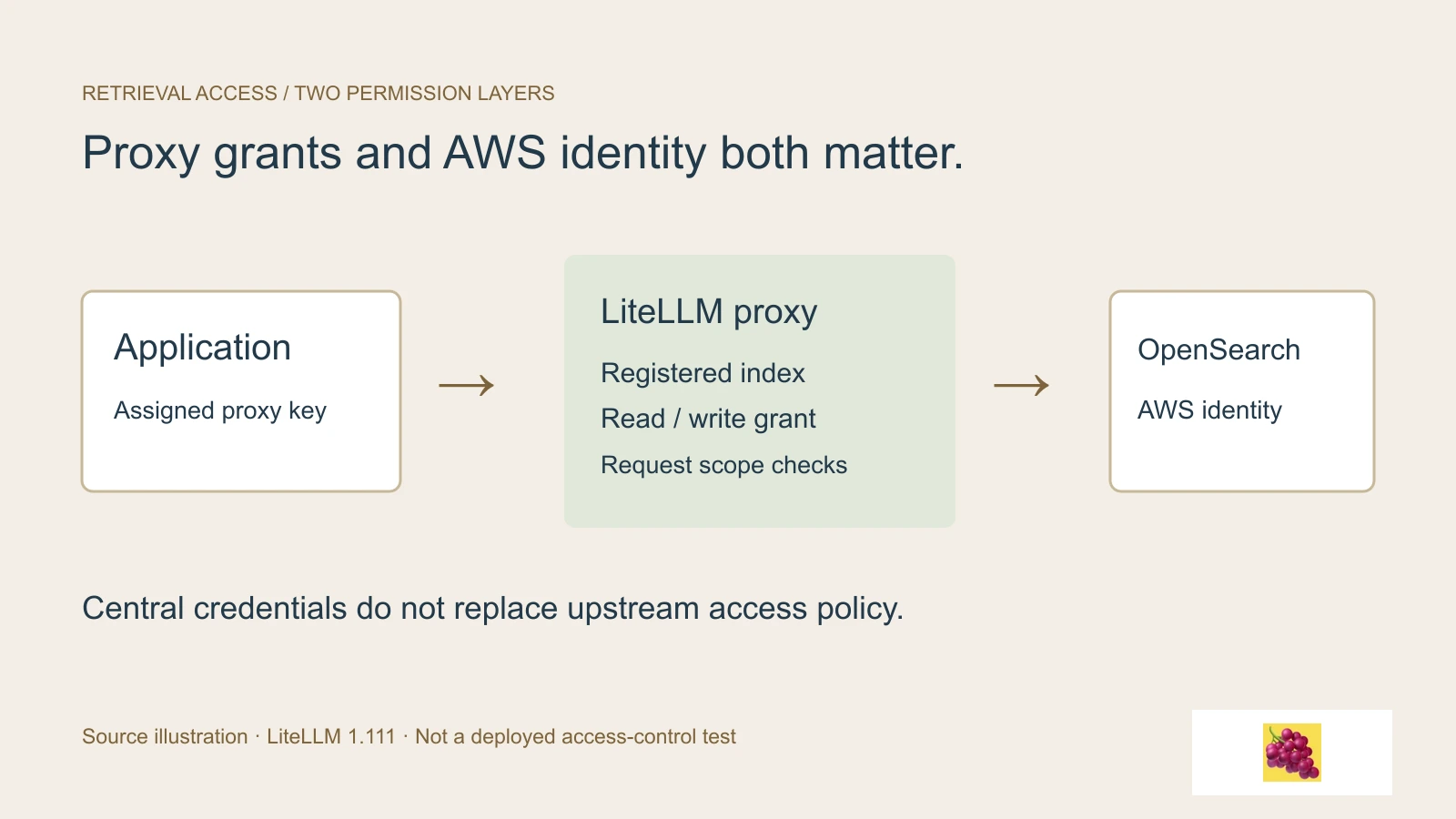

LiteLLM 1.111.0, published November 25 UTC, includes an Amazon OpenSearch index pass-through. An administrator registers an index and grants proxy keys or teams read or write access, while LiteLLM signs upstream requests using its configured AWS identity.
The practical change is credential placement. An application can call the proxy with its assigned key rather than possessing the AWS credentials used by the proxy. That does not remove the need to configure the proxy's identity, protect its credentials or restrict its AWS permissions.
Index scope is part of the request
The merged change introduces a path naming a registered index and supported operation. The exact tagged endpoint checks for a LiteLLM-managed index, a uniquely identified registered store and an OpenSearch provider before forwarding the request through the permission path.
The parser also examines supported paths, query parameters and request bodies for references that could escape the selected index. Bulk operations require their own handling because a request can name indices inside individual action lines. These are implementation controls we reviewed, not an independent penetration test proving that every possible isolation failure is excluded.
Read and write grants are not always mutually exclusive alternatives. The change accounts for writes that return stored documents and therefore also require read access. Simply classifying every HTTP POST as a write, or every mutation as having no read implications, would miss the distinctions the implementation is designed to preserve.
Passing through a query is not running a search service for free
The feature preserves raw query capabilities, including hybrid search and filters, within the accepted operation and scope checks. The release change describes only search operations as billable within this pass-through's LiteLLM accounting. That is not a statement that AWS compute, storage or requests have no cost.
Centralizing upstream credentials can simplify application configuration, but it also gives the proxy an important operational role. Key issuance, index registration, AWS policy and monitoring remain separate decisions. A permission model in a proxy is not a substitute for checking the actual permissions granted to its upstream identity.
Our analysis: this feature is useful when a team wants one place to mediate retrieval access across applications. Its value depends on understanding both layers: which index the proxy key may access, and what the proxy itself may do in OpenSearch. Treating one layer as proof about the other would overstate the release.
The tagged license makes ordinary repository content MIT-licensed while separately licensing content under litellm/enterprise. Hosted infrastructure and services have separate terms.
Our LiteLLM repository profile links the source. We inspected the exact tagged request parser and endpoint implementation and the merged tests. No AWS account, index, key, proxy deployment or billable request was created or changed.
EXPLORE THE SOURCE
Projects in this story
GitHub repositories
- BerriAI/litellm ↗View project details
Original primary-source-reviewed reporting. No weights, software installation, inference, upstream tests, robotics simulation or independent benchmarks performed.