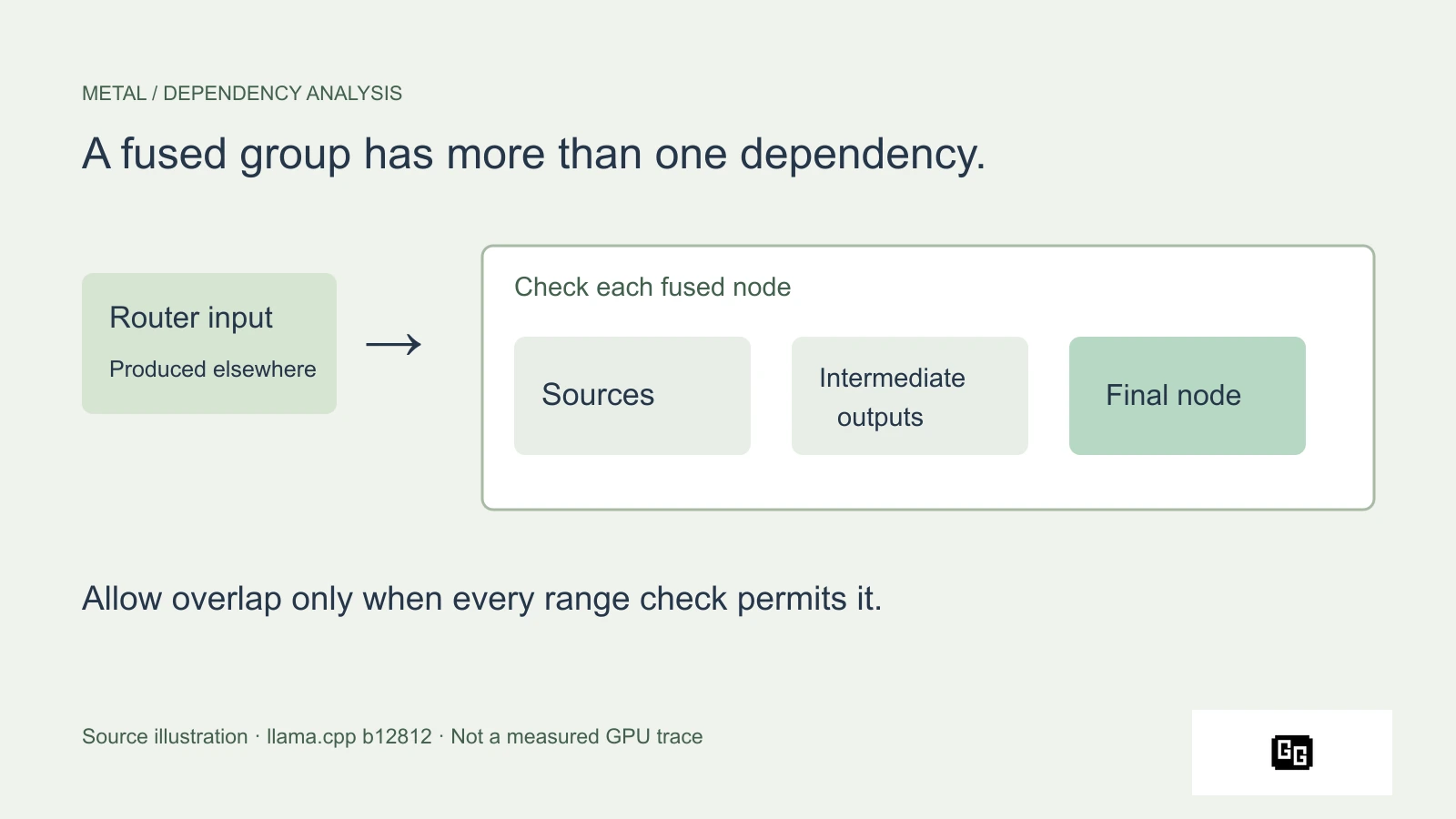

llama.cpp build b12812, published November 27 UTC, changes the Metal backend's concurrency analysis for fused operations. Instead of examining only the last node of a fused group, the backend now checks each node before deciding whether the group can run concurrently.
The merged change describes a dependency gap involving a fused top-k operation and the matrix multiplication producing its input. Looking only at the final node omitted intermediate outputs and earlier source ranges from the analysis. Operations could therefore overlap despite depending on the same memory.
The reported symptom was routing nondeterminism
The contributor reproduced a difference in expert routing for the first token of a 64-token microbatch in a hy_v4_flash architecture test on Metal, using a Mac Studio M5 Ultra. The report identifies specific configurations and numerical discrepancies; it does not establish that every model, Apple device or inference backend was affected.
The reviewed patch loops over the fused group. If any member fails the memory-range concurrency check, the group is marked non-concurrent and the loop stops. Checking the group preserves the ability to use fusion while accounting for dependencies that were previously invisible to this decision.
The contributor reports that the corrected branch passed three architecture-test configurations and produced zero mixed-batch discrepancy on the identified Metal device. Those are upstream observations. We reviewed the exact tagged backend source and patch; we did not run an Apple hardware test or independently reproduce the numerical result.
Correctness should precede a speed conclusion
This release should not be summarized as a general Metal speedup. Restricting concurrency where a dependency exists can change scheduling, but the published evidence here addresses correctness. It does not quantify the performance consequence across workloads, and the fix does not disable all fused execution.
The release also updates a Metal fusion-test baseline for a separate SSM_CONV plus SILU fusion in bailingmoe3. A recorded baseline count is not a benchmark showing that all models gained the same optimization. Keeping those changes separate avoids turning a narrow maintenance build into a broader model-support announcement.
Our analysis: a fused kernel is not just its final output. Intermediate values and the inputs produced elsewhere still belong to the dependency graph. This patch is a concrete example of why backend testing needs to examine numerical consistency alongside throughput, especially when scheduling and graph transformations interact.
The tagged project code is MIT-licensed. Our llama.cpp repository profile links the upstream project. This article does not assign a CVE, assert active exploitation or claim a new model release. No installed inference service, model or backend configuration was changed.
EXPLORE THE SOURCE
Projects in this story
GitHub repositories
- ggml-org/llama.cpp ↗View project details
Original primary-source-reviewed reporting. No model weights, software installations, inference, cloud deployments or independent benchmarks performed.