
Pydantic 2.14.4, released November 19, repairs several mismatches between validation settings, generated JSON Schema and type metadata. The notes also list a jiter dependency update to address memory issues introduced by its previous release, alongside garbage-collection and schema fixes.
For applications that use Pydantic to structure model outputs or tool arguments, these changes concern the data boundary around a model. They do not establish that a model's answer is true or that an agent chose the right operation.
A runtime strict flag should reach the relevant validator
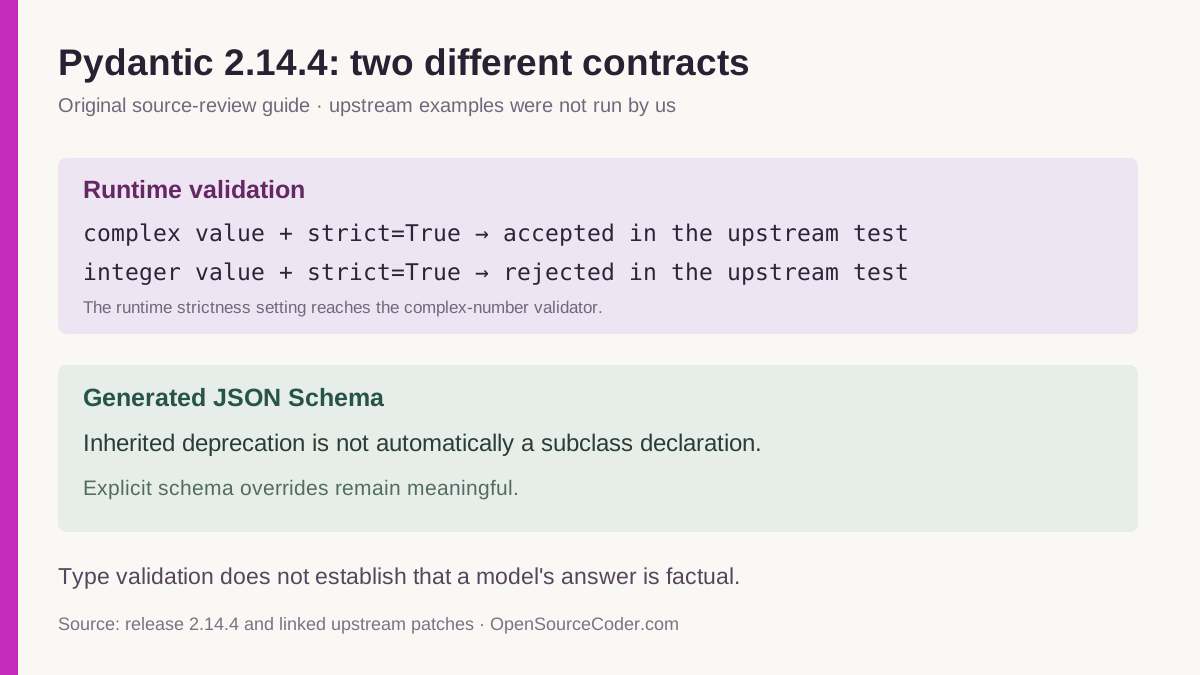
The complex-number change passes the effective runtime strictness setting into validation. The accompanying upstream test accepts an actual complex value under strict validation and rejects an integer that the ordinary non-strict path can convert.
That is a specific type-conversion repair, not a claim that every conversion rule changed. A caller should examine the actual type and validation path it depends on. We read the implementation and tests without executing them or upgrading this site's dependencies.
Our analysis: structural validity and factual validity remain separate
A schema can help an application reject an unexpected shape, but a correctly typed value can still describe the wrong event or the wrong person. Treating successful validation as verification would ask a type system to answer a question it was not designed to decide.
The practical value of a clear boundary is that it makes failures more specific. A caller can distinguish an unacceptable representation from a syntactically valid result that still needs evidence or application-level checks. Both questions matter, especially when a downstream tool acts on the value.
Inherited metadata should not silently deprecate a subclass
A separate JSON Schema change checks whether deprecation is defined on the class itself, instead of treating an inherited marker as enough. The patch also preserves explicit schema overrides.
This matters to consumers of generated schemas: an inaccurate deprecation flag can communicate the wrong lifecycle information even when runtime validation still works. Repairing that metadata is a different task from removing a class or changing an application's supported API.
Review the dependency and the consumer together
Our view is that a useful compatibility check should include both accepted and rejected inputs, the emitted schema, and the code that consumes it. A change can be small in a library while affecting a generated interface or integration farther downstream.
The Pydantic repository profile links its MIT-licensed source. Reported memory and implementation fixes remain upstream claims; we did not benchmark memory use, run the regression suite or test generated model outputs.
EXPLORE THE SOURCE
Projects in this story
GitHub repositories
- pydantic/pydantic ↗View project details
Primary-source reporting with original editorial analysis. No software installation, paid API call, local inference, deployment or independent performance/security test performed.