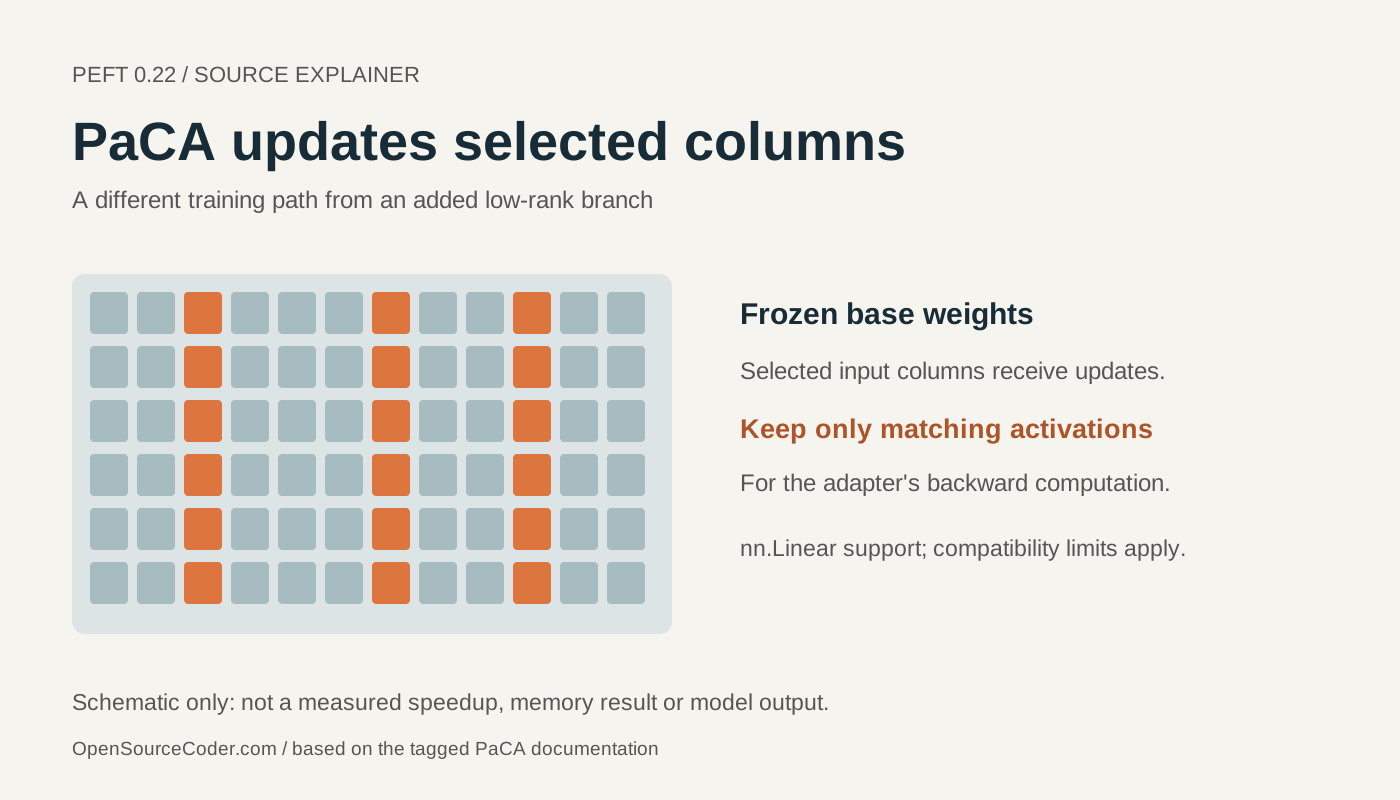

Hugging Face's PEFT 0.22.0 release, published November 19, expands the library's fine-tuning choices and adapter diagnostics. One notable addition is PaCA, which adapts selected input columns of pretrained weights instead of introducing the usual extra low-rank branch.
This is a new library integration of an existing research method, not a newly released foundation model. The distinction matters when assessing what changed this week and which earlier performance claims are being carried into a tool release.
What PaCA changes in the training path
The tagged PaCA documentation describes randomly selected columns receiving the trainable updates. Only their corresponding input activations need to be retained for that update's backward computation. The method can also be converted into an equivalent LoRA representation for an inference stack that expects LoRA adapters.
The release cites earlier paper comparisons with LoRA. Those results are workload- and hardware-dependent; we have not reproduced them. A lower adapter parameter count or an attractive headline memory number is not enough to predict a particular training run.
The practical limits are explicit: supported layers are linear layers, including quantized variants. Mixed-adapter batches are unsupported in this method, base-layer forward hooks need attention, and the documentation says sharded-weight training with FSDP or ZeRO-3 has not been tested. That last qualification is easy to miss beside separate distributed-training improvements elsewhere in the same release.
LoRA initialization and distributed behavior also change
The notes add Astra and NoRA initialization options and describe tensor-parallel and FSDP2 fixes for LoRA. They call for Transformers 5.17 or later to benefit from the distributed improvements. PEFT itself now requires Python 3.11 or newer.
Adapter health reporting can summarize state, devices, data types and parameter counts. This is an engineering diagnostic, not a measurement of answer accuracy or a guarantee that a fine-tuned model is safe. Checking that the intended layers are trainable is one useful step in a much larger evaluation.
Our analysis: compare the complete workflow
A useful adapter comparison includes preparation, training, export and serving compatibility. A method that reduces one training bottleneck may create different integration work at the next stage. Record the same base model, target layers, sequence lengths and evaluation task before interpreting a speed or memory difference.
Our PEFT repository profile links the Apache-2.0 source. That library license does not replace a base model's terms or the license attached to training data. We reviewed the release and versioned documentation without installing the update, training an adapter or running upstream tests.
EXPLORE THE SOURCE
Projects in this story
GitHub repositories
- huggingface/peft ↗View project details
Original primary-source reporting and editorial analysis. No deployment, model download, inference, paid service call or independent performance test performed.