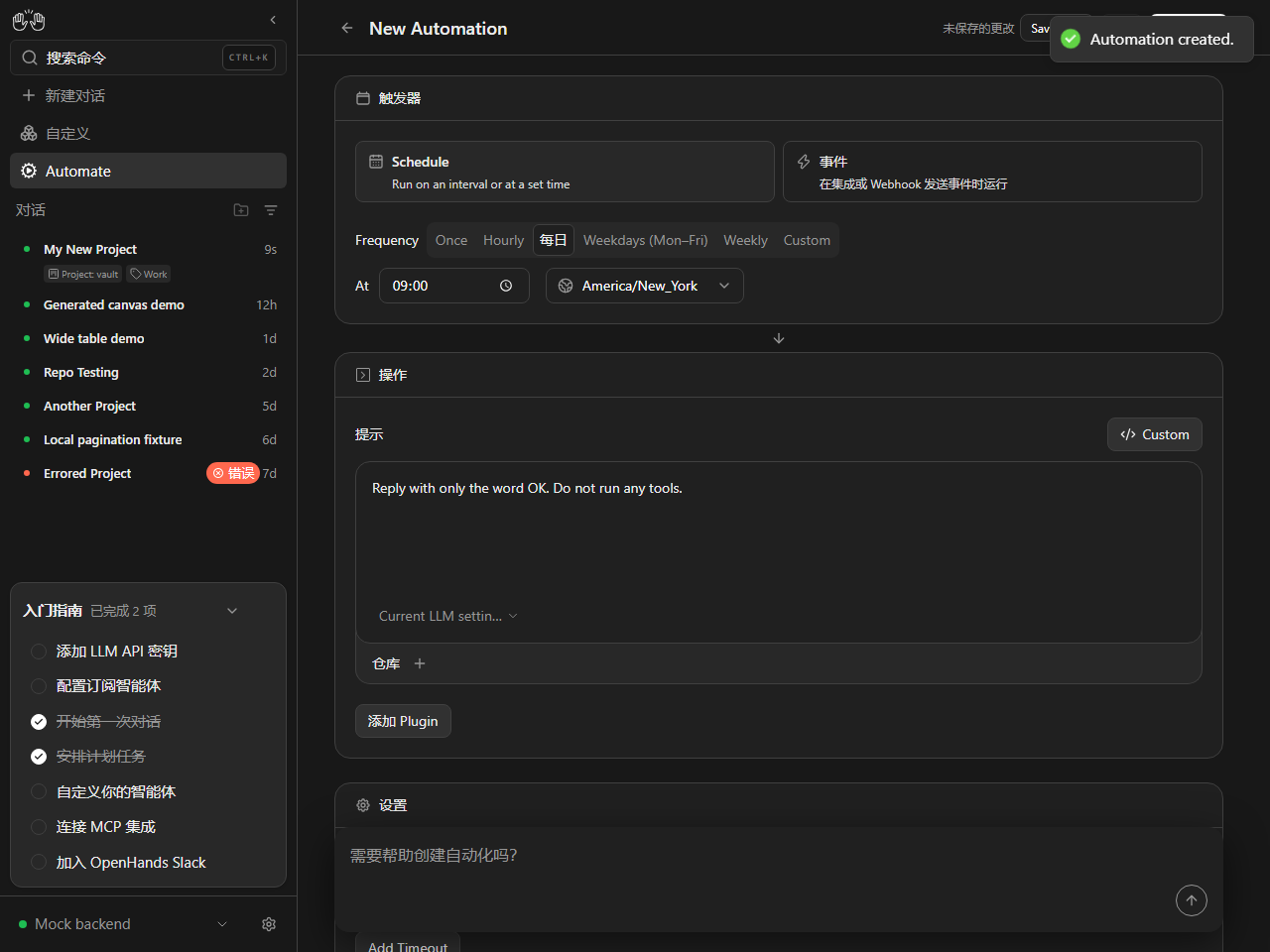

OpenHands 1.43.0, released November 20, changes an important last step in its automation wizard: completing setup creates the new automation enabled, instead of leaving a second activation step for the user.
The release also adds experimental chat features and changes conversation rendering. We reviewed the automation behavior against the tagged source rather than treating every screenshot or pull-request test statement as a completed test of our own.
Create and save a draft now have distinct effects
The merged wizard change passes an enabled flag into the request builders. In the 1.43.0 source, final creation passes true for both preset and custom automations. Draft-building and preflight-validation paths continue to pass false.
That distinction is narrower than saying all saved automations run immediately. The change concerns completing this setup flow. It does not establish that an arbitrary imported automation, an unfinished draft or an existing disabled record has been activated.
Our analysis: the final action needs to match its consequence
A wizard that ends by creating an inactive record can leave a user wondering why nothing happened. Activating the completed setup makes that flow more direct. It also makes the final review of a trigger, schedule and run identity more consequential.
The useful interface question is whether a person can tell that Create is the point at which the automation becomes eligible to run. A positive toast alone cannot establish that the intended schedule, permissions or external service connections work. The contributor's illustrated session used a mock backend; its screenshot is included here with that context.
Experimental message changes remain experimental
The notes separately list decision cards, reactions and display of an agent's message edits. The message-edit change describes showing revised agent text with an edited indicator while retaining edit events in the history. That is a display and history behavior, not evidence that revised statements are correct.
For teams reviewing an agent's work, seeing the original sequence and subsequent corrections matters. An edit can improve a conversation's readability while still requiring a reviewer to inspect what was changed and why. Availability and behavior also depend on the relevant experimental settings and compatible components.
What readers can inspect
Our repository profile links the MIT-licensed core source. Hosted plans, model providers and connected services have separate terms and costs. We did not install the app, create an automation, bypass operating-system protections or run the upstream suite. This is a review of the published release and exact request-building code.
EXPLORE THE SOURCE
Projects in this story
GitHub repositories
- OpenHands/OpenHands ↗View project details
Original primary-source reporting and editorial analysis. No software installation, model download, inference, paid service call or independent benchmark/security test performed.