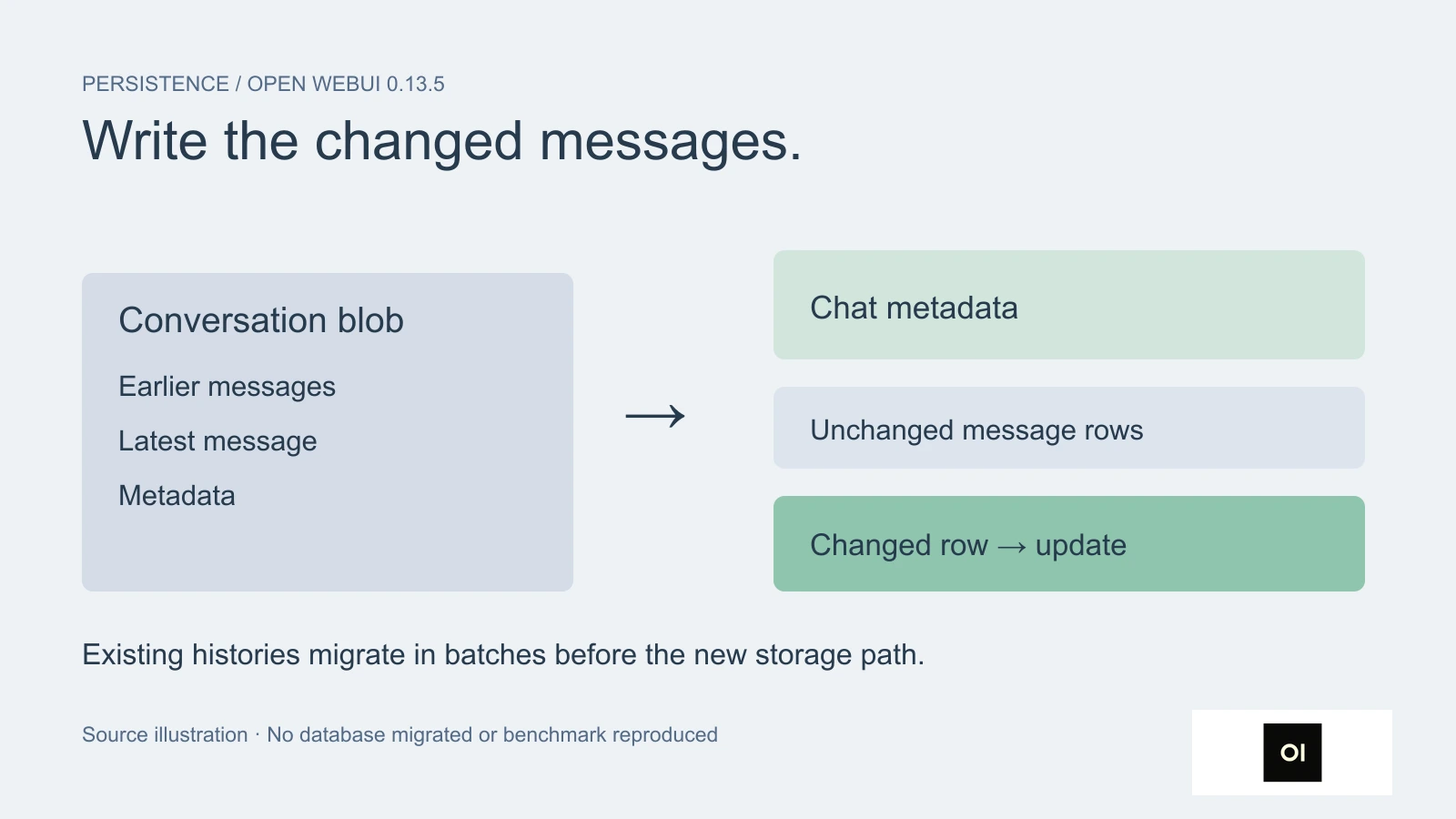

Open WebUI 0.13.5, released November 25 UTC, changes how long conversations are stored. Instead of repeatedly rewriting the conversation's full message history, the application keeps messages in its message table and writes the entries affected by a change.
The upstream performance report used a 130 MB chat and an instant-response test model. On its PostgreSQL setup, accepting a message fell from 10.9 seconds to 0.32 seconds, while reported database writes per message fell from 533 MB to 2 KB. These are maintainer measurements of that experiment, not our own benchmark or a promise that model generation becomes 34 times faster.
The storage boundary changes
The tagged chat implementation reconstructs history from message rows when needed. During updates, it compares submitted messages with stored messages and upserts changed entries instead of embedding the entire history back into the chat's metadata blob.
The code also merges history built from an earlier read with current stored history. That matters when another writer has saved messages since the caller loaded its copy. It is a specific persistence strategy, not an independently verified claim that every concurrent-edit race is impossible.
Existing data needs a migration
The release-tag migration moves existing histories in batches of 100 chats. It commits batches and checks whether a chat still has history in its old blob, allowing already processed work to be skipped after interruption.
It handles older flat message lists as well as history maps, carries additional message fields in a data column and includes a downgrade path to rebuild history. Those provisions are useful to inspect before an upgrade, but source review alone does not prove recovery for every existing database. Operators need a tested backup and upgrade plan for their own installation.
There are API compatibility implications too. The release notes say responses no longer include the duplicate flat message list that older clients stored beside the conversation. Responses for metadata operations such as pinning or archiving also stop repeating message content. Custom clients that relied on those shapes should review the change.
Our analysis: perceived chat latency is not always inference latency. A large serialization or database write can delay the moment a request reaches a model. Reducing that overhead addresses a different bottleneck from faster token generation, and the upstream experiment should be read in that light.
Source availability has conditions
The current Open WebUI license includes a branding-preservation condition, with stated exceptions including deployments of no more than 50 users in a rolling 30-day period and separately granted permission. It should not be described as ordinary unrestricted MIT software. Historical materials can retain their prior terms.
Our repository profile links the project and flags its custom license. We inspected the release, merged change, tagged persistence code and migration; we did not install the update, migrate a database or measure its performance.
EXPLORE THE SOURCE
Projects in this story
GitHub repositories
- open-webui/open-webui ↗View project details
Original primary-source-reviewed reporting. No model downloads, installation, inference, training, database migration, upstream tests or independent benchmarks performed.