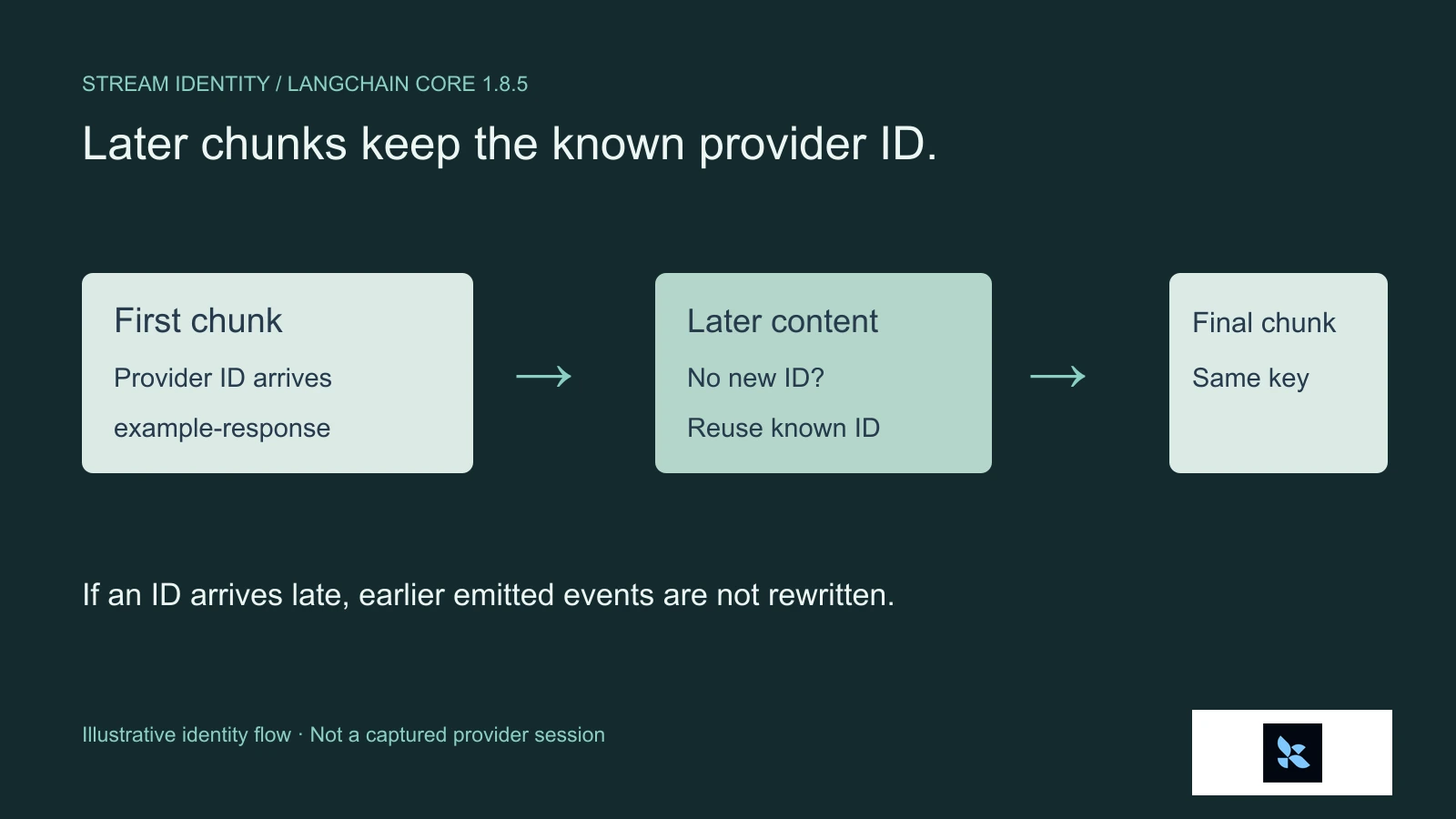

LangChain core 1.8.5, released November 25 UTC, fixes an identity mismatch in streamed chat output. When a provider supplies a message identifier on an early chunk but omits it on later chunks, the affected paths now reuse the known provider identifier rather than assigning a different synthetic one.
The merged report describes the practical symptom: transcript interfaces that group chunks by message ID can show one answer twice. The final merged message retained the provider ID while intervening chunks could carry a locally generated run-based ID.
One answer needs a consistent key
The exact tagged implementation remembers the first recognized provider message ID. Later chunks without their own identifier use it, and the synthetic final chunk uses the same value. If no provider identifier has been observed, the local fallback remains available.
The helper distinguishes provider identifiers from LangChain's generated prefixes. An internally generated run ID should not become mistaken for a provider ID simply because it is a non-empty string.
The change covers synchronous and asynchronous streaming paths, including invocation paths that stream through callbacks. The accompanying tests inspect identifiers seen by those callbacks as well as the final merged message. We read the tests and tagged implementation, without executing an upstream suite or opening a provider connection.
A late identifier still has a boundary
The regression cases include a provider identifier arriving after an earlier chunk. That first chunk can already have been emitted with a fallback ID; later chunks then use the provider's ID. The fix does not retroactively rewrite an event an application has already consumed.
Applications that persist every event or build their own transcript grouping should therefore consider both the streaming contract and the final merged message. Preserving an identifier where possible is different from promising that all providers emit one before any content.
The change report also scopes the repair to the affected streaming paths; it does not claim a redesign of the separate v2 protocol path or a new final-message identity format. This is distinct from our earlier coverage of 1.8.4's finish-reason handling: one concerns which answer a chunk belongs to, the other describes how a stream ends.
Our analysis: message identity is part of an interface's correctness. A model can produce an accurate answer while an application renders duplicate bubbles because two layers disagree about its key. This patch addresses that integration boundary, rather than changing the model's reasoning quality.
The project is MIT-licensed. Our LangChain repository profile links the source. We made no changes to the sites' inference service, installed packages or active conversations, and we do not claim an end-to-end application test.
EXPLORE THE SOURCE
Projects in this story
GitHub repositories
- langchain-ai/langchain ↗View project details
Original primary-source-reviewed reporting. No model downloads, installation, inference, training, database migration, upstream tests or independent benchmarks performed.