
Logfire 6.0.0, released November 19, changes how its Python SDK scrubs structured AI telemetry before export. The release also moves the command-line interface to a separate package and adds broader string-transformation controls.
The privacy-related changes deserve a close read because an AI trace can contain more than a prompt and answer. Tool arguments, results and system instructions may include structured fields whose contents should not be sent to an observability backend.
Nested field names receive more attention
The structured-message change introduces key-only pattern matching inside supported GenAI and Pydantic AI message attributes. It can redact a sensitive-looking field inside a tool call while leaving ordinary conversational text containing the same word readable.
A related provider change removes broad whole-span exemptions for legacy OpenAI and Anthropic scopes, with specific treatment for their structured data. These changes do not amount to general detection of sensitive facts in prose or innocuously named fields.
Two callbacks, two different error behaviors
The versioned guide distinguishes a scrubbing-match callback from the new string transformer. A raised match callback is logged and its matched value is redacted. If a string transformer raises, its input string is retained for that call, with ordinary pattern matching still applied where permitted.
That difference matters when masking an email address or a sensitive URL that a field-name pattern would not catch. Treating every callback error as automatic redaction could produce a mistaken expectation about what leaves the process.
The guide also warns that pattern-matching replacements can include the matched text. Matching a secret's actual value with a pattern intended for field names can therefore be the wrong approach. Its examples are illustrative, not a complete privacy policy or a performance guarantee for arbitrarily large inputs.
Our analysis: inspect the exported shape, not the feature name
A redaction feature is useful only in relation to the data it sees and the behavior it follows when a transformation fails. Structured tool data and free-form conversation require different treatment. A successful trace export says nothing about whether the resulting record contains information an organization meant to exclude.
A meaningful evaluation should use representative synthetic inputs, include nested data and failure cases, and inspect the final exported record. It should also account for telemetry collected by other libraries or processors. The SDK documentation recommends excluding message content entirely when it may contain sensitive information rather than relying on pattern matching alone.
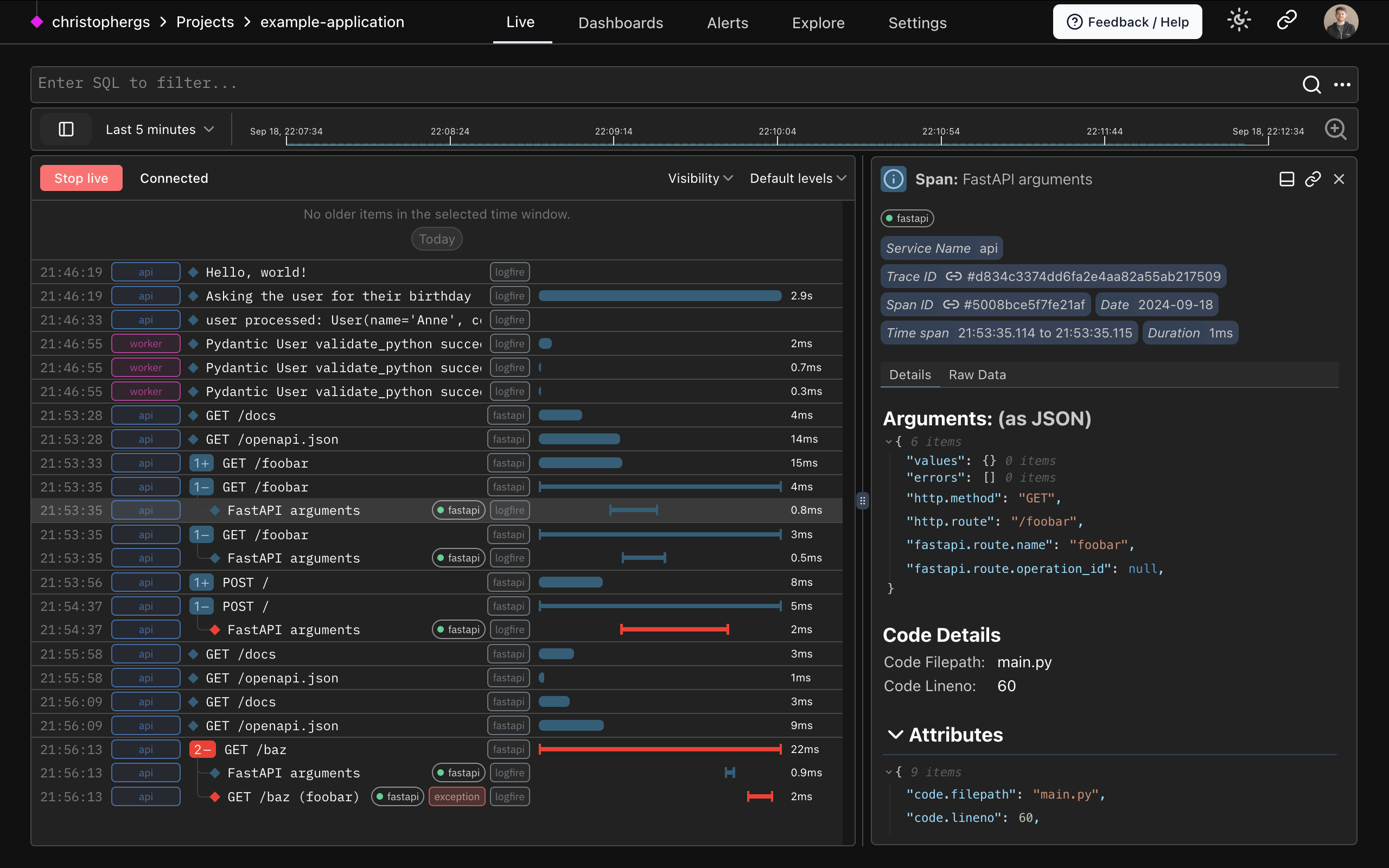
Our repository profile links the MIT SDK source; hosted Logfire services have separate terms. We reviewed the tagged guide, implementation and merged changes without installing the SDK, exporting traces or independently testing a privacy boundary. The screenshot illustrates the product interface only.
EXPLORE THE SOURCE
Projects in this story
GitHub repositories
- pydantic/logfire ↗View project details
Original primary-source reporting and editorial analysis. No software installation, model download, inference, paid service call or independent benchmark/security test performed.