
Deep Agents 0.7.41, published November 20 UTC, repairs its message-channel integration with LangGraph and corrects an inaccurate statement in a file-edit tool's description.
One change affects how the framework recognizes a message channel. The other changes what the model is told about a tool. Neither establishes a broad guarantee that agent memory or file editing is inherently reliable.
A reducer's identity can matter to its integration
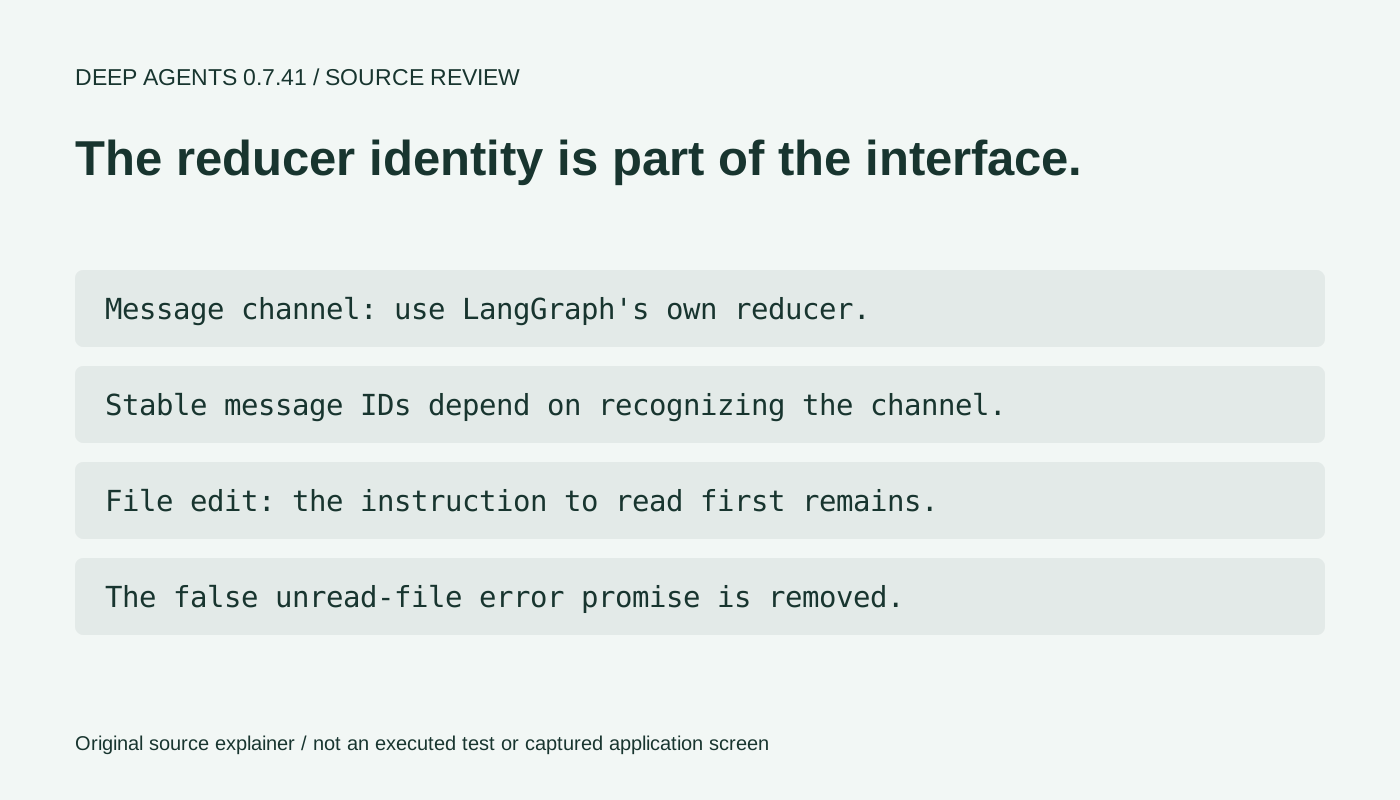
The message-handling change replaces a local reducer copy with LangGraph's own message reducer. The maintainers explain that LangGraph recognizes the channel by reducer identity when assigning stable IDs to input messages; a copied implementation was not recognized in the same way.
The release dependency file requires LangGraph 1.2.24 or later within its allowed major range. The integration relies on the upstream reducer's handling of message removal and empty checkpoints. Overlooking dependency constraints can leave an operator with a different combination from the one described by the release.
The file-edit instruction stays; the runtime promise is corrected
The description repair retains the instruction to read a file before editing it. It removes the added claim that the tool will error otherwise.
That is a correction to a description, not the addition of an enforcement check. A reviewer should distinguish what an agent is asked to do from what an implementation makes impossible. Treating the old sentence as a runtime barrier would have created a mistaken expectation.
Our analysis: inspect both sides of a tool contract
Agent behavior depends partly on accurate descriptions and partly on the machinery behind them. Clear wording helps a model choose an appropriate sequence, while validation determines what happens if that sequence differs. The two can support each other without being interchangeable.
Message identity has a similar integration dimension. Two functions that look equivalent to a human reader may differ to a framework using their identity as a signal. Extension points and dependency versions therefore deserve inspection, rather than assuming copied helper code will always remain compatible.
Our repository profile links the MIT source and release commit. We reviewed the code, dependency file and merged changes without installing the harness, running an agent or executing its tests. This concerns framework behavior, not a new underlying model.
EXPLORE THE SOURCE
Projects in this story
GitHub repositories
- langchain-ai/deepagents ↗View project details
Original primary-source reporting with editorial analysis. No installation, model/data download, inference, upstream suite, paid service call or independent security/performance test.