
Anthropic Python 2.12.0, released November 20, fixes how its Amazon Bedrock client sends a user-profile identifier. Both the synchronous and asynchronous clients now place it in the Messages request body, which is where Bedrock expects it.
The change is small in code but important in behavior: before this repair, supplying the profile through the client's header setting did not mean the server applied it. A successful model response could therefore coexist with an ignored profile selection.
The request body is the relevant boundary
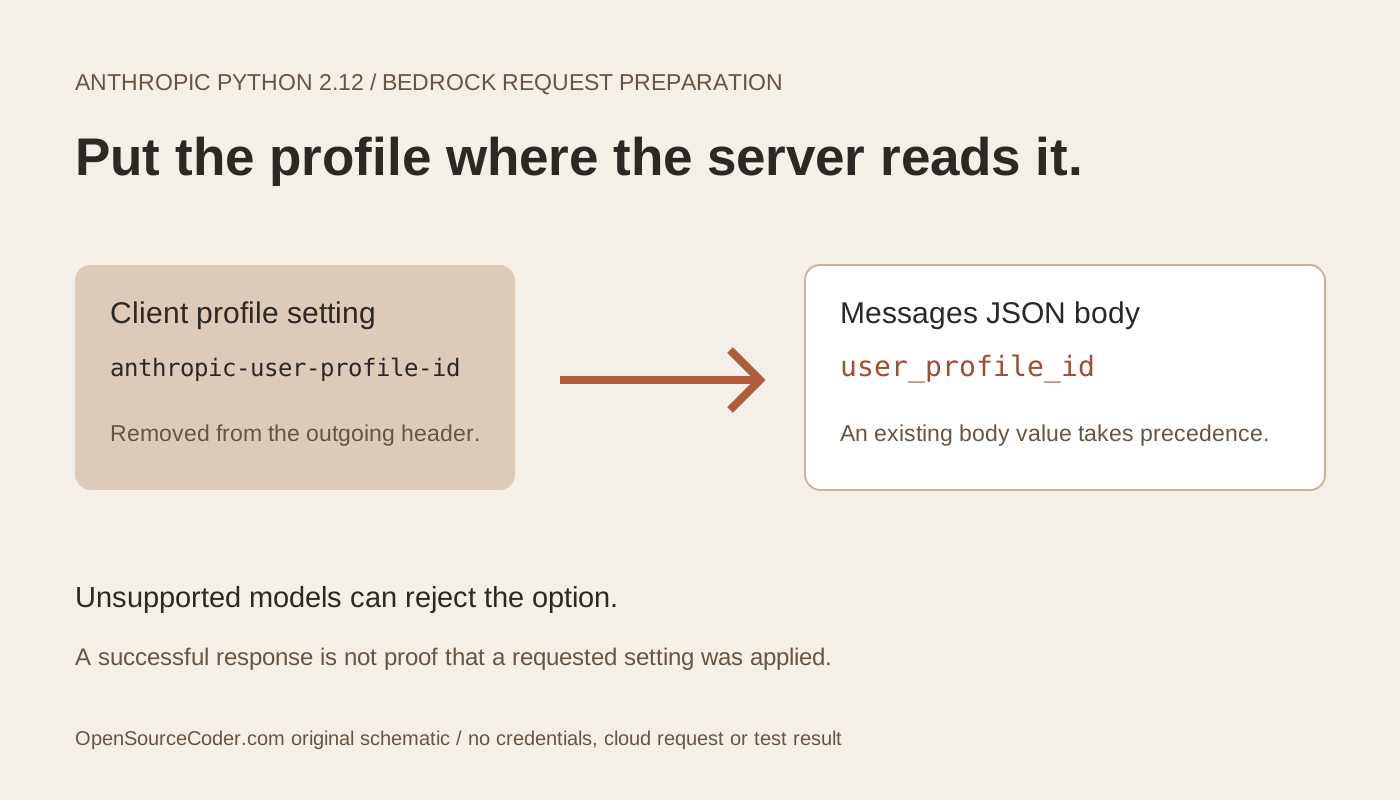
The tagged Bedrock implementation reads the configured profile header, removes that header from the outgoing request and sets the JSON user_profile_id field when it is absent. An identifier already in the body takes precedence.
This is a targeted Messages request-preparation change. It should not be read as a new universal profile feature, a new model release or a change to every API operation supported by the SDK. The SDK remains a client for services whose access and supported features are governed separately.
A newly visible error can be the correct outcome
The release notes warn that some Bedrock models do not support user profiles. Sending the profile to one of those models can now produce a 400 error, where the former header-based path silently failed to apply the setting.
That distinction matters when reviewing an upgrade. The question is not only whether a request still returns text. It is whether the intended options reached the service and were accepted. Leaving an unsupported profile off a request is different from assuming that an ignored option worked.
Our analysis: evaluate configuration effects as well as responses
SDKs sit between application intent and a provider's wire format. A configuration field can look valid in application code while being ineffective at that boundary. This makes a check of the final request shape useful when an integration depends on a particular routing or profile setting.
A meaningful integration test would distinguish a body-specified ID from a client-level setting and include the case in which both are supplied. It would also check a supported service configuration separately from an unsupported one. We did not make those cloud calls for this article.
The release also adds an image-dimension error code and documentation clarifications. Those additions do not establish improved visual accuracy or broader model availability.
Our repository profile links the Apache-2.0 SDK source and its exact release. Service use can still require accounts, credentials and paid access. We reviewed the published notes and versioned request-building code without installing the package, entering credentials, changing a deployment or calling a paid model.
EXPLORE THE SOURCE
Projects in this story
GitHub repositories
- anthropics/anthropic-sdk-python ↗View project details
Original primary-source reporting and editorial analysis. No software installation, model download, inference, paid service call or independent benchmark/security test performed.