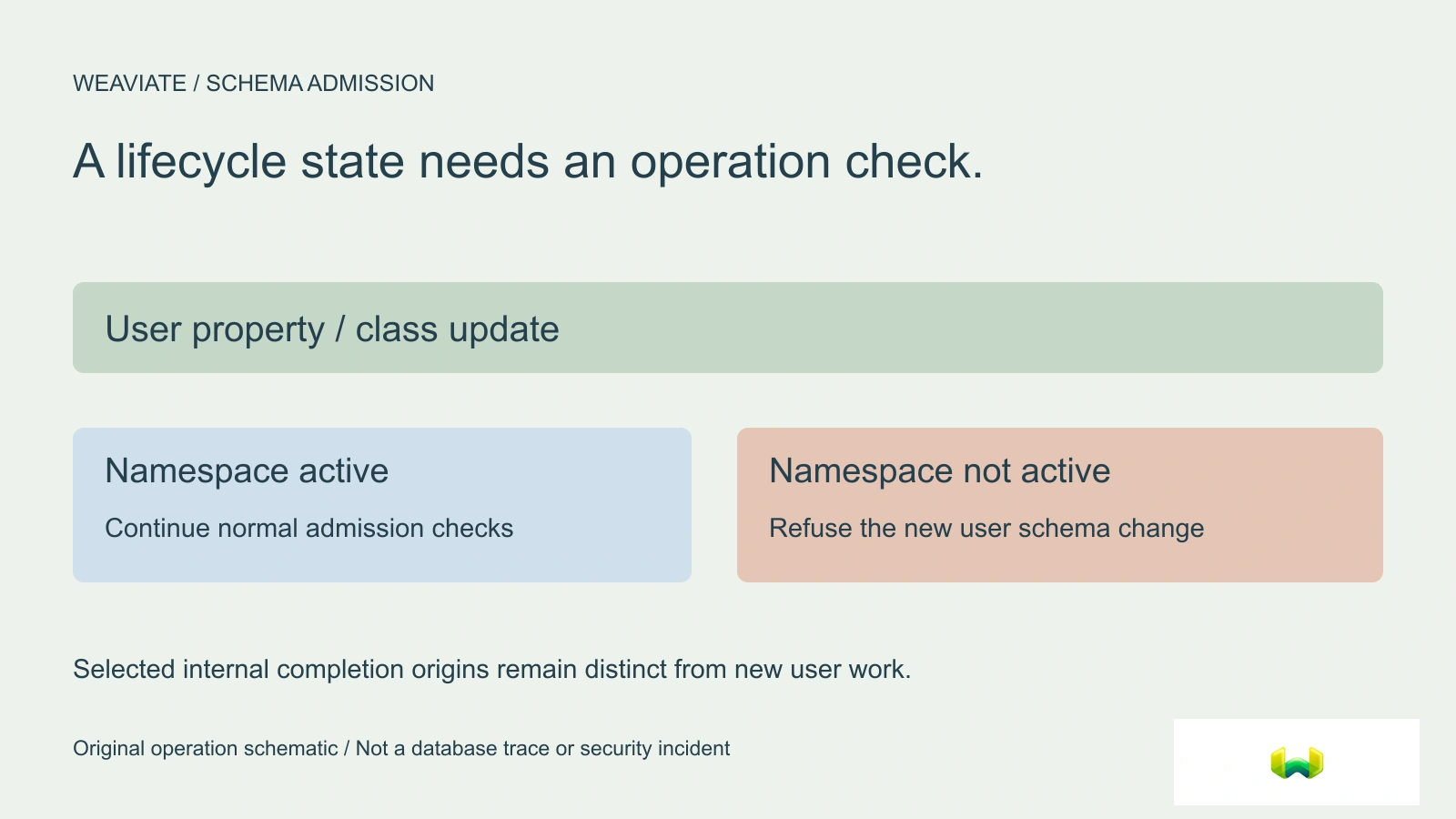

Weaviate 1.41, released November 23, includes a targeted change to schema operations in namespaces that are not active. Adding properties and changing collection or property configuration now face an explicit admission check instead of relying on the assumption that suspension already covered every relevant command.
The included schema-state change describes a gap in which some updates could still be proposed while a namespace was suspended, resuming or deleting. The fix concerns operation admission; it is not a claim of unauthorized access, an observed attack or a newly assigned security vulnerability.
Check the state before the command is committed
The tagged store implementation performs admission checks before appending an accepted schema command to the Raft log. Its create-like path now requires an active namespace for property additions and user-originated property and class updates.
That placement matters in a distributed database. A check performed only in a particular front-end handler can be narrower than the command paths that ultimately change the schema. The release strengthens the point where the system decides whether to admit the proposed operation.
The change does not mean a namespace's status is a replacement for user authorization. Permission to request a change and the namespace state that admits that change are separate questions. The code and associated tests address those boundaries separately.
Already-accepted work needs a different treatment
The implementation preserves specific internal completion paths. A reindex schema flip marked as coming from an in-flight migration can proceed. Internal class-update origins for dropped-vector cleanup and a BlockMax cutover also have exceptions.
These are designated completion operations, not a blanket allowance for arbitrary user updates during suspension. Without the distinction, a broad prohibition could prevent an operation the database had already accepted from finishing its cleanup or transition.
The release includes other namespace, replication and suspension work. We isolated the schema-admission behavior by reading its included change and tagged store source, rather than treating every namespace feature as one uniform guarantee.
Our analysis
The useful engineering lesson is that a lifecycle state has to be reflected in each operation that can change it or depend on it. Calling a namespace suspended does not, by itself, prove every schema command respects that status. Explicit admission rules and narrowly identified completion paths make the intended behavior easier to inspect.
The repository's licensing is also more specific than a single badge. Its root notice assigns code outside the wl directory to BSD 3-Clause terms, while wl is subject to a separate enterprise license. The admission files reviewed here are outside that directory; this does not make every enterprise feature unrestricted BSD software.
Our repository profile records that split. We did not install a cluster, suspend a namespace, execute the upstream tests or verify hosted-service entitlements.
EXPLORE THE SOURCE
Projects in this story
GitHub repositories
- weaviate/weaviate ↗View project details
Original primary-source review. No model weights/data downloaded, upstream tests or workflows run, clients installed, servers/credentials changed or benchmark independently reproduced.