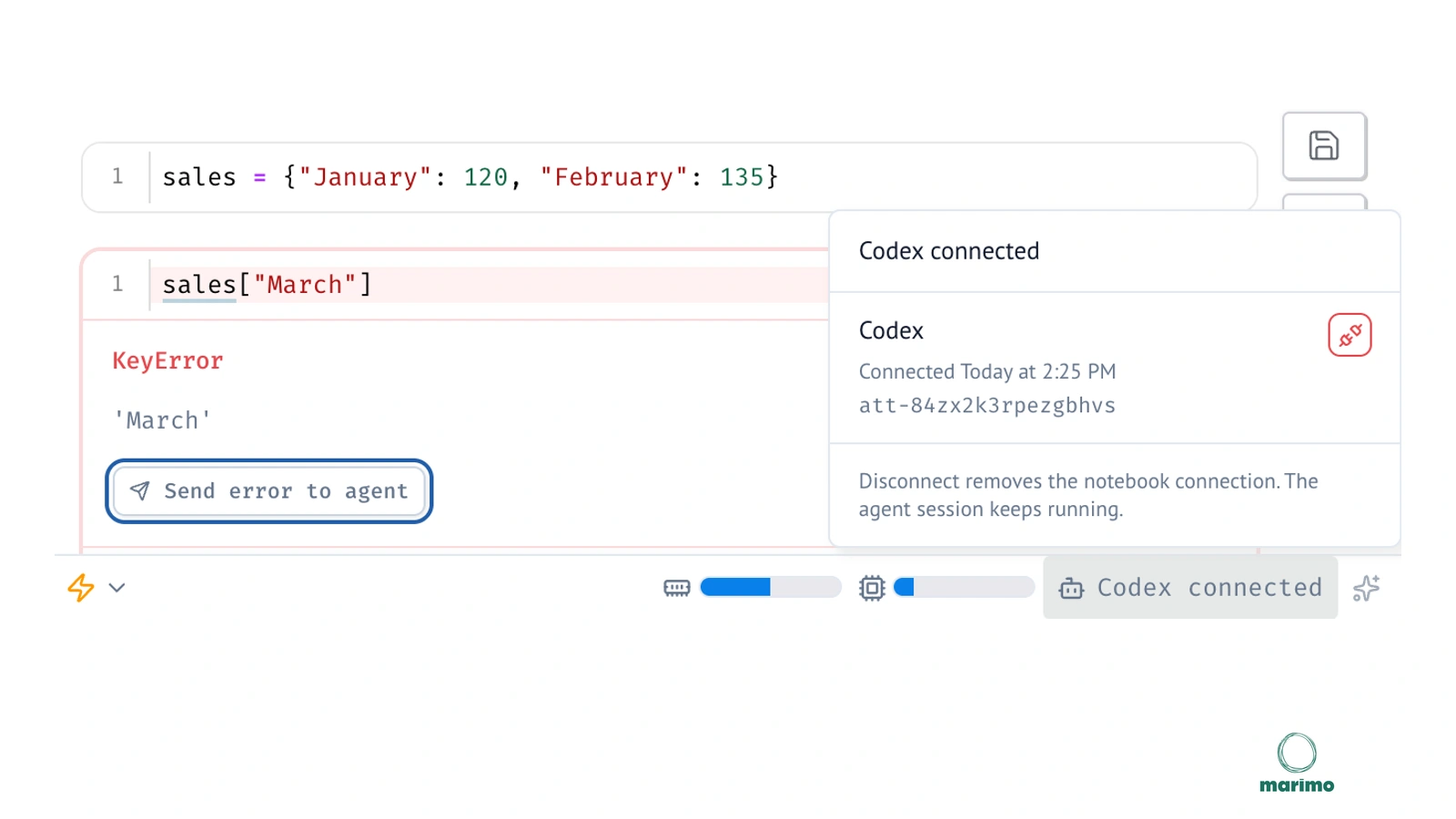

marimo 0.26, released November 24, reorganizes how coding agents connect to running notebooks. Its pairing tools now ship with the marimo CLI, and the editor can identify connected agents and send a failed cell's code and traceback back to their conversations.
This is a workflow integration, not a new model. It is intended to let a developer and an agent work against the same reactive notebook state instead of passing isolated snippets between disconnected interfaces.
A connected agent can see more useful context
The release describes discovering running notebooks and pairing from the editor's Actions menu. Once connected, the agent appears in the footer. The explicit Send error to agent action shares the relevant cell and error context with connected agents, making the handoff more concrete than a copied error headline.
Messaging remains a preview for supported Codex, Claude Code and OpenCode configurations. The release does not promise identical messaging behavior in every editor, agent or deployment. Sharing source and tracebacks with an agent also remains a deliberate data-flow decision; a local notebook does not establish that an external agent processes everything locally.
One protocol for several kinds of clients
The tagged host protocol separates a notebook host from clients that display or operate it. Hosts expose notebook state, event streams and supported operations. A client needs a base URL and authentication token; local discovery is one way to obtain them, not a claim that notebook execution is anonymously available.
The specification distinguishes editable document state, runtime state and retained results. A visible result may be stale after source changes, and hosts advertise what operations a client can perform. That distinction matters when an agent can inspect a notebook but does not necessarily have the same editing or execution capabilities as another client.
Upgrade changes are part of the announcement
Version 0.26 requires Python 3.11 or newer. It removes the earlier experimental real-time collaboration path, retires marimo new PROMPT and removes Codeium completion support. The maintainers describe future multiplayer editing on the host protocol; that is a direction, not a claim that this release already replaces every former collaboration feature.
The release also makes configuration sources easier to inspect and improves lazy tables whose total result size is unknown. Those changes can affect notebook behavior independently of agent pairing, so a successful connection should not be mistaken for a complete upgrade check.
Our analysis
The promising change is a shared account of what is running, what failed and which client is connected. It can reduce the gap between the notebook a human sees and the context an agent receives. It does not establish that an agent's subsequent edit is correct, or that every retained output is current.
Our repository profile links the Apache 2.0 source. We reviewed the release, tagged protocol, pairing guide and delivery interfaces without installing marimo or connecting an agent.
Official background walkthrough
This official marimo video was published April 7, 2026. It introduces pairing and predates 0.26; it does not demonstrate every November change.
EXPLORE THE SOURCE
Projects in this story
GitHub repositories
- marimo-team/marimo ↗View project details
Original primary-source review. No model weights/data downloaded, upstream tests or workflows run, clients installed, servers/credentials changed or benchmark independently reproduced.