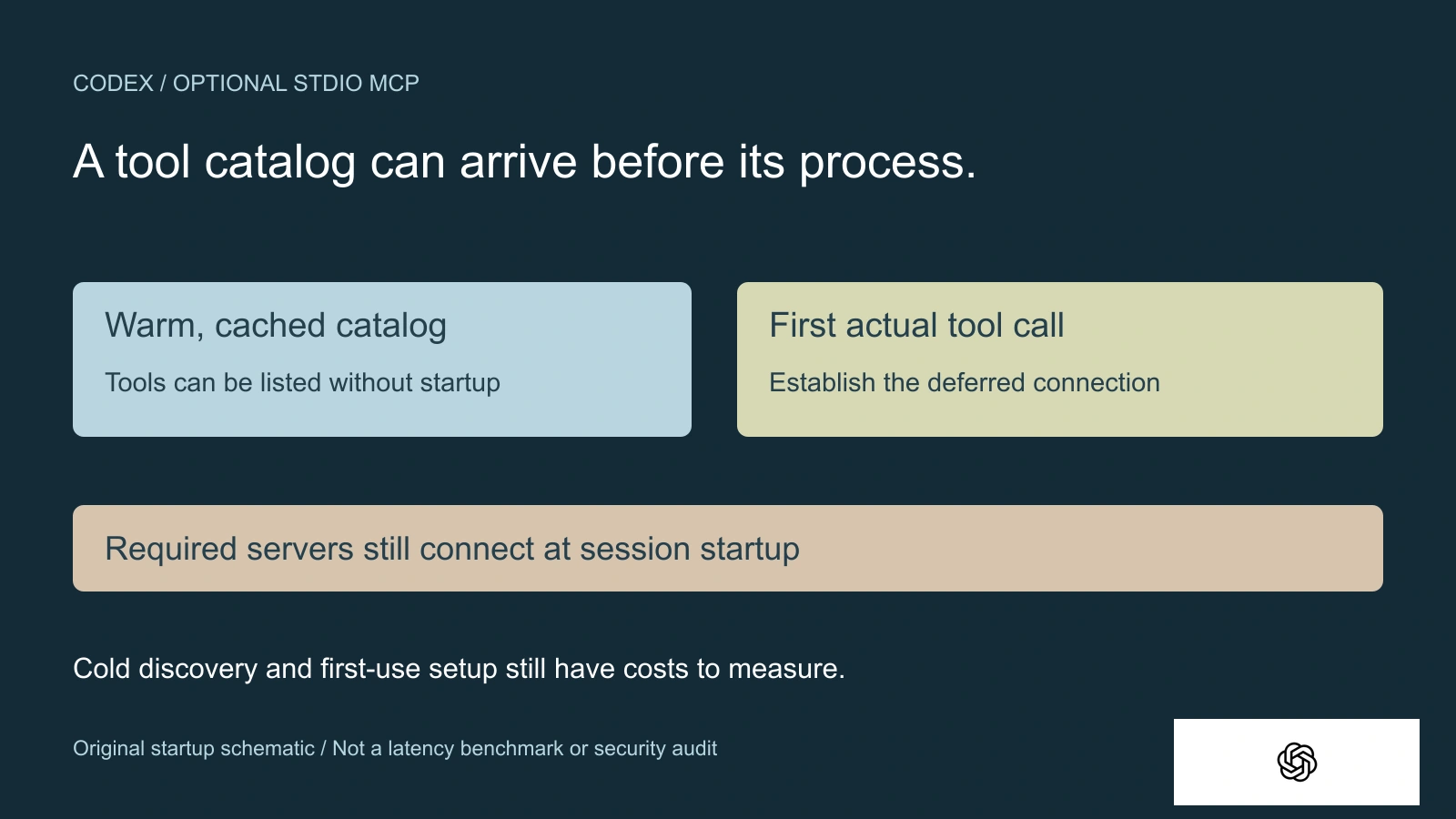

OpenAI's Codex 0.172 release makes lazy startup the default for optional stdio MCP servers when their tool catalog is already cached. The release appeared November 24 UTC, or November 23 in California. Required servers still establish a live connection at startup.
The distinction is practical for sessions configured with several integrations: knowing which tools a server advertises does not always require starting its process immediately. The first actual tool call can become the point at which the connection is established.
A cached catalog is not a running service
The included startup change moves mcp_lazy_stdio_startup from an under-development feature to a stable feature enabled by default. Its scope is conditional: an optional stdio server with a cached tool catalog, not every MCP transport and not every fresh configuration.
A cold configuration still needs a way to discover its tools. A required integration has a different startup obligation from an optional one. Those conditions prevent a useful optimization from being mistaken for a promise that no configured server will ever start until a model requests it.
The tagged upstream tests distinguish a cold start, an explicitly eager control, a required server with a warm catalog and a later session that can work without using the optional server. The first-use scenario then checks what happens when the cached tool is called. We read that test structure; we did not execute it.
Move the work, then measure the right interval
Lazy startup changes when connection work happens. It can avoid starting an unused optional integration, but it can also move initialization into the first call that needs it. A ready-looking tool list is therefore not proof that the underlying process is already reachable or that its first response has no setup cost.
The release does not supply a universal startup-time reduction for readers' machines. A useful comparison would distinguish cold sessions, warm catalogs, unused integrations and first-use latency, while retaining the same set of required servers and permissions.
Our analysis
This is a sensible separation of capability description from resource activation. It also makes observability more important: tooling should communicate whether it is showing cached metadata or a live connection, and a delayed initialization failure still needs to reach the user clearly.
Caching is not evidence that a server's advertised tool is safe or appropriate for a particular action. This article examines startup scheduling, not a security audit of all connected-tool approval behavior.
Other changes in 0.172 cover navigation, session restoration and provider handling. We have kept those separate from the narrower startup claim. Our existing Codex repository profile links the Apache 2.0 source; connected services retain their own terms. We reviewed the release, included change, feature definition and test cases without installing a client, changing MCP configuration or launching a server.
EXPLORE THE SOURCE
Projects in this story
GitHub repositories
- openai/codex ↗View project details
Original primary-source review. No model weights/data downloaded, upstream tests or workflows run, clients installed, servers/credentials changed or benchmark independently reproduced.