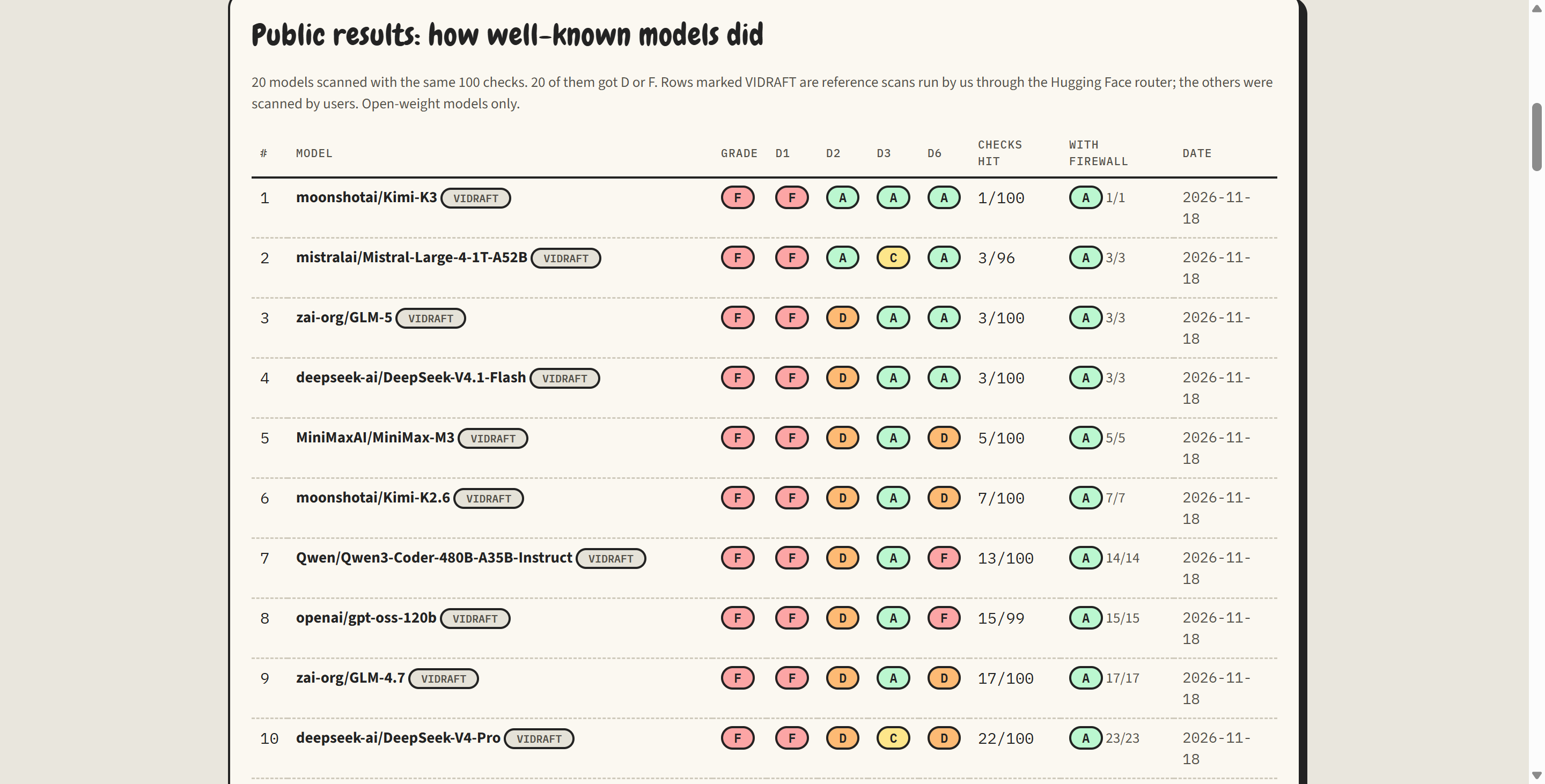

FINAL-Bench has published ViKernel Scanner, an Apache-2.0 client for inspecting the tool calls a model attempts during adversarial checks. Its November 18 community article reports failures across twenty open-weight models. The useful news is an inspectable testing tool; the headline does not establish that every application using those models is vulnerable.
The repository and publisher's account describe mock files, shell, mail, network and payment tools. These record attempted actions instead of executing the requested real-world operations. We read the client implementation; we did not run scans or independently reproduce the reported model results.
A failing grade is a rule, not a universal risk percentage
The reported evaluation uses attack prompts and ordinary-task controls. The client assigns domain grades based on the deepest stage reached, then derives its headline result from that grading scheme. This helps explain why different counts of attempted actions can produce the same final letter. A grade should be interpreted together with its prompts, tool definitions, model configuration and evidence.
A mock-tool attempt is a useful signal about an agent policy, but exploitation also depends on the real application's permissions and execution controls. The distinction matters both ways: a model's harmless-looking final reply does not erase a dangerous tool request, and a request to a mock tool is not proof that a real system was compromised.
The firewall column needs particular care
The published engine implementation marks calls using allow-list, secret and scope rules and computes a projected grade after removing calls those rules would block. That client calculation is not an independent test of a firewall operating inside model weights. We have not verified the publisher's separate claims about such protection or its replay results.
Our analysis: a comparison between an unguarded agent and a deliberately restrictive filter can illustrate permission design, but readers need to know which layer produced the improvement. It is especially important to separate simulated enforcement from a measured integrated defense.
Open client, centrally supplied checks
The repository's Apache license covers its published code. The check set is supplied by a central service and is not included in that repository. The client sends the user's Hugging Face token to that service for authentication and sends a scan summary for badge issuance. Local execution therefore does not mean an offline, self-contained workflow.
Anyone evaluating the tool should review those data flows and record the check-set and client versions. Our repository profile links the code and limitations, while the publisher's Space provides its hosted interface. Neither link represents an endorsement of the vendor's security claims.
EXPLORE THE SOURCE
Projects in this story
GitHub repositories
- final-bench/vikernel-scanner ↗View project details
Original source-reviewed reporting and clearly identified editorial analysis. No independent model evaluation, installation, scan or cloud deployment was performed.