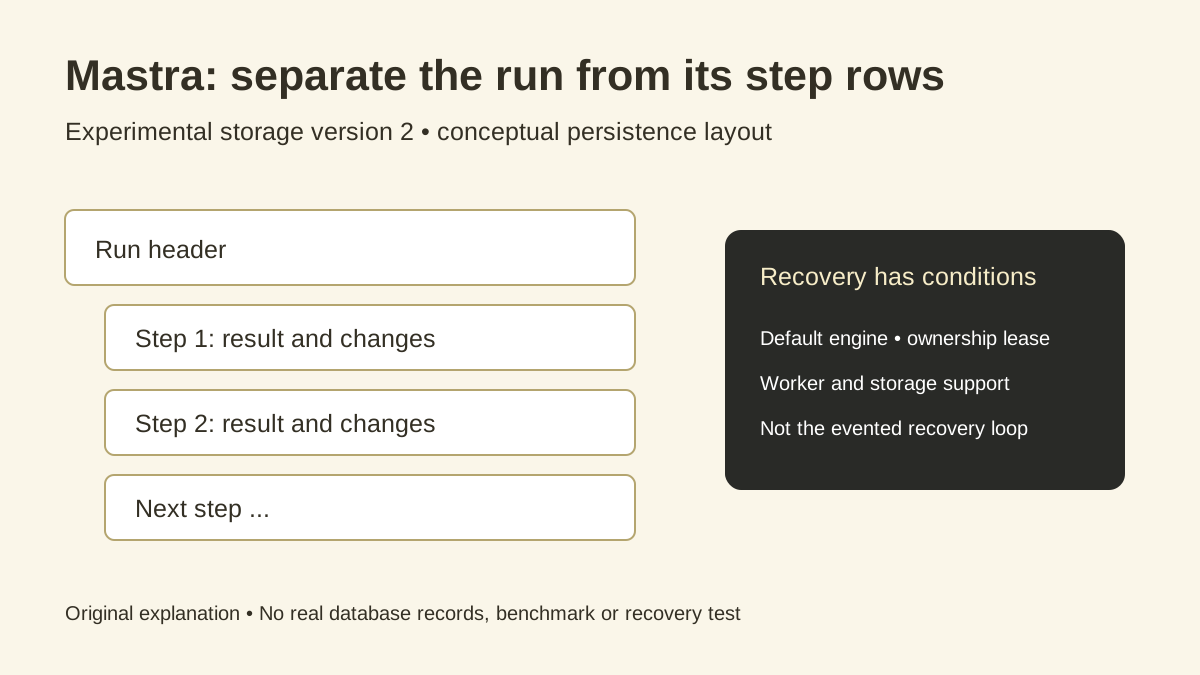

Mastra’s November 18 core 1.84.0 release extends experimental storage version 2 to evented workflows and offers it for durable and evented agents. It also adds a recovery loop for eligible default-engine workflow runs whose instance has crashed.
These are related operational features, but they address different problems: how much state is moved and stored during execution, and when interrupted work is eligible to restart.
Store changed state instead of repeatedly moving the whole run
The storage change describes a run header plus per-step records, with event messages carrying a previous result and state changes. The new mode is opt-in and experimental, not a blanket change to every existing run.
Adopting it can require asynchronous state and step-result reads. Source notes identify cases where synchronous access throws under version 2, so enabling a flag without reviewing application code is not a complete migration.
Recovery depends on the engine and ownership rules
The recovery implementation starts a periodic loop through the orchestration worker. It uses ownership leases and a grace period before restarting eligible default-engine runs. A leader coordinates scans among instances sharing a store.
The loop does not recover evented runs. Its documented limits also include which workflows the leader registers and whether the storage adapter supports run ownership. Those qualifications matter more than a broad promise that any crashed workflow automatically resumes.
Our analysis: persistence is a contract, not just a size reduction
Reducing repeated state can help a long workflow, but application code still needs a clear contract for reading the state it depends on. A more compact representation is useful only if the resumed execution sees the information it expects.
Restart policy deserves similar attention. Operators need to know which work can restart, where it restarts and what happens to external actions already attempted. A recovery loop should not be interpreted as a general exactly-once guarantee for everything the application does.
Mastra publishes favorable measurements from an example run. We have not reproduced them, migrated stored data or tested failure recovery. The implementation details are useful preparation for that work, not a substitute for it.
Read the license boundary too
The tagged license notice places the main open-source content under Apache-2.0 while directories named ee/ have separate enterprise terms; third-party components retain their own licenses. Our repository profile preserves that distinction.
Official framework background
Mastra’s November 20 publisher-channel discussion concerns building a custom factory. It is broader framework context, not a demonstration of our tests or evidence for the release’s storage measurements.
EXPLORE THE SOURCE
Projects in this story
GitHub repositories
- mastra-ai/mastra ↗View project details
Primary-source review and original editorial analysis. No software installation, model inference, API call, security validation or independent benchmark performed.