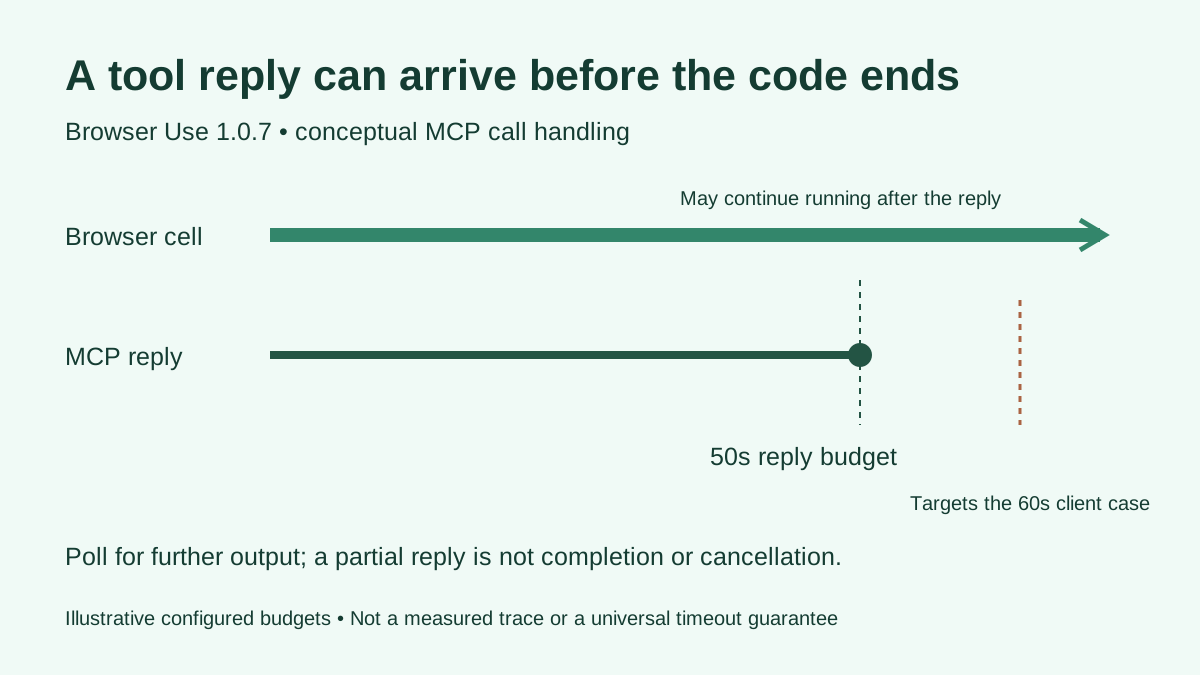
Browser Use 1.0.7 changes how its MCP server responds when browser code takes a long time. The November 20 release targets clients that cancel tool calls at around 60 seconds: a long browser_exec call now returns available output within a configured 50-second budget while its code can keep running.
The upstream change describes the earlier failure: a client could report a timeout even though the browser cell continued. The agent then lacked the output needed to understand what had happened.
Getting a reply is different from finishing the work
A follow-up browser_exec call with empty code can retrieve further output and the cell’s ending status. A sufficiently long operation can require further polling. The patch also reports when it could not acquire the browser in time and therefore did not run the requested code.
The implementation separates the cell’s thread from the lifetime of one MCP call. It retains unreported output for later calls and keeps recovered cell text out of telemetry records. These are source-level behaviors we inspected, not a runtime test we performed.
Our analysis: avoid treating timeout handling as cancellation
This distinction matters most when a browser action changes something. Receiving a partial result should not prompt an agent to repeat the same action as if nothing ran. The application needs to check the outstanding operation and its outcome before deciding what to do next.
Likewise, a shorter reply budget does not make the underlying website or code faster. It changes how progress is communicated across a boundary between the client and tool server. That can improve continuity without reducing the total execution time.
It also does not raise a language model’s output-token limit. Execution time, tool-result size and model-response length are different constraints. A workflow can handle one successfully and still need a strategy for another.
The client still matters
The release addresses a common 60-second client case; it is not a guarantee against every shorter deadline, disconnect or resource failure. Integrators should examine their own client settings and distinguish a running cell, a finished cell and a request that never started.
The project’s MIT license applies to its source; hosted services have separate access terms. Our existing repository profile links the code. We did not install the update, start a browser, run an agent or reproduce the contributor’s timing tests.
EXPLORE THE SOURCE
Projects in this story
GitHub repositories
- browser-use/browser-use ↗View project details
Primary-source review and original editorial analysis. No software installation, model inference, API call, security validation or independent benchmark performed.