
ty 0.0.112, released November 26, fixes a shutdown race in watch mode and expands support for attrs converter methods. The release also lists targeted performance improvements, without establishing one universal speedup for every Python project.
The practical changes sit at two boundaries: what a background watcher should do after its consumer exits, and what a field accepts on input versus what a program reads after conversion.
A file event can arrive after shutdown
The watch-mode change replaces an unconditional unwrap when forwarding a filesystem event into the main loop. If Ctrl+C has already closed the receiver, a late batch now follows an error-handling path that logs the ignored change rather than panicking on that send.
The release describes the affected sequence as interrupting shortly after saving a watched file, with the normal interrupt exit status of 130. This is a specific shutdown-race fix, not evidence that all possible watch-mode crashes or filesystem races have been eliminated.
Accepted input can differ from the stored type
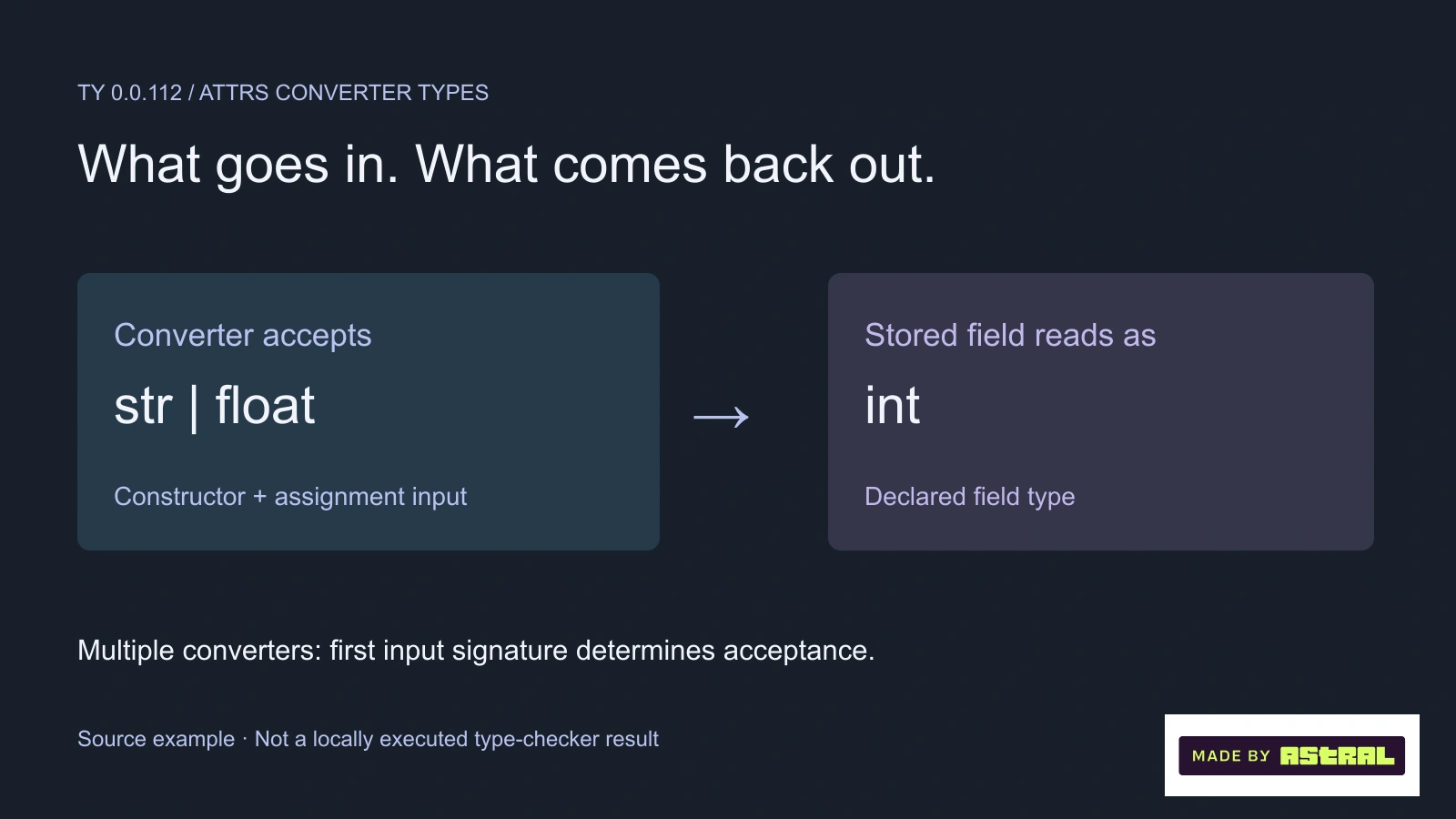
The attrs converter update recognizes methods registered with a field's converter decorator. When a converter accepts a broader input and returns the field's declared type, constructor checking and assignment checking can use that input type while reads retain the declared field type.
The upstream example uses a field declared as an integer with a converter accepting a string or floating-point value. Accepting either input does not mean subsequent reads become a union of all three types: the stored field is still checked as the declared integer.
The maintainer also specifies that when several converters are registered, the first determines the accepted input type. Readers should preserve that qualification instead of assuming the checker merges every converter signature into a broad union.
Performance notes need their workload
The changelog describes faster annotation and Final lookup, tuple-union simplification, inference for collections of functions, and control-flow analysis for files with large wildcard imports. These are different internal paths, and some examples are particularly relevant to libraries with large registries or imported symbol sets.
No single percentage in this article summarizes those changes. We did not time a project, run the upstream suite or establish that a particular application benefits. A type checker's performance depends on the code shapes that exercise its affected paths.
Our analysis: the converter fix is more useful than treating every accepted assignment type as the value's eventual representation. Static tools need to model the transformation a library performs while retaining a stable type for later reads. The shutdown fix follows a similarly narrow principle: once the receiver exits, a late notification is not a reason to crash the process.
ty is MIT-licensed. Its repository profile links the release source. We reviewed the release and merged watch/converter changes, including added regression coverage, but did not install or execute this version.
EXPLORE THE SOURCE
Projects in this story
GitHub repositories
- astral-sh/ty ↗View project details
- astral-sh/ruff ↗View project details
Original primary-source-reviewed reporting. No upstream installations, runtime tests, weights, datasets, inference, benchmarks, cloud resources or deployments performed.