
OpenShell 0.1.10, published November 24, changes both where its release images are fetched and what a default Kubernetes Helm installation forwards through the gateway. For existing deployments, these are upgrade decisions to review together, rather than reasons to assume a sandbox has become automatically secure.
The project is now hosted at ai-openshell/openshell; the older NVIDIA repository address redirects there. A November 27 Fahd Mirza tutorial brought the release back onto our desk, but that video date is not the software's release date. This coverage is based on the primary release, tagged chart and implementation changes.
A different registry and chart address
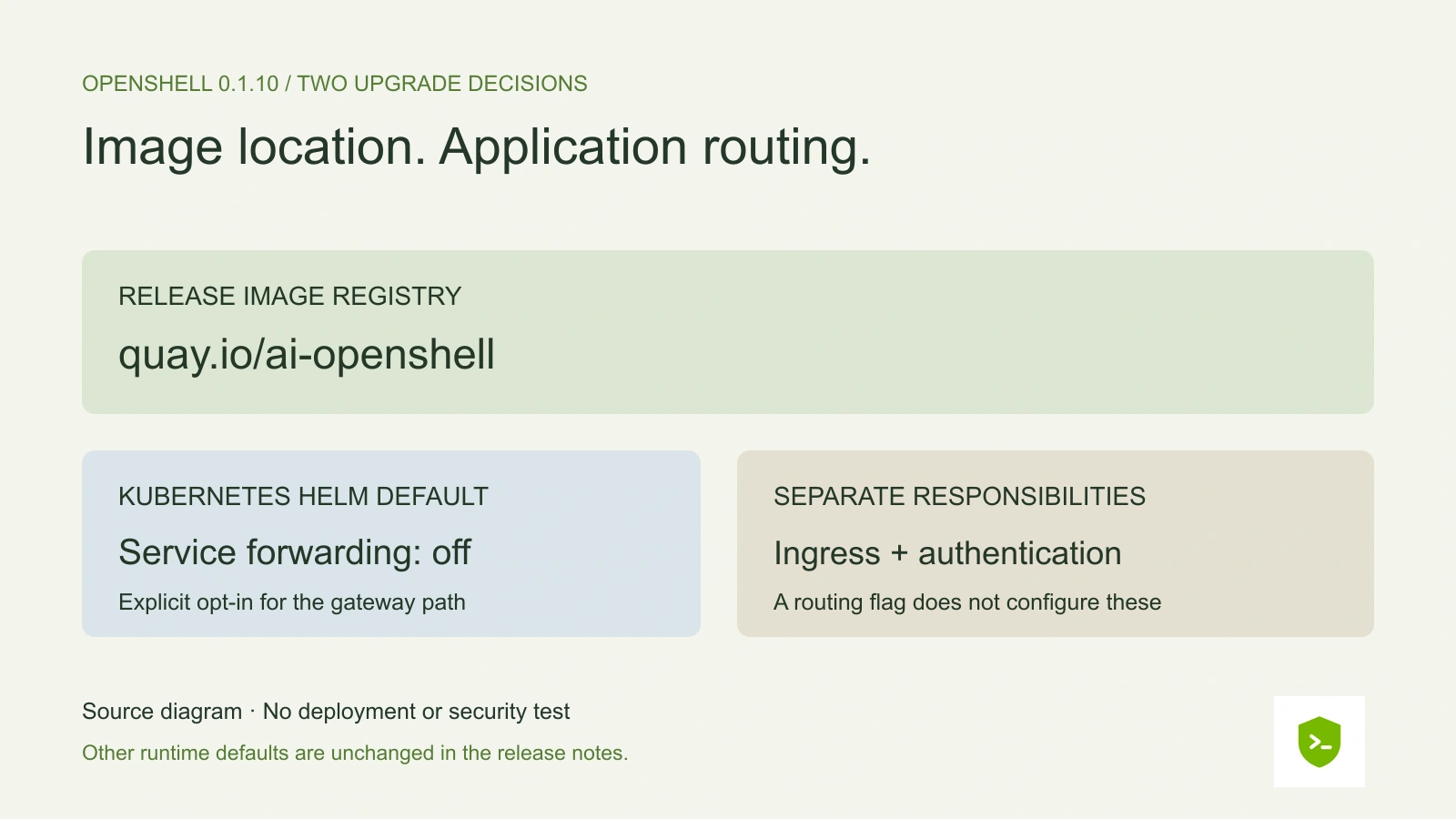
Release images move to quay.io/ai-openshell. The tagged gateway configuration names that registry for its default supervisor and sandbox-runtime images, while the chart values use quay.io with repositories such as ai-openshell/gateway.
Operators using a registry mirror need to check the repository path as well as the hostname. The release notes specify that a custom global.image.registry now resolves under <mirror>/ai-openshell/<name>, replacing the previous <mirror>/openshell/<name> layout. Changing only an allowed registry hostname would not address a mirror organized around the old paths.
The Helm artifact is also renamed from helm-chart to openshell, at oci://quay.io/ai-openshell/charts/openshell. Maintainers say an existing release installed from the older GHCR chart can be upgraded in place. We checked the tagged chart name and merged migration changes, but did not execute a Helm upgrade or pull a registry image.
Helm routing is an explicit choice
The 0.1.10 chart values disable gateway-mediated sandbox service URLs and HTTP/WebSocket forwarding by default. An installation relying on that route must explicitly enable gatewayConfig."openshell.gateway".enable_gateway_service_routing to retain it.
This is a Helm deployment default, not a statement that every OpenShell runtime has switched routing off. The release notes say core, Docker, Podman and VM defaults are unchanged. The tagged renderer also supplies the Kubernetes false default when saved values omit the field or set it to null, while preserving an explicit boolean choice.
The routing change distinguishes this service-forwarding path from control-plane APIs and gateway application authentication. Disabling forwarding does not configure a replacement ingress, establish who may access an application or prove that its endpoint is protected. Application-listener exposure and authentication still require their own design.
Review the deployment contract
Our analysis: the practical value of this release is clearest in the boundary between an artifact upgrade and an infrastructure migration. Registry allowlists, mirror paths, chart references and application access can fail independently. A successful package update alone would not show that a previously published application URL still works as intended.
The release identifies Kubernetes 1.33 as its minimum tested version; that is a statement about testing coverage, not evidence that every earlier cluster necessarily fails. Its separate application-origin changes also carry matching gateway, driver and supervisor requirements, which operators should review in the complete upgrade notes.
OpenShell's tagged source is Apache 2.0-licensed. Our existing repository profile remains the site's entry for this same project under its earlier address, avoiding a duplicate listing after the move. We inspected the exact release, chart values, rendering code and merged changes. We did not install the runtime, run its tests, deploy a cluster, invoke an agent or independently audit its isolation.
Original primary-source-reviewed reporting. No software installation, weights/downloads, credential revocation, graph operations, model inference, upstream test execution or benchmark reproduction performed.