
OpenHands 1.46, released November 25, adds a Git Sync control for keeping automation activation status local to an OpenHands environment. It addresses a deployment problem: synchronizing what an automation does need not mean synchronizing whether it is currently allowed to run.
The setting is optional and organization-scoped. It is not a change that silently switches every existing installation to a new activation policy.
A repository can carry a definition without carrying a switch
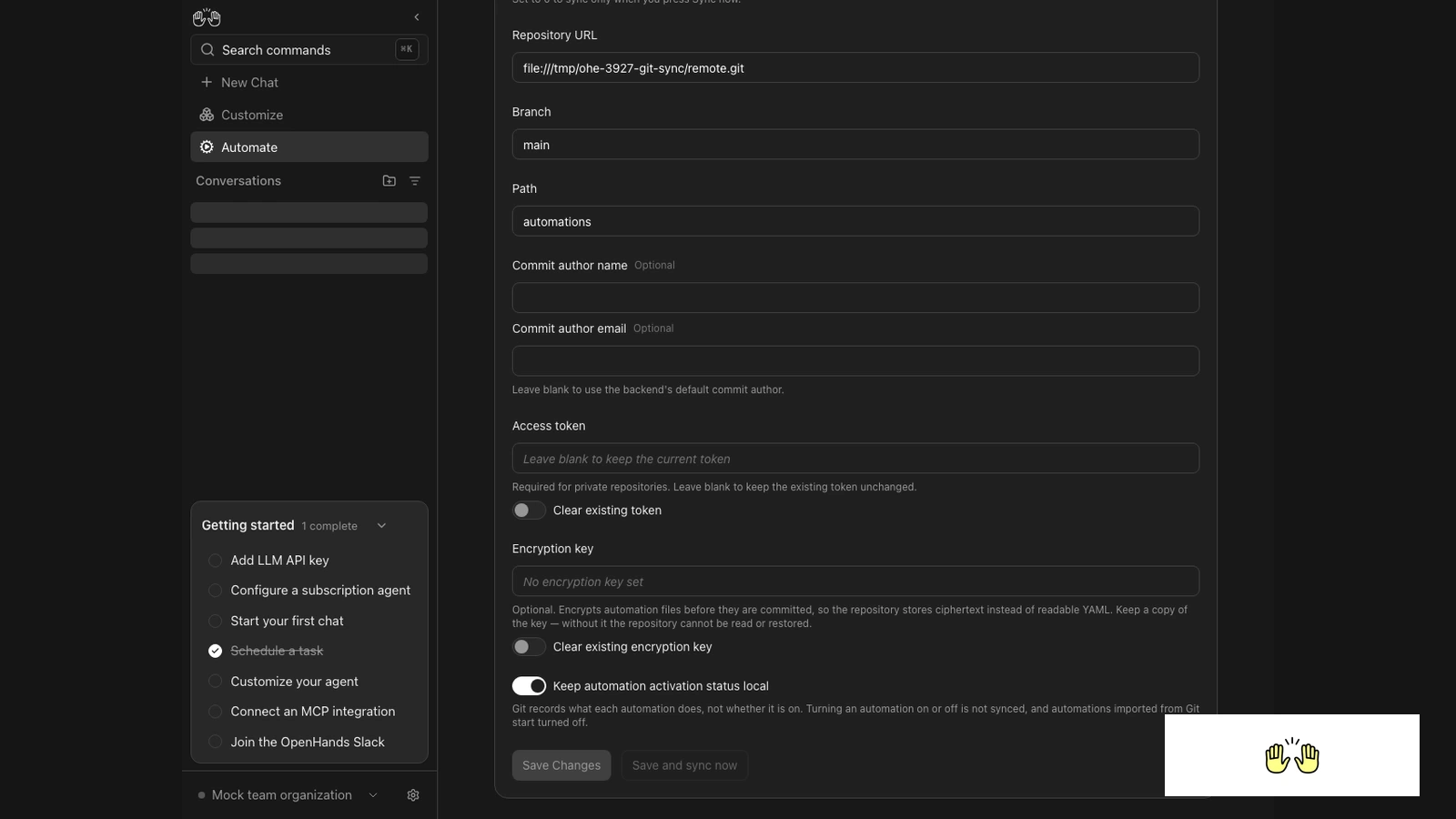
The paired automation-service change introduces keep_activation_local, defaulting to false. With it enabled, an active/inactive toggle alone does not mark the automation as pending for export, and ordinary non-draft exports omit the activation fields.
On import, existing automations retain their local activation status and a newly imported non-draft automation starts inactive. A definition change can still synchronize. The option does not mean Git Sync stops importing all changes or that a local environment becomes disconnected from the repository.
Here, local means the OpenHands environment's stored status, not necessarily a file on a user's laptop. That is the useful boundary for teams sharing definitions between development and production instances.
Drafts keep their own rules
The implementation deliberately treats draft state separately. Draft exports still carry draft state, and the existing consistency checks run before ordinary activation status is preserved. It would be inaccurate to describe the switch as ignoring every state field in every YAML document.
Turning the option on also does not immediately rewrite the repository. Existing activation lines are ignored on import under the new policy and disappear when the corresponding non-draft automation is next exported. Turning the option off marks synchronized automations pending so a later sync can write their current status again.
The interface waits for backend support
The Canvas interface change displays the switch only when the backend status includes the new field. An older automation service would ignore an unsupported configuration value, so the frontend does not present the control there.
The tagged form also tracks whether the option actually differs from its stored value. The added request test checks that changing this setting alone submits this setting alone, while a separate case covers a backend that does not advertise it.
The upstream evidence includes a locally captured interface connected to an automation service with mocked organization membership. We use that source screenshot with its context; it is not a production deployment or a test carried out by OpenSourceCoder.com.
Our analysis: defining a job and activating it are different operational decisions. Keeping them separate can make shared automation repositories easier to review without letting one environment's on/off choice determine another's. The feature does not replace membership permissions, review of imported code or controls around what an enabled automation may execute.
The reviewed OpenHands application source is MIT-licensed. Its repository profile links the project. We inspected the release, tagged interface and paired backend implementation without starting an automation service, changing a Git repository or running the upstream tests.
EXPLORE THE SOURCE
Projects in this story
GitHub repositories
- OpenHands/OpenHands ↗View project details
Original primary-source-reviewed reporting. No upstream installations, runtime tests, weights, datasets, inference, benchmarks, cloud resources or deployments performed.