
Pydantic AI 2.76.0, released on November 26, extends progressive tool discovery to realtime sessions on supported models. A voice agent can begin with a limited tool set, then reveal an additional capability during the conversation instead of advertising every tool from the start.
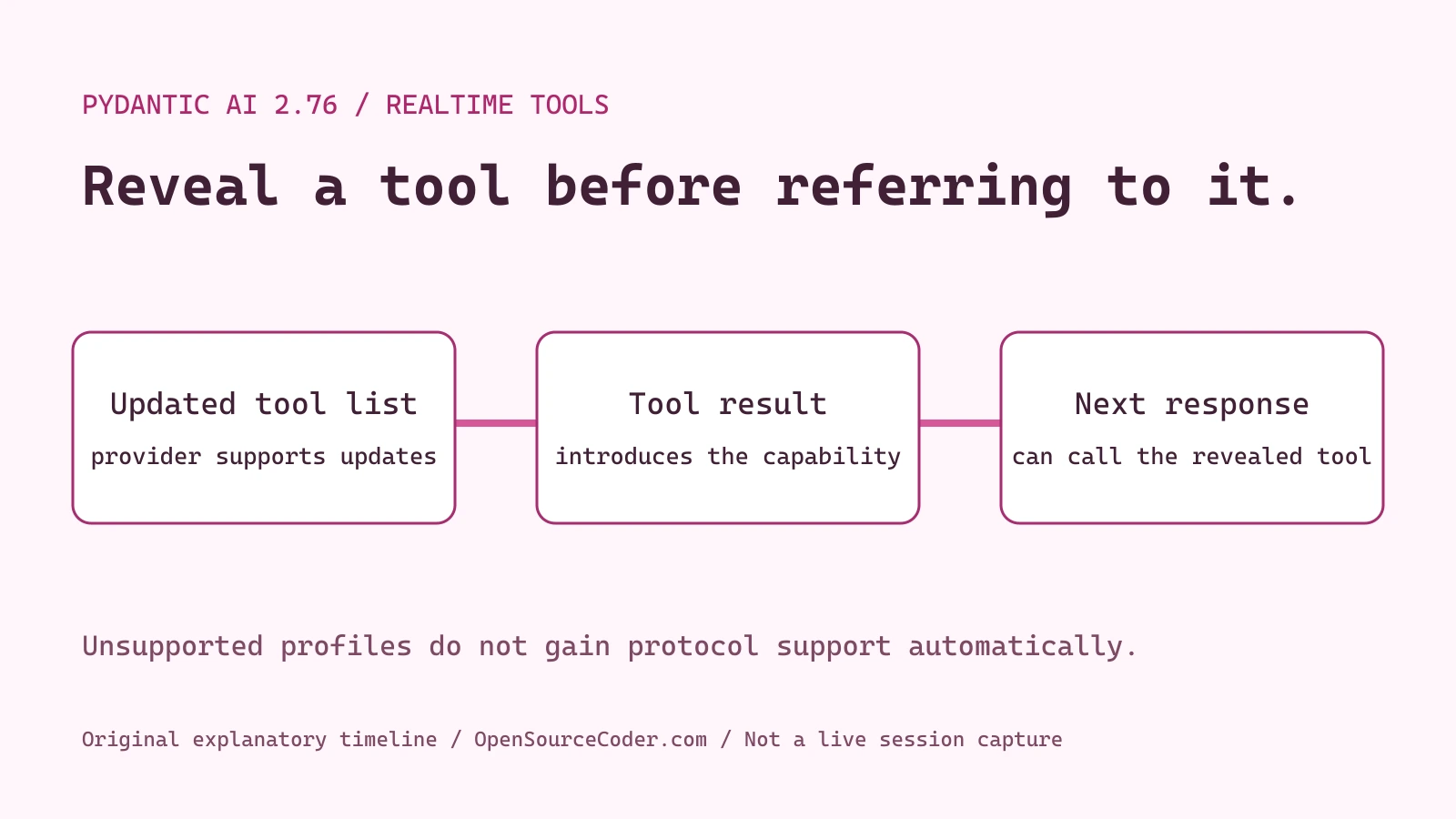
The important qualification is support in the model’s realtime profile. The merged change adds a supports_tool_updates flag that defaults to false. This is not a promise that every realtime provider accepts a changing tool list, and adding the framework feature does not change an unsupported provider’s protocol.
Order is part of the feature
The tagged documentation describes several explicit reveal paths: tool search can find deferred tools, a tool can return additional tools, and loading a deferred capability can expose its tools. For a compatible model, the session sends the updated tools before the result that introduces them. The next response can therefore call a newly disclosed tool.
This is more specific than arbitrary hot reconfiguration. A dynamic toolset or preparation hook changing between turns can alter which calls the application accepts without changing what the model has been offered. The documentation distinguishes those operations from an explicit reveal.
Unsupported sessions fail differently
Opening a session with a hidden deferred tool on a model that cannot receive tool updates raises an error before connecting, unless seeded history has already revealed it. If a dynamically introduced tool appears only after an unsupported session opens, the session warns that the model cannot call it. These boundaries matter when a developer expects one workflow to behave identically across providers.
The compatibility note also affects custom connection code. RealtimeInput gains an UpdateTools variant. Existing connections without the support flag are not sent that new input, but an exhaustive type match can stop type-checking until it handles the added variant or deliberately rejects it.
Our analysis: staged discovery can make a large capability catalogue easier to manage in a voice interaction. Its reliability depends on keeping three things aligned: the model’s advertised tools, the application’s accepted calls and the conversation history. It does not replace authorization over what an exposed tool may do.
The Pydantic AI repository profile links the MIT-licensed project. We reviewed the release, merged patch and tagged documentation, including the unsupported-provider behavior. We did not open a realtime session or test any provider connection.
EXPLORE THE SOURCE
Projects in this story
GitHub repositories
- pydantic/pydantic-ai ↗View project details
Original primary-source-reviewed reporting. No package installation, hosted API call, model inference or independent benchmark was performed.