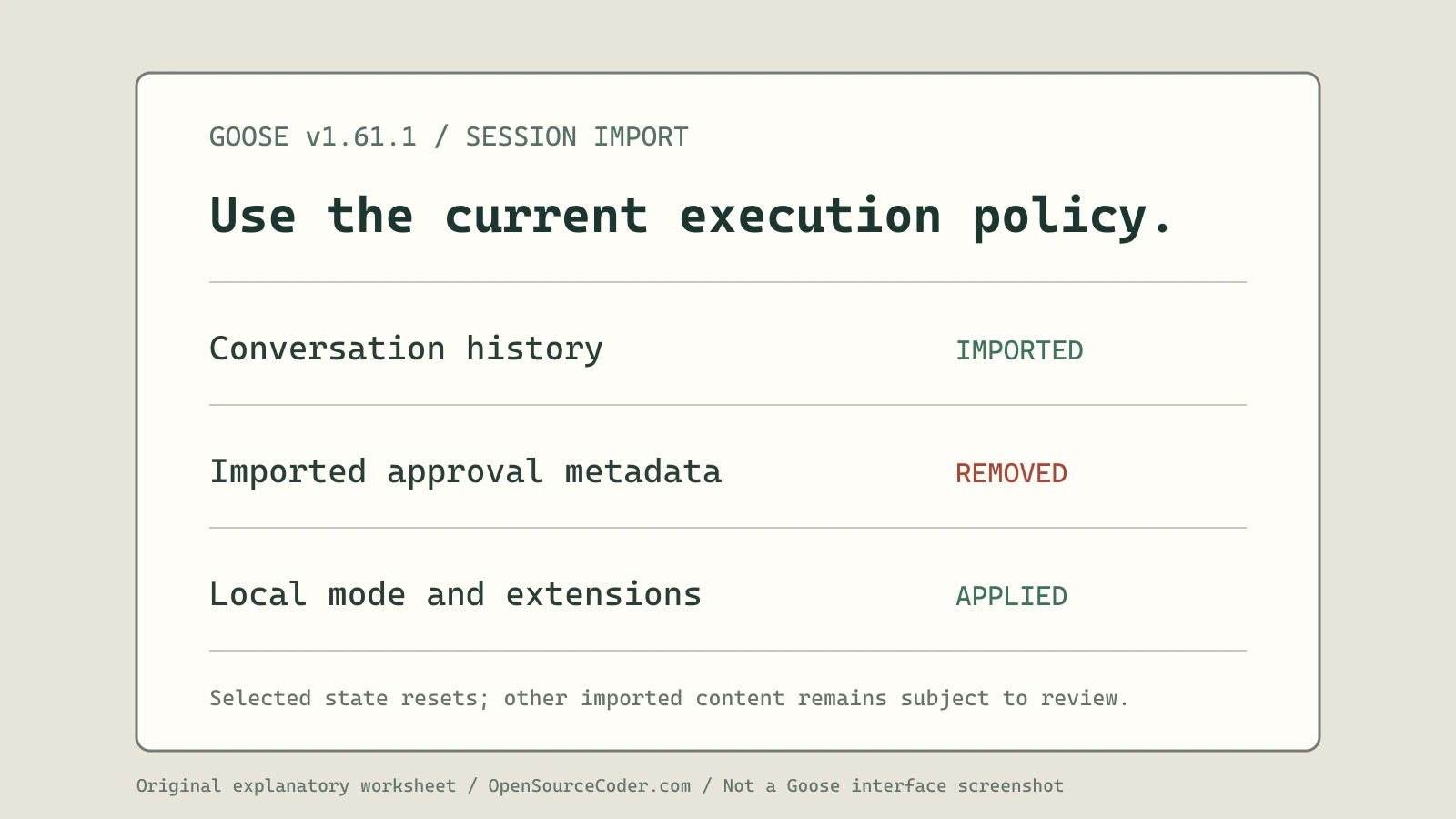

Goose 1.61.1 hardens session import by dropping stored tool-approval state that could otherwise carry execution permission into a loaded session. Its release timestamp is November 26 UTC, or November 25 in Pacific time. The change draws an important boundary between a saved record of a conversation and authority to perform an operation now.
The published comparison shows a sanitization step applied to imported conversation data. It removes tool-confirmation records and confirmation responses, clears the stored approval operation, and strips the execution marker attached to imported tool requests. It also clears provider session identifiers in imported inference metadata.
Local configuration replaces selected imported settings
The import path now obtains the Goose mode and enabled extensions from local configuration. It clears recipe retry configuration and no longer imports certain recipe values or container state through the same update path. These are specific execution-state changes; they do not mean every field in an imported session is discarded or that the file has been certified harmless.
The release also removes stored recipe-template re-rendering when sessions are loaded or forked. In the desktop application it removes dotenv loading intended to prevent unintended environment-variable imports. We reviewed these code and release-note changes; we did not load a crafted session or test an exploitation scenario.
A transcript is not a permission token
The practical issue is that a saved session can contain more than visible chat text. Its operational metadata may describe pending work, a previous permission decision or the environment in which a tool ran. Restoring those details without considering the current application’s policy can blur the distinction between remembering an action and authorizing another one.
This patch resets particular forms of imported state. It should not be described as a guarantee that all imported content is trustworthy, that every extension is safe, or that every existing stored session has automatically been rewritten. The primary release describes fixes; our review does not establish an actively exploited vulnerability or a public CVE assignment.
Our analysis: agent portability needs a clear trust boundary. Conversations are useful to move between applications, but permissions are contextual: they depend on the current user, available tools and local policy. Preserving useful history while re-evaluating execution authority is a stronger design than treating an exported session as a reusable grant.
The Goose repository profile links the Apache 2.0 project. We reviewed the exact release and import/load/fork changes. No package, session, extension or desktop environment was modified for this article.
EXPLORE THE SOURCE
Projects in this story
GitHub repositories
- aaif-goose/goose ↗View project details
Original primary-source-reviewed reporting. No package installation, hosted API call, model inference or independent benchmark was performed.