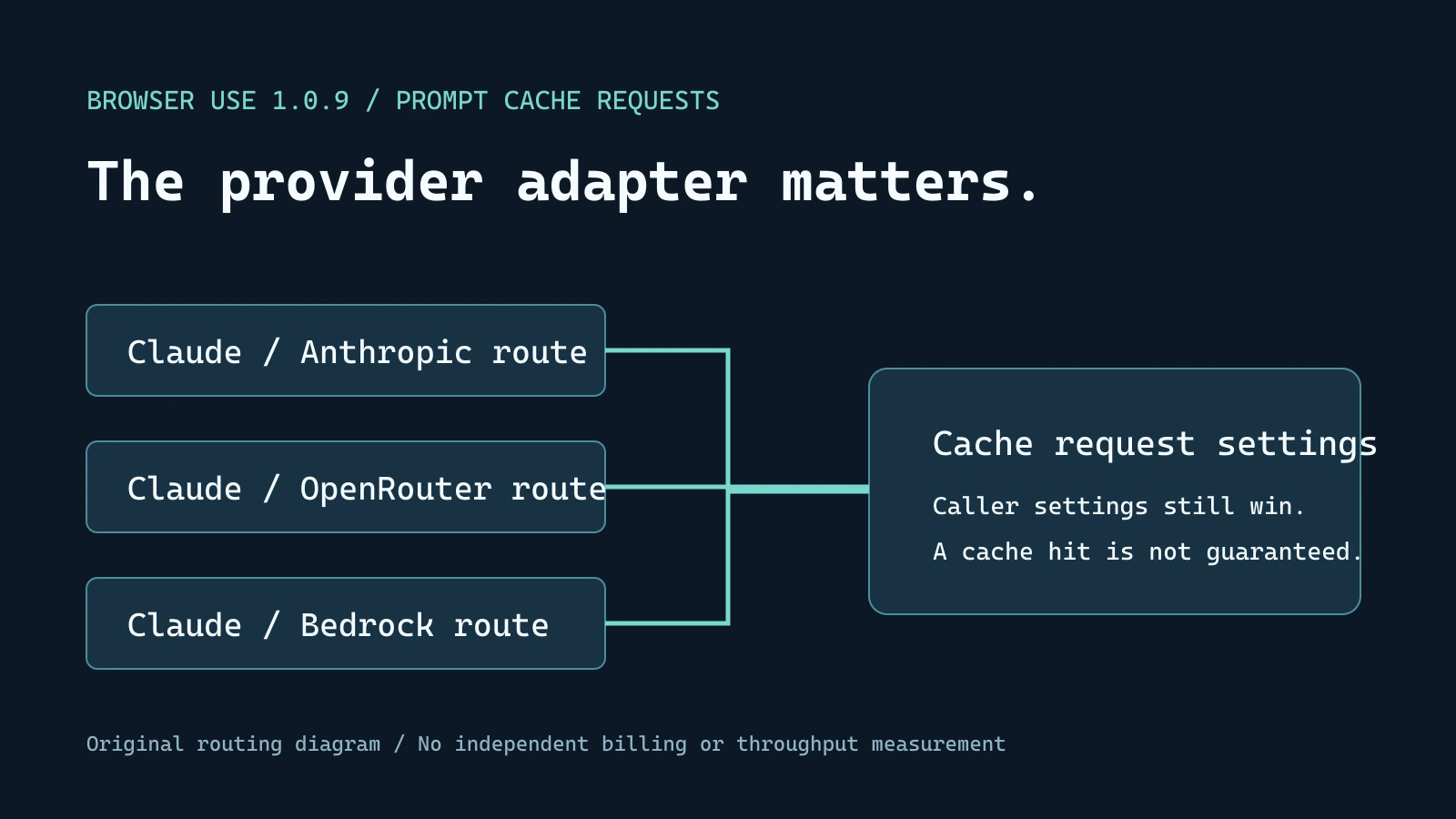

Browser Use 1.0.9 repairs prompt-cache configuration for Claude reached through several provider routes. The November 26 release matters to applications whose browser-agent prompts include substantial tool definitions, conversation history or screenshots: routing the same model through a different provider adapter could previously leave caching unrequested.
The merged fix explains that the earlier setup enabled the unified cache setting only on the direct Anthropic route. OpenRouter and Bedrock routes did not pass the corresponding request. An OpenAI-style client pointed at OpenRouter could also resolve to a generic adapter unable to carry the required cache-control fields.
The adapter is part of the request
The updated logic requests the shared cache setting for the relevant Claude routes while preserving an explicit setting from the caller. The OpenRouter entry point is resolved to the provider-aware OpenRouter model class rather than treated as an undifferentiated compatible endpoint. This is a targeted route-selection and request-configuration repair, not a claim that every OpenAI-compatible service supports the same caching behavior.
Non-Claude models remain outside this particular change. A caller who deliberately disables caching still controls that choice. Caching also depends on the provider’s rules and on whether the reusable prompt prefix actually matches; an updated client cannot guarantee a hit for every request.
Read the test conditions before estimating savings
The maintainer supplies live OpenRouter examples showing cache-read tokens after the change. Those trials took different numbers of agent steps before and after the patch. They are useful evidence that cache requests reached the route, but not a controlled basis for a universal percentage reduction in application cost.
Bedrock coverage is explicitly described as unit-tested rather than live-tested. We retain that distinction instead of treating every supported path as an independently measured production result. Our review did not make a paid model request or replay the maintainer’s browser task.
Our analysis: provider abstractions are helpful until a provider-specific feature quietly disappears at an adapter boundary. Teams should inspect request settings and usage counters together when evaluating cache behavior. A zero cache-read counter can have more than one cause, and a single successful cached request does not settle the cost of an entire agent workload.
The Browser Use repository profile links the MIT-licensed code. We reviewed the exact release, adapter patch and tagged cache-selection function. No browser automation, proxy rotation or model service was run as part of this reporting.
EXPLORE THE SOURCE
Projects in this story
GitHub repositories
- browser-use/browser-use ↗View project details
Original primary-source-reviewed reporting. No package installation, hosted API call, model inference or independent benchmark was performed.