
Pydantic AI 2.71.0 adds a way for applications reviewing deferred tool calls to inspect the arguments after validation. The November 19 UTC release includes DeferredToolRequests.validated_args, alongside changes to harness permissions, tool dispatch and paused runs.
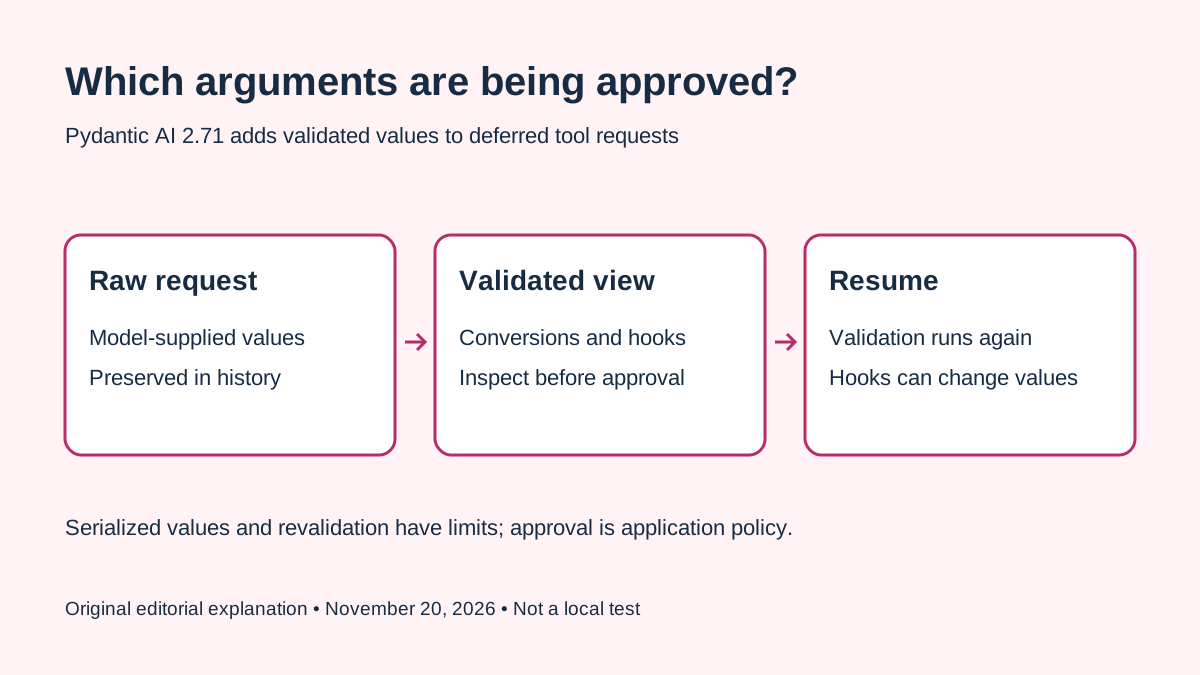
The implementation and review notes explain the gap: the model’s requested values can differ from the values passed to the function. Validation may convert a type, remove unaccepted keys, resolve an alias, normalize a value or apply a hook.
The raw request remains available
The change keeps the original tool-call arguments in their existing fields and adds a map of validated values keyed by tool-call ID. The stored representation is JSON-compatible and uses Python parameter names. It gives an approval interface more useful evidence without silently replacing the model’s recorded request.
That is not a guarantee that an approved call will receive an immutable set of values. On resume, the recorded call is validated again. The source explicitly warns that a validation hook whose output depends on changing conditions can produce a different result.
Our analysis: approval needs a clearly defined object
A useful approval screen should explain what the application intends to execute. Showing only the model’s text can miss a meaningful transformation made by the application itself. Showing normalized values helps reviewers understand that transformation.
Applications still need to decide what an approval binds to: an original request, a normalized request or an exact action checked immediately before execution. This release supplies data for that design; it does not decide the application’s entire authorization policy.
The serialized view also has limits. Fields excluded by an object’s serializer are not displayed even though the function can receive them. The documented streaming path that stops before validating a deferred call has no validated arguments to attach. These details deserve tests in the particular integration.
Compatibility and related harness changes
Tests comparing a complete deferred-request object may need to account for the new field, or compare the intended existing fields explicitly. The PR documents that migration even though no existing field is removed.
Separately, PermissionRule adds allow, ask and deny rules, with denial taking precedence. The ToolBridge change provides fixed dispatcher tools while retaining special treatment for approval-required and external tools. These are application controls, not evidence of an independently audited sandbox.
The MIT-licensed source is linked in our repository profile. We inspected release notes and implementation changes without installing the package, executing tools or testing a provider service.
EXPLORE THE SOURCE
Projects in this story
GitHub repositories
- pydantic/pydantic-ai ↗View project details
Primary-source review and original editorial analysis. No software installation, model inference, API call, security validation or independent benchmark performed.