
Prefect 3.9.5, released November 24, includes two changes worth checking before updating workflow operations: exported flow-run logs gain worker identity fields, and mixed day-and-time interval schedules receive a daylight-saving correction. Neither change is an AI model release, but both affect the infrastructure used to run data and agent workloads.
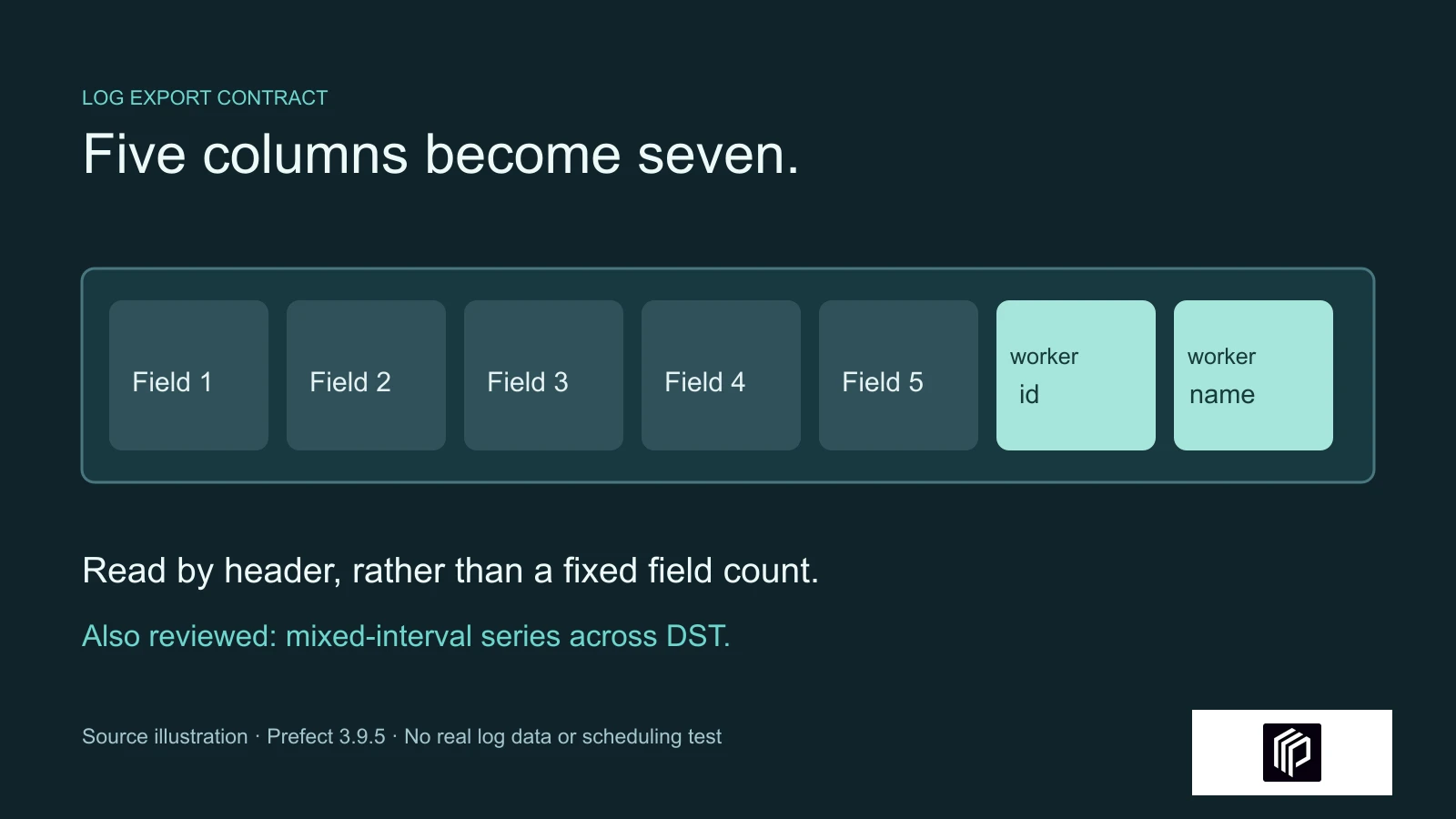
The CSV export change appends worker_id and worker_name to self-hosted flow-run log exports, taking the schema from five columns to seven. The release specifically advises readers that unpack five positional fields to switch to header-based reading.
A useful addition can still break a reader
Worker identity can help relate a log record to execution infrastructure. It does not establish that every row has a nonempty identity, nor does an exported name alone prove why an operation failed. The concrete compatibility issue is structural: a script expecting exactly five fields can reject a valid new export or mis-handle additional values.
Header-based parsing lets a consumer select the fields it understands without treating their position or the total column count as a permanent contract. Where a downstream system uses a strict schema, the export and consumer should be reviewed together. That is a migration implication of the documented change, rather than a claim that we tested a particular external log service.
Refilling the same schedule after a clock change
The interval fix addresses schedules combining calendar days and exact seconds, such as a 26-hour interval. Their intended sequence applies each interval step in order. Previously, estimating a later occurrence by jumping from the anchor in exact seconds could land on a different series after a daylight-saving transition.
The correction seeks within transition-free segments and steps across transitions while retaining the calendar-based sequence. It applies to both supported datetime implementation paths when the requested start is at or after the anchor. Starts before the anchor retain the earlier estimate. The change also uses timestamp comparisons in the Pendulum path to handle a repeated fall-back hour.
The contributor reports regression checks across several time zones and interval shapes on Python 3.12 and 3.13. We reviewed the source and reported coverage; we did not execute those checks. This is a targeted correction, not proof that every scheduling or time-zone edge case is resolved.
Our analysis: operational reliability often depends on small data contracts: what a log row identifies, and whether refilling a schedule reproduces the series already promised. Teams running unattended workloads should examine those contracts alongside headline features.
The tagged project license is Apache 2.0. Our Prefect repository profile links the upstream code. No scheduler, production workflow or automation timetable was changed for this review.
EXPLORE THE SOURCE
Projects in this story
GitHub repositories
- PrefectHQ/prefect ↗View project details
Original primary-source-reviewed reporting. No software installation, model-serving API call, inference, deployment or independent benchmark was performed.