
Mastra Core 1.86.0, released November 25, adds opt-in durable dataset experiments. A run started with durable enabled is represented as an evented workflow, allowing another worker to continue after a process stops rather than leaving the experiment tied to the process that started it.
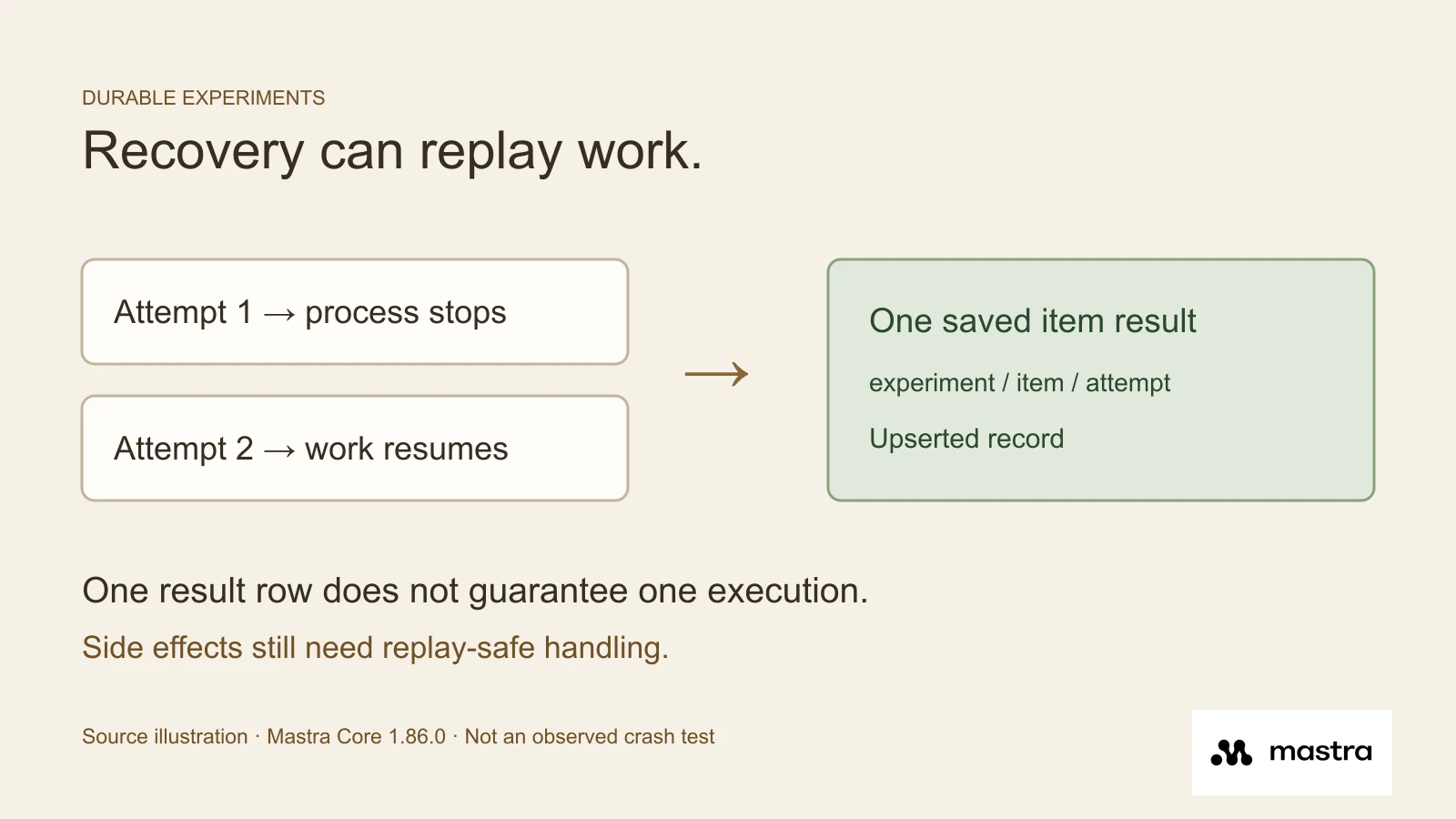
The implementation change divides work into preparation, item steps and finalization. The workflow run uses the experiment's identifier. Item results are upserted by experiment, item and attempt, so replaying an item after a crash can retain one result row.
One saved result is not one execution
The distinction matters when an experiment calls tools or services with side effects. The documentation explicitly allows a workflow target to run twice after a crash, even though the recorded item counts once. A unique result row does not establish exactly-once execution of everything the target did.
Recovery also depends on the selected infrastructure. Redis Streams redelivery waits for the configured idle-reclaim interval, and a pull worker processes one workflow step at a time. The maintainer reports live recovery checks in the pull request, but those are upstream observations, not tests performed by OpenSourceCoder.com.
Durable starts return a pending state with no start timestamp. That response means the run was accepted, not that a worker has begun or finished it. Older cores reject the new durable request rather than quietly falling back to in-process execution.
Persistable configuration and interrupted status
A durable run must use configuration that can be stored and reconstructed. Inline task functions, certain hooks, model or scorer objects and non-JSON request context are among the rejected cases. The implementation strips the caller's authentication token and user from this stored request context; that narrow behavior should not be expanded into a guarantee about every credential in an application.
Another shutdown-status change distinguishes a durable run handed back at shutdown as interrupted rather than failed. Recovery can later produce a final outcome on the same subscription. Recovery being disabled or unavailable can leave the run interrupted; ordinary agent runs retain their separate failure behavior. Subscribers and exhaustive status handling need to understand the new value.
Our analysis: durable execution makes progress and recovery more explicit, but application authors still own replay behavior. An experiment that only computes a score and one that sends an external action need different idempotency arrangements, even if both store one item result.
The tagged license places ordinary repository content under Apache 2.0 while excluding directories named ee, which have separate enterprise terms, and retaining third-party licenses. Our repository profile links the project. No worker, database, Redis instance or model execution was started for this article.
EXPLORE THE SOURCE
Projects in this story
GitHub repositories
- mastra-ai/mastra ↗View project details
Original primary-source-reviewed reporting. No software installation, model-serving API call, inference, deployment or independent benchmark was performed.