
Polars Python 2.2.0, published November 24, highlights out-of-core joins. Two less glamorous changes may be more immediately important when upgrading existing pipelines: string searches now return character offsets, and SQL DELETE changes the table registered inside a SQLContext.
A string offset is no longer a byte offset
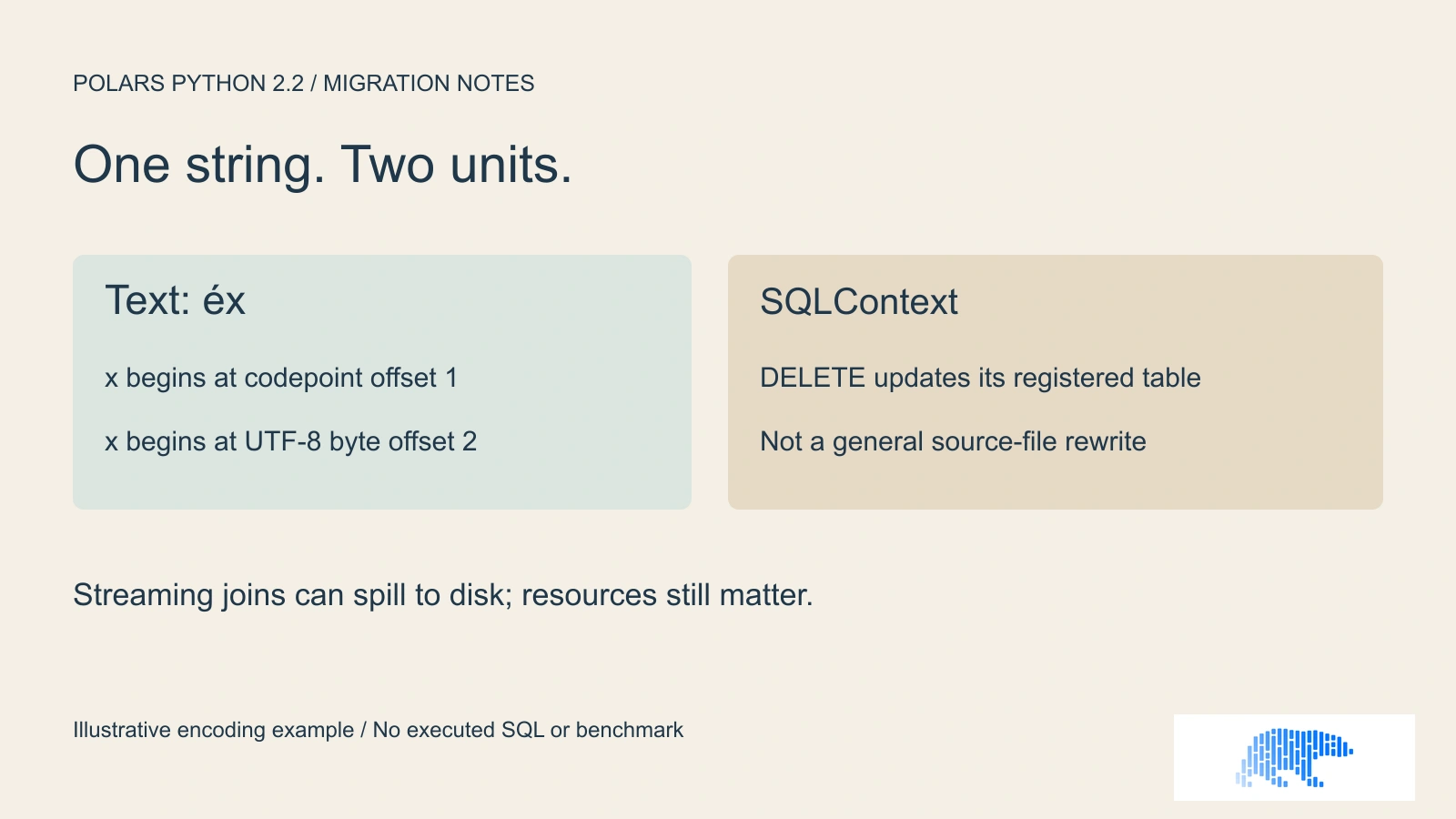
The string-search change makes Expr.str.find and find_many return Unicode codepoint offsets, aligning their unit with string slicing. Code that used these results as UTF-8 byte positions needs review.
For an illustrative example, the letter x in the text éx follows one Unicode codepoint but two UTF-8 bytes. That describes the encoding difference; it is not an output from a test we ran. More complicated text can also contain combining marks, so a codepoint offset should not be advertised as a count of user-perceived characters or grapheme clusters.
New binary find and find_many methods provide byte-oriented searching. Their tagged documentation marks them experimental, meaning compatibility assumptions should be more cautious than for an established stable method.
DELETE now changes the registered table
The SQL change addresses a semantic surprise: DELETE previously returned the rows remaining after filtering without updating the table registered in SQLContext. The new implementation replaces that registered table's plan, so later statements in the context see the remaining rows.
The distinction is about a registered table in that context. It is not a promise that an arbitrary database or source file is rewritten. The implementation rejects a DELETE target that is not a registered table, and its separate catalog path has its own requirements. Applications should identify which object they expect to change before treating SQL-shaped syntax as durable storage behavior.
Out-of-core does not mean resource-free
The streaming equi-join implementation partitions work by hash and can spill data to disk rather than requiring every relevant frame to remain in memory at once. It uses memory grants and partition handling to control the operation's footprint.
That expands the kinds of joins worth attempting on bounded-memory machines. It does not remove memory requirements, disk capacity, temporary-file costs or workload-dependent performance. We have not measured its speed or maximum dataset size.
Our analysis
A productive upgrade review should separate capability gains from changed meanings. A job that previously ran out of memory may benefit from spilling, while a job that already completed can still produce different downstream behavior if it assumed byte offsets or a non-mutating DELETE. Those are different migration questions and deserve different checks.
Our new Polars repository profile provides an in-house route to the upstream code and release. Polars is MIT licensed. This article reviews the tagged implementation and documentation; no datasets were downloaded and no SQL, benchmark or upstream test suite was executed.
EXPLORE THE SOURCE
Projects in this story
GitHub repositories
- pola-rs/polars ↗View project details
Independent primary-source review. No upstream tests, inference, installations, weight downloads or hardware benchmarks performed. Publisher measurements are not independent validation.