
CrewAI 1.15.45, released November 24, includes two credential-boundary changes: additional cleanup when a safe HTTP fetch changes origin, and stricter handling of empty credentials in server authentication. They are targeted implementation fixes, not a claim that every integration has been audited.
A redirect is a new request decision
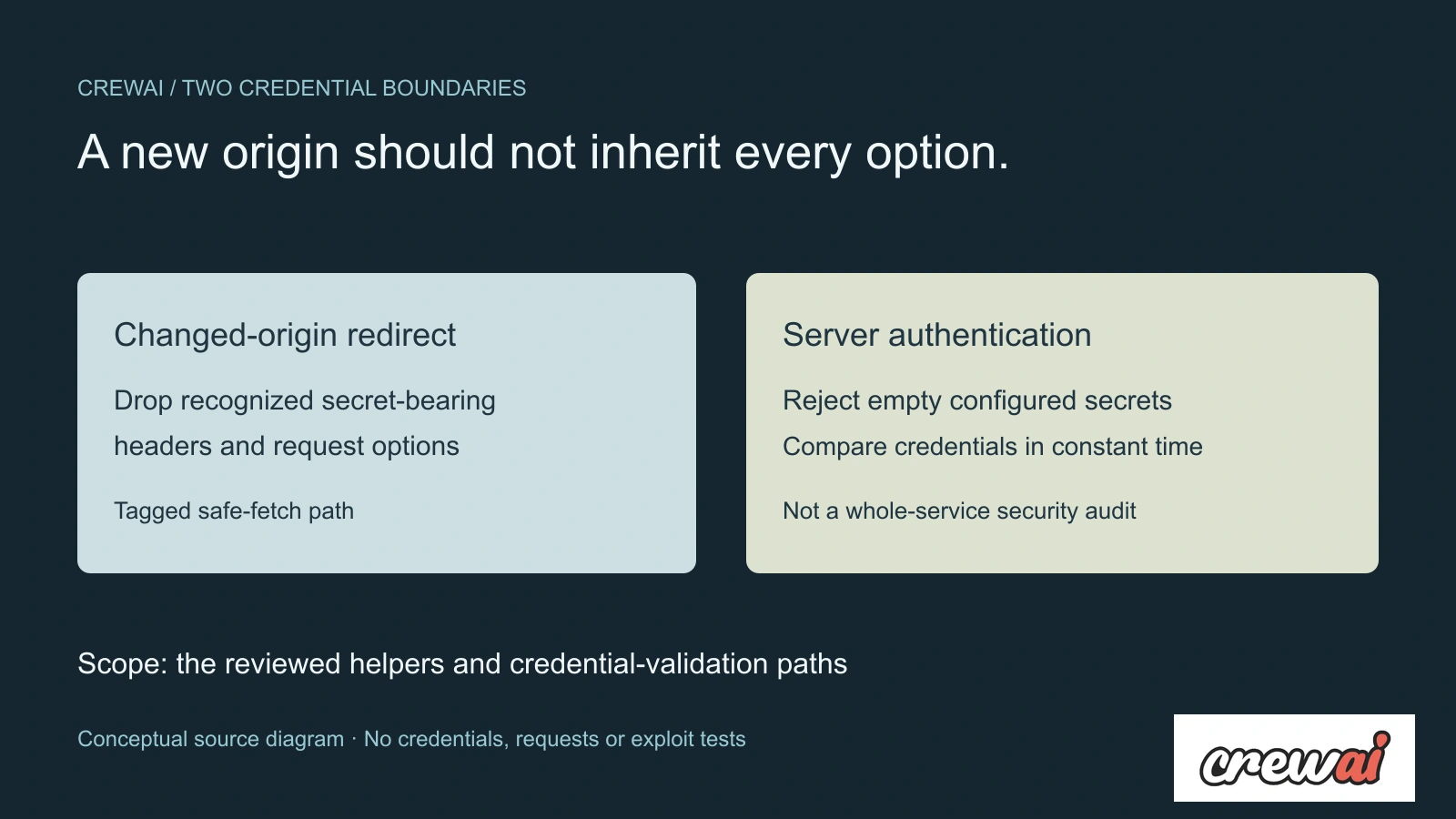
The redirect change concerns the safe-fetch helper's manually followed hops. Request options supplied for the first origin could otherwise be reapplied to a different one, even after some sensitive headers and cookies were removed.
The updated path also removes authentication handlers, TLS client-certificate options, separate query-parameter options and request-body/file options when the origin changes. The tagged source retains non-sensitive headers rather than indiscriminately deleting every header, and validates each redirect target before following it.
That scope matters. It concerns callers using this helper and the options it recognizes; it is not evidence that an arbitrary secret placed in a URL or a custom integration is automatically scrubbed. Same-origin behavior and explicit destination validation remain separate parts of the request flow.
Empty is not an acceptable configured secret
The server-authentication change rejects empty explicitly configured bearer tokens and API keys. It also retains runtime checks so constructing an object outside ordinary validation does not make an empty configured key acceptable.
The simple-token path treats an empty or absent environment token as missing configuration. For the reviewed credential comparisons, the code uses UTF-8-encoded constant-time comparison rather than a normal inequality check.
This is a statement about these comparison and validation paths, not a claim that all request timing is constant or that an entire deployed server is secure. We did not test a real endpoint, send credentials or perform an exploitation assessment.
Why agent tooling needs ordinary boundary discipline
Our analysis: an agent may decide which page to fetch, but the surrounding client still decides which credentials accompany the next request. A redirect can change that destination without looking like a separate action in the agent's plan. Keeping destination checks and credential forwarding explicit reduces the amount of authority silently inherited by later hops.
The empty-secret checks address a different failure mode: configuration that exists structurally but does not contain a usable authentication secret. Neither fix removes the need to review how a service is exposed and which tools an authenticated caller may invoke.
The release also contains other artifact, streaming and schema changes; this article focuses on the credential paths we inspected. We did not establish an active exploitation campaign or assign a new vulnerability identifier.
The reviewed CrewAI source is MIT-licensed. Its existing repository profile links the project. We read the exact release, included commits, tagged helpers and regression tests without installing the package or running the upstream suite.
EXPLORE THE SOURCE
Projects in this story
GitHub repositories
- crewAIInc/crewAI ↗View project details
Original source-reviewed reporting. No software installed, model weights or datasets downloaded, inference, upstream tests, security audit, hardware qualification or cloud deployments performed.