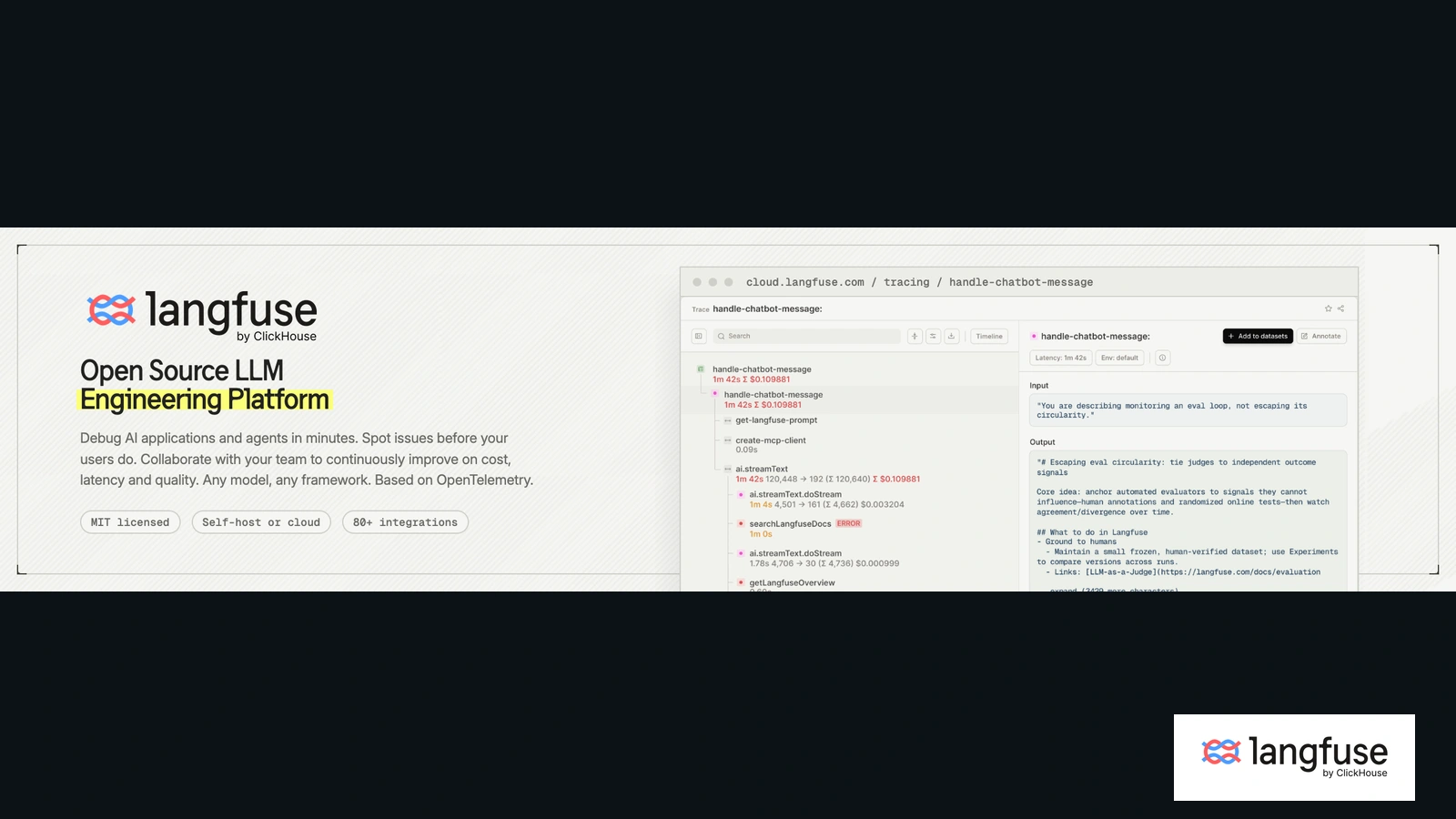

Langfuse 4.88.0, released November 26, introduces organization and instance controls over public trace and session sharing. The important detail is what the switch changes: public access checks, rather than the underlying records' stored sharing flags.
That makes the feature useful for organizations that need to stop link-based access quickly. It also means switching sharing back on can restore access to records marked public before or during the restriction. A temporary restriction should not be confused with permanently making every trace private.
Stored state and effective access differ
The tagged sharing helper checks whether the instance or organization disables public sharing. The reviewed trace and session access paths apply that decision when public flags would otherwise grant access to a non-member. Project members retain their separate membership-based access path.
The merged change explains that ingestion still accepts and stores public flags. The public API continues returning that stored value rather than replacing it with an effective-access summary. A downstream inventory that reads only the flag can therefore miss the organization's active restriction.
Covered read paths include the trace and session checks and the authorized-trace path used by export and IO-stream handling. The code also rejects attempts to make records public while sharing is disabled; unsharing remains allowed. This is a scoped access-control change, not a claim that every possible copy of previously shared information has been revoked or erased.
This is not an unrestricted MIT feature
The organization setting requires the relevant entitlement to turn the restriction on. The reviewed entitlement definitions cover specified paid cloud and self-hosted plans. An already-saved restriction remains effective after a downgrade, while lifting it remains allowed under the documented design.
The instance-wide environment option additionally checks the self-hosted UI-customization entitlement. Merely setting that variable is not sufficient for an unlicensed instance. Organization updates also require the appropriate organization-update permission and are audit-logged.
Langfuse's root license makes the boundary explicit: the core is MIT-licensed, while specified Enterprise directories have separate terms. The sharing implementation reviewed here sits under an Enterprise directory. Our repository profile preserves that distinction instead of calling the entire release freely licensed.
Why the distinction matters
Our analysis: a reversible organization policy and a stored per-record flag solve different problems. Operators need both an accurate view of current access and a deliberate decision about what should happen when a restriction ends. The re-enable confirmation is consequential because the system retains those earlier sharing decisions.
We inspected the exact tagged helpers, entitlement definitions, access paths, export handling and merged-change description. We did not change an organization's sharing settings, inspect private traces, test a paid entitlement or perform an independent security audit.
EXPLORE THE SOURCE
Projects in this story
GitHub repositories
- langfuse/langfuse ↗View project details
Original independent source review; no upstream tests, training, inference, benchmarks, model weights, datasets or software installs performed. Publisher results are not our measurements.