
Instructor 1.18.0, published November 26, brings together a substantial set of structured-output correctness changes. One particularly practical part concerns what developers leave behind while debugging: request options, raw provider responses and disk-cache contents have different controls.
The fixes discussed here were merged earlier in November and are present in the reviewed release. Their inclusion in a new release is not evidence that a newly discovered attack occurred on November 26, or that every application using Instructor previously exposed credentials.
Debug information without the entire request
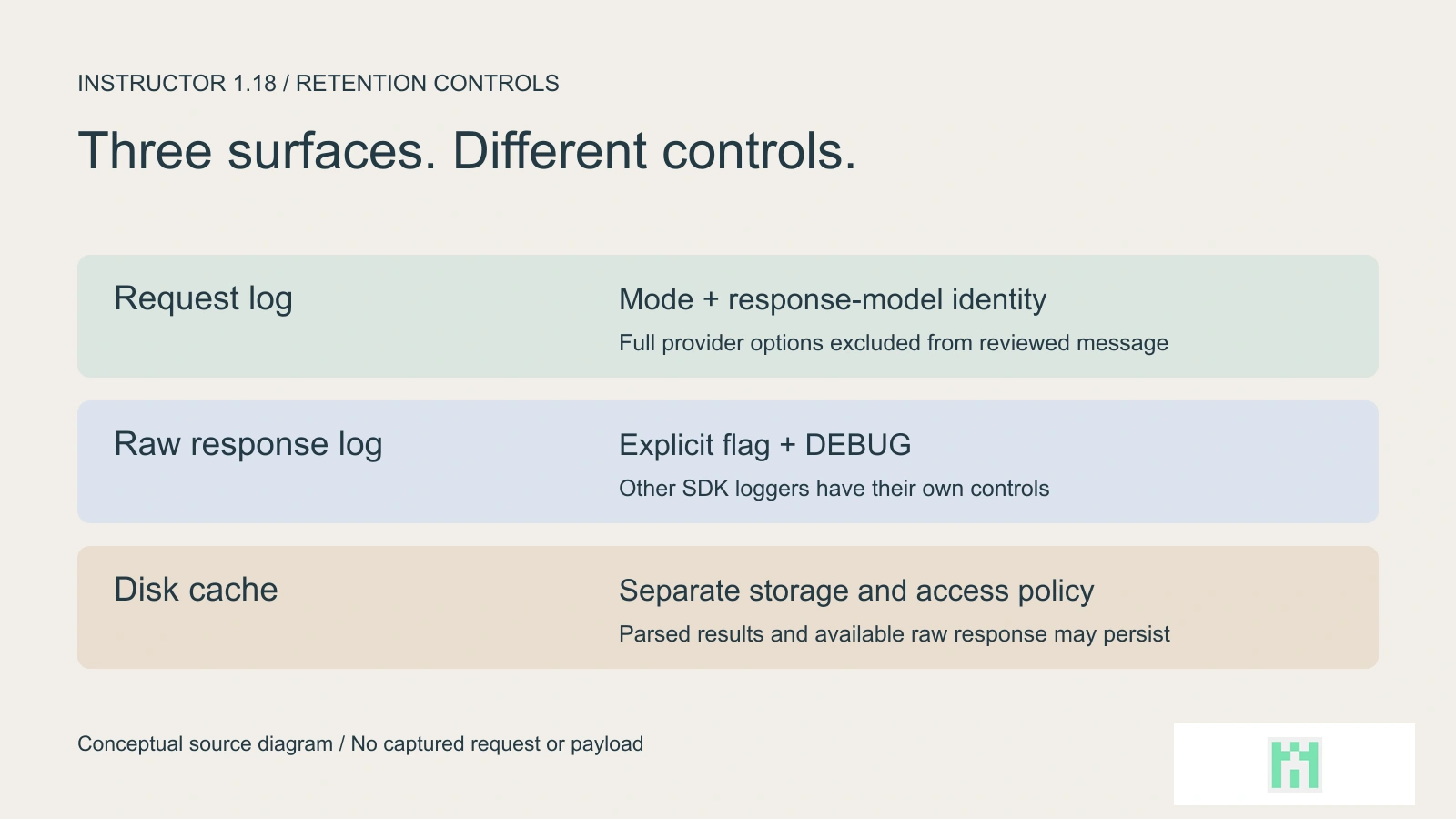
The tagged response-processing source logs the request mode and response-model name. Its structured log fields follow that same narrow scope rather than copying the full provider-option dictionary. The merged request-logging change explains the concern: custom authentication headers or cookies in those options could otherwise reach log storage.
That distinction matters because changing the printed message alone would not necessarily remove sensitive information from a structured record. A log collector may ingest the record's extra fields even when the console looks harmless. The reviewed path now retains useful request identity without treating provider options as routine diagnostic data.
Raw responses are a separate opt-in
The sync and async response helpers call a small logging helper that checks whether INSTRUCTOR_LOG_RAW_RESPONSES equals 1. Only that opt-in enables the raw-response DEBUG message. The updated logging guide recommends enabling DEBUG specifically on Instructor rather than indiscriminately on the root logger.
This is not a universal redaction layer. Provider SDKs and HTTP libraries maintain their own loggers; an application can still configure those to record headers or payloads. Nor does the flag decide whether data is sent to a provider in the first place. It controls the reviewed Instructor raw-response log messages.
A quiet logger does not make a private cache
The cache API explicitly supports serializing parsed results and an available raw response. Ignoring the example cache directory in the project's Git configuration helps prevent an accidental commit; it does not erase an application's existing cache or establish its access permissions.
Our analysis: structured-output systems deserve the same retention review as ordinary data pipelines. Developers should distinguish information needed to diagnose a schema failure from the full document that produced it, then review the actual logging and cache configuration together. An opt-in flag is useful precisely because these choices should be deliberate.
Instructor's reviewed code is MIT-licensed. Our repository profile links the source. We inspected the exact release, tagged implementation, documentation and merged-change descriptions; we did not execute the upstream tests, capture a request, inspect credentials or audit an installed application.
EXPLORE THE SOURCE
Projects in this story
GitHub repositories
- 567-labs/instructor ↗View project details
Original source review; no upstream tests, inference, training, benchmarks, installs, model weights or datasets downloaded. Research methods are not asserted to be newly available checkpoints.