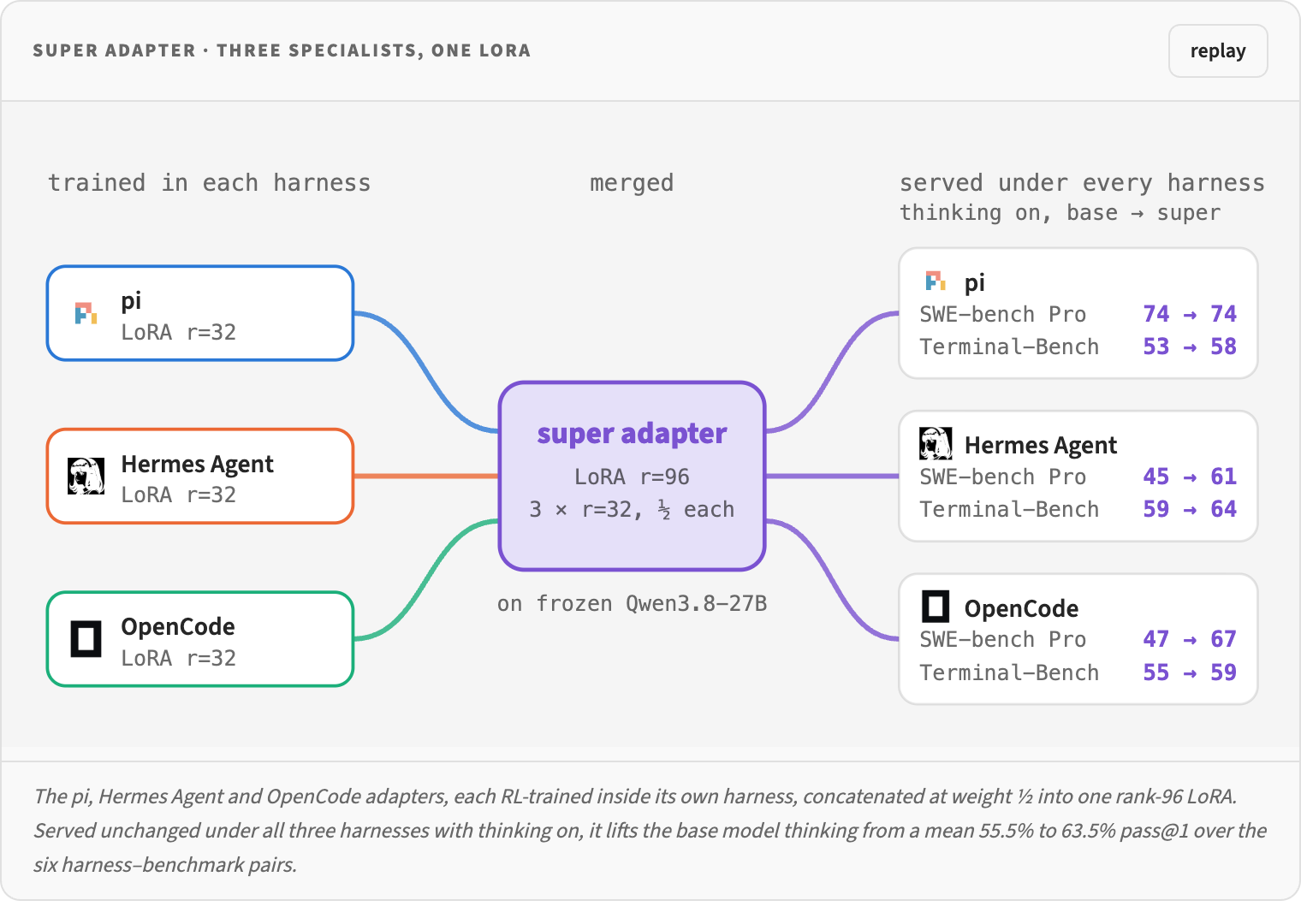

Hugging Face has published a broader harness-adapter recipe and a single merged adapter for Qwen3.8-27B that can run under pi, Hermes Agent and OpenCode. The November 20 report goes beyond the project's earlier November 6 exploration: it documents task filtering, training and cross-harness evaluations, and releases a rank-96 super-adapter assembled from three specialists.
The new report and artifact history establish this as a separate development. The final adapter was released November 20. It depends on Qwen3.8-27B and is not a new standalone foundation model.
The merge has a measurable tradeoff
The team concatenated three rank-32 LoRA updates at half weight, producing rank 96 without an additional training run for the merge. In its thinking-on comparison, the publisher reports mean pass@1 rising from 55.5 to 63.5 percent over six harness-and-benchmark pairs. The merged adapter wins five pairs and ties the sixth.
That average is not a universal coding-success rate. The model card supplies task-level settings and identifies a selection issue: the merge weight was chosen using Terminal-Bench 2.1, making those results somewhat optimistic. SWE-bench Pro was not used for that choice.
The report also finds that a specialist is generally preferable when using one harness with thinking disabled. On a substantially different business-automation evaluation, the merged adapter stays close to the base model rather than showing a clear transfer gain. A useful specialization is not evidence of general improvement everywhere.
Our analysis: evaluate the agent as a system
The harness supplies the model's tools, prompts, context handling and control loop. Training within that environment therefore targets behavior a model-only benchmark can miss. Fewer calls could mean less wasted work, but the useful question is whether the same task finishes correctly under comparable conditions.
It is also easy to mistake fewer calls for a guaranteed speedup. Wall-clock performance depends on the runtime, concurrency and tool latency. The reported efficiency results do not replace an application's own end-to-end measurements.
The public recipe uses TRL for training and a safeagents checking layer for tool calls. A screening layer can block particular attempts without proving that every action is safe. Its permissions and failure behavior remain part of the system to review.
The adapter card declares Apache-2.0; no standalone LICENSE file was present in the artifact listing we reviewed. Our exact adapter profile links that declaration and the existing base-model profile. The card and report differ in some training-task descriptions, so we do not merge their task counts into a claimed exact training dataset here. No weights were downloaded and no benchmark was reproduced.
Original primary-source reporting and labeled analysis. No model inference, installation, API submission, hardware test or independent benchmark performed.