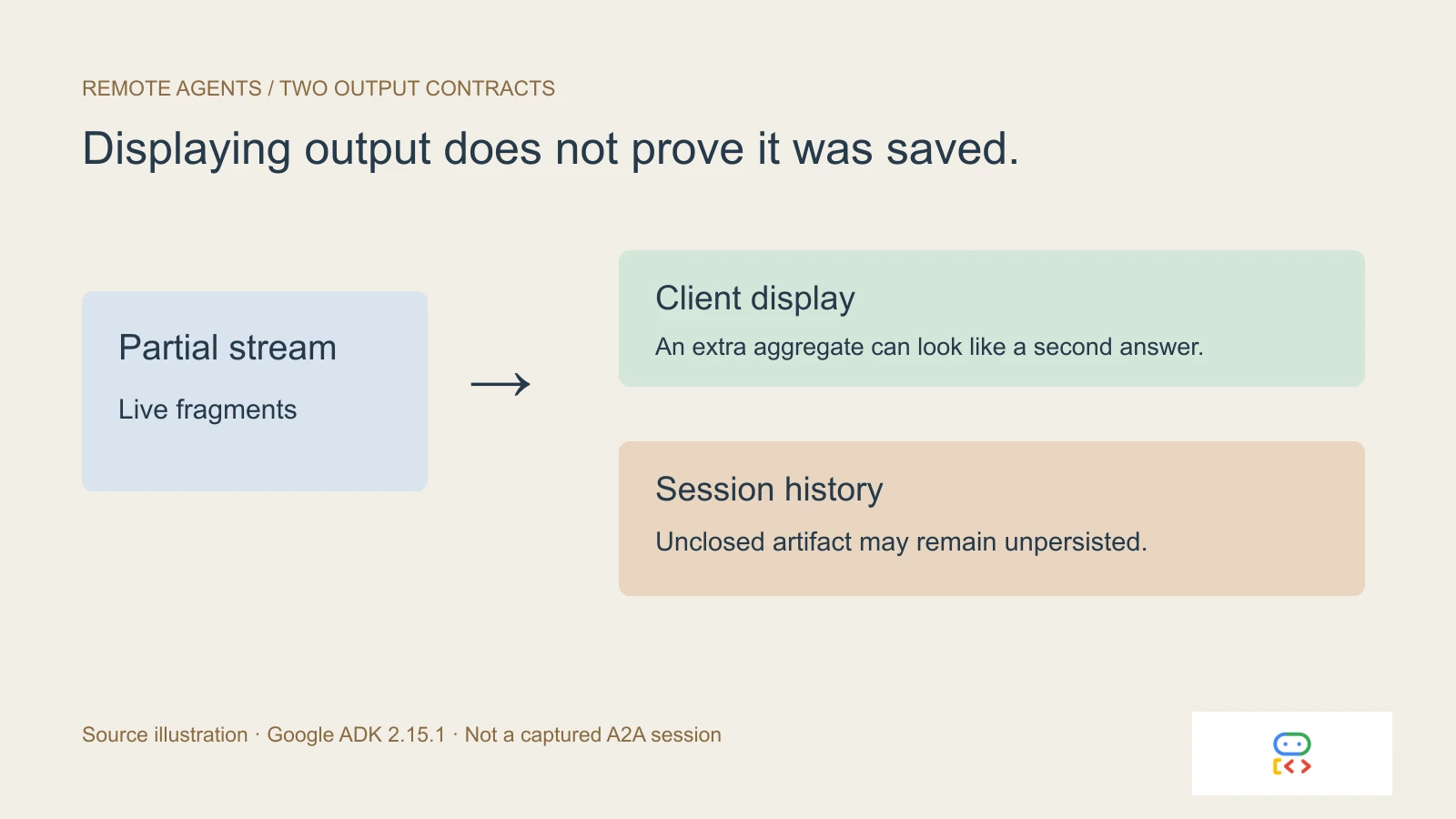

Google ADK 2.15.1, published November 25 UTC and dated November 24 in its changelog, includes an important reversal in remote-agent streaming. A change intended to persist streamed output was reverted because integrations forwarding both partial events and an added aggregate event could display the answer twice.
The actual change description is more specific than a general promise of improved persistence: when streamed artifact output is not closed with a last-chunk marker, the reverted behavior again does not persist that answer to the session. The author describes a follow-up behind a setting; that is not a feature we verified as shipped in this release.
A stream and a stored answer are different contracts
A client can display partial output as it arrives. A session store may instead depend on a non-partial event to retain a completed message. Adding an aggregate message after the partials can repair the storage path while changing what a client sees if it treats every forwarded event as new content.
The reverted implementation collected artifact fragments and flushed pending output at completion boundaries. The tagged replacement removes that aggregation path. Reading the release's short description alone would miss the compatibility reason and the persistence limitation that returns with it.
This is why a terminal task state, an artifact's closing marker and the message rendered by an interface should not be treated as interchangeable signals. A completed remote task does not automatically demonstrate that every streamed artifact has been retained in the local session history.
What an integration needs to verify
The relevant boundary is the complete remote-agent path: which partial events reach the interface, which event closes the artifact, and what remains after a session is loaded again. Checking only the live display can miss a storage gap; checking only stored text can miss a duplicate live answer.
We inspected the merged change, its test changes and the exact release-tag remote-agent source. We did not open an A2A connection, execute those tests or reproduce the duplicate-output scenario. The article therefore describes the reviewed implementation and reported regression, rather than claiming an independent interoperability result.
Our analysis: a compatibility revert can be the right immediate response without resolving the original design problem. Here, the useful lesson is to define how live deltas become a durable answer and how a consumer recognizes that transition. An undocumented extra final message is not a neutral change for every client.
The release also contains other integration fixes, but this article focuses on the verified streaming reversal. It is separate from our earlier 2.15 coverage of the visual builder and reliability evaluation.
ADK is Apache 2.0-licensed. Our repository profile links the source. No installed agent, credential, conversation or shared inference service was changed.
EXPLORE THE SOURCE
Projects in this story
GitHub repositories
- google/adk-python ↗View project details
Original primary-source-reviewed reporting. No model downloads, installations, inference, database/robot tests, security exploitation, upstream test execution or service changes performed.