
CrewAI 1.15.44 adds opt-in artifacts for retaining outputs as named, versioned files. The November 19 release also changes file handling, including a symlink-containment repair whose exact scope matters.
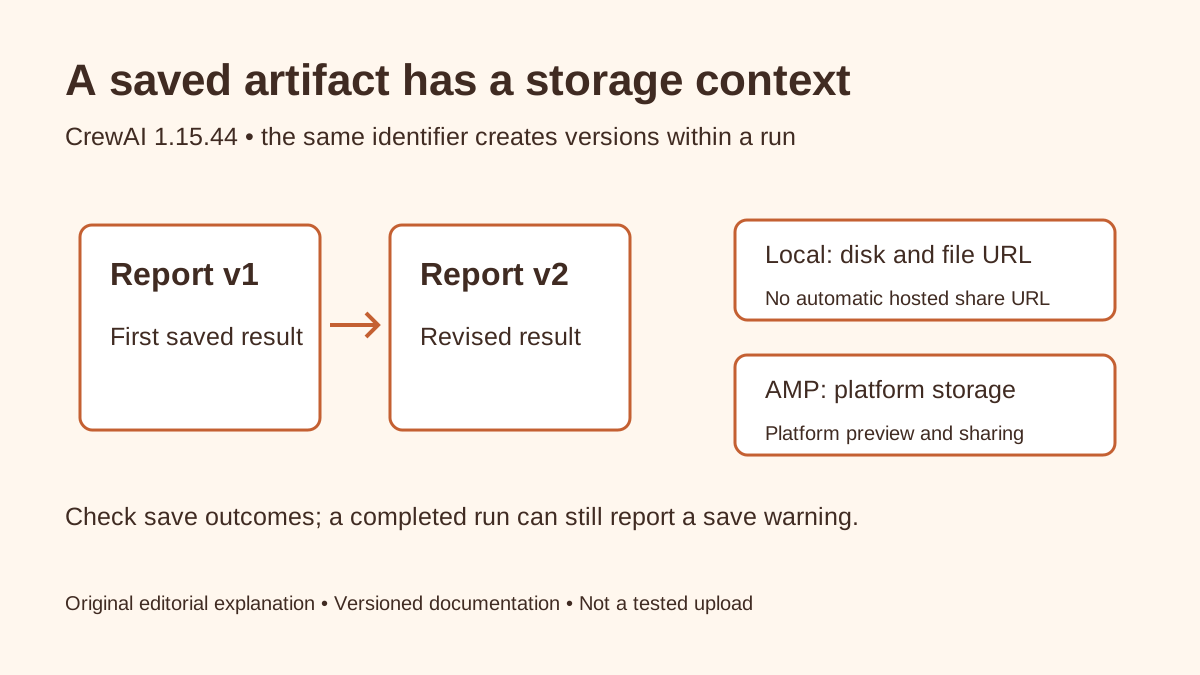
The versioned artifact guide describes reports, charts and other files identified within a run. Saving the same identifier again in that run creates another version. Tasks and agents can be configured to save their final output, tools can save artifacts, and application code can call the storage functions directly.
A local artifact is not automatically a public link
Locally, the guide says artifacts are stored on disk and receive file URLs with an empty share URL. On CrewAI AMP, the platform supplies its own store so files can appear alongside the run for preview, download and sharing. These are different delivery environments, not a promise that every local save produces a hosted page.
The same guide documents different failure behavior across entry points. A configured task save can log a warning while the run finishes, whereas a direct call from application code raises the error. Applications that depend on a delivered report need to check the save outcome instead of assuming a completed run proves the file is available.
The file-path repair has a narrower boundary
The reviewed patch and tests address symlinks in files or parent directories and replace a string-prefix check with a path-relative check. This handles a sibling-directory case that can fool a simple name-prefix comparison.
However, an upstream test explicitly permits an ordinary absolute path outside the working directory. The change should therefore not be described as making every FilePath read stay inside that directory, or as an independently audited sandbox. This conclusion comes from reading the patch and its test expectations, not from running an exploit.
Our analysis: persistence and permission are separate
Versioned outputs make it easier to revisit a result after feedback. They also make it more important to define where that result is stored, who can retrieve it and what constitutes a successful delivery. Version numbers alone do not establish retention, access policy or a backup strategy.
File-boundary claims deserve the same specificity. A repair can be useful without enforcing every restriction a reader might infer from a release summary. Reviewing the tested cases is a practical way to keep that distinction clear.
Our repository profile links the MIT-licensed source. We did not install the update, save a file through it, create an AMP account or independently validate its security behavior.
EXPLORE THE SOURCE
Projects in this story
GitHub repositories
- crewAIInc/crewAI ↗View project details
Primary-source review and original editorial analysis. No software installation, model inference, API call, security validation or independent benchmark performed.