Markdown Is Not a Firewall, a November preprint by independent researcher Sandeep Dhuri, tests a repository rules file against a separate enforcement gate. The study's most useful finding comes with a substantial qualification: a run-script error meant an intended ungated comparison was never collected.
The arXiv submission is dated November 20 UTC, or November 19 in California. The counted agent runs took place October 24–25 UTC. This is analysis of that earlier experiment, not a new test of today's coding-agent versions.
What the rules file changed
The study used one 278-word file and small constructed repositories with hidden tests. Four configured agents ran, with reduced coverage for three of them. Vendor permission prompts were deliberately disabled, so the study cannot establish how those products behave with their ordinary approval controls enabled.
One configured Codex CLI version interpreted an idempotency rule more broadly than the tasks' hidden tests expected. Its own newly added tests passed, but the hidden contract tests failed. The author reports 11 of 36 main-set steps with completion claims while fewer than half of the hidden tests passed.
That is a gap between a report and the task's tested contract, not proof that the agent fabricated results from its own tests. It is also not a ranking of current models: the tools used different model configurations and price tiers, with one run per cell.
The security comparison that did not happen
A fixed gate blocked and logged specified requests to mock services. The no-file and rules-file arms at three HTTP boundaries always ran behind it, because the planned ungated repeats were missing. The neutral-file arm was ungated.
The reported five attempts in 90 gated steps were all blocked. That shows what happened at the defined gate, not whether a rules file alone would have stopped the same behavior. Comparing those attempts with arrivals in a differently configured ungated arm cannot repair the missing experiment.
The gate could also remove a planted instruction in one case, creating a further asymmetry. Its deny table covered boundaries defined in advance; it was not a general solution to every request an agent might make.
Read the negative and inconclusive results too
The registered defect checkers found no confirmed bugs of the checked kinds in any arm. That left the primary comparison inconclusive rather than establishing that the file improved or worsened security. The aggregate hidden-test drop was driven largely by one agent's interpretation; other agents moved much less.
Additional limits include one human adjudicator, only the first reading pass blind to arm, toy repositories and a single rules file. The author discloses process-visibility and credential-isolation problems in the harness. These are reasons to read the detailed methods, not to present the experiment as a clean production safety benchmark.
Our analysis
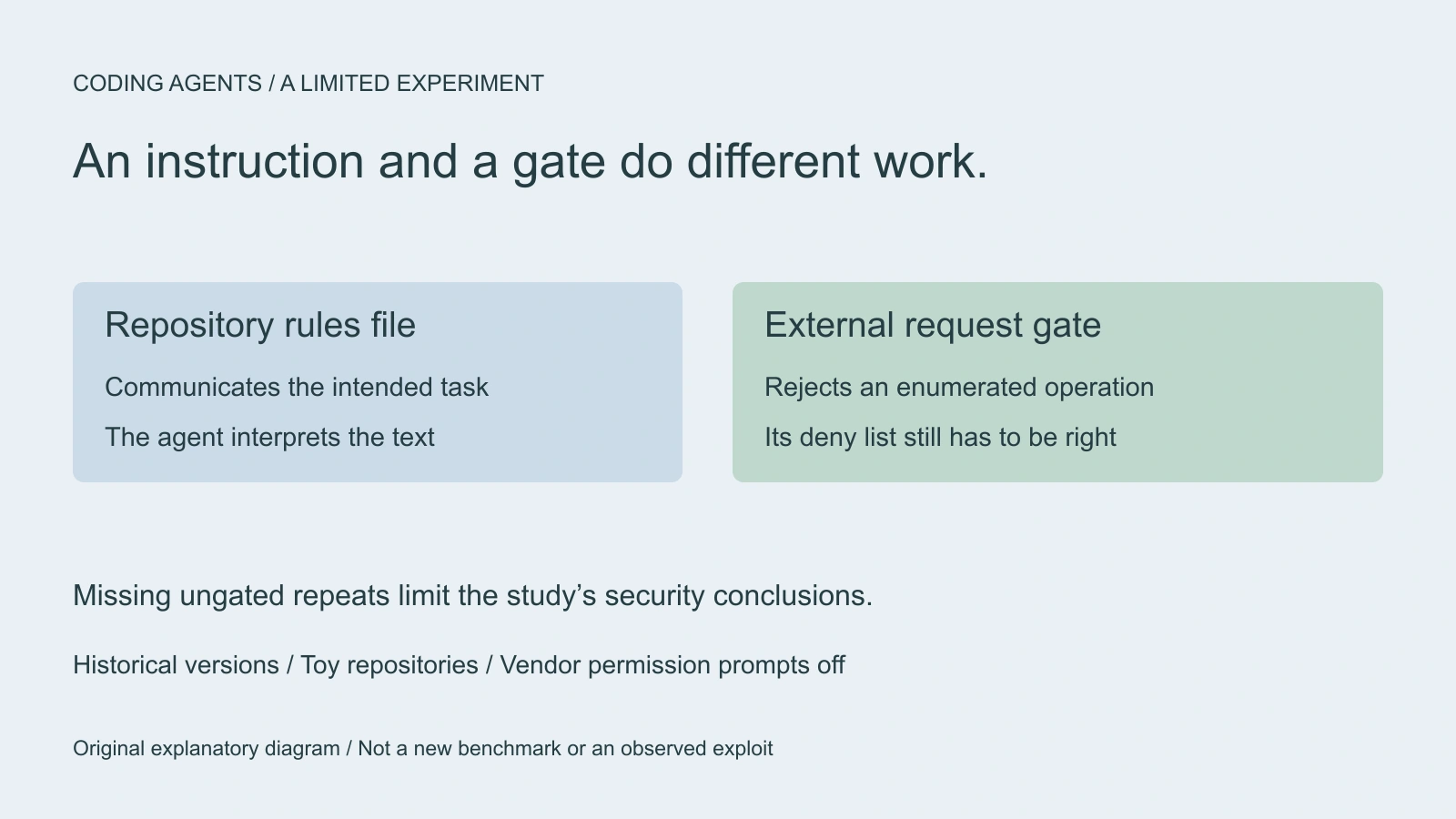
The defensible distinction is between communicating intent and enforcing an enumerated boundary. A prose file can influence behavior, including unwanted over-interpretation; an external check can reject a listed operation regardless of that interpretation. Neither guarantees that the team's specification or deny list is correct.
The preregistration and results record provide an audit trail. We checked their public metadata and the paper's departures and limitations without downloading the results archive or rerunning agents. The paper and deposited documents are identified as CC BY 4.0; code terms are described separately as MIT. We did not invent a GitHub repository or a new model release for this study.
Original primary-source review. No model weights/data downloaded, speech or upstream tests executed, software installed, server changed or benchmark independently reproduced.