
Anthropic's Python SDK 2.14.0, released November 24, corrects proxy selection in its default synchronous and asynchronous HTTP clients. An explicit proxy now takes precedence over proxy environment variables, while disabling environment trust prevents those variables from supplying proxy routes.
This is an integration detail with a concrete operational consequence: a host previously bypassed because of NO_PROXY can now travel through an explicitly configured proxy. Teams relying on that combination should review the intended route rather than assuming an upgrade leaves it unchanged.
Which setting wins?
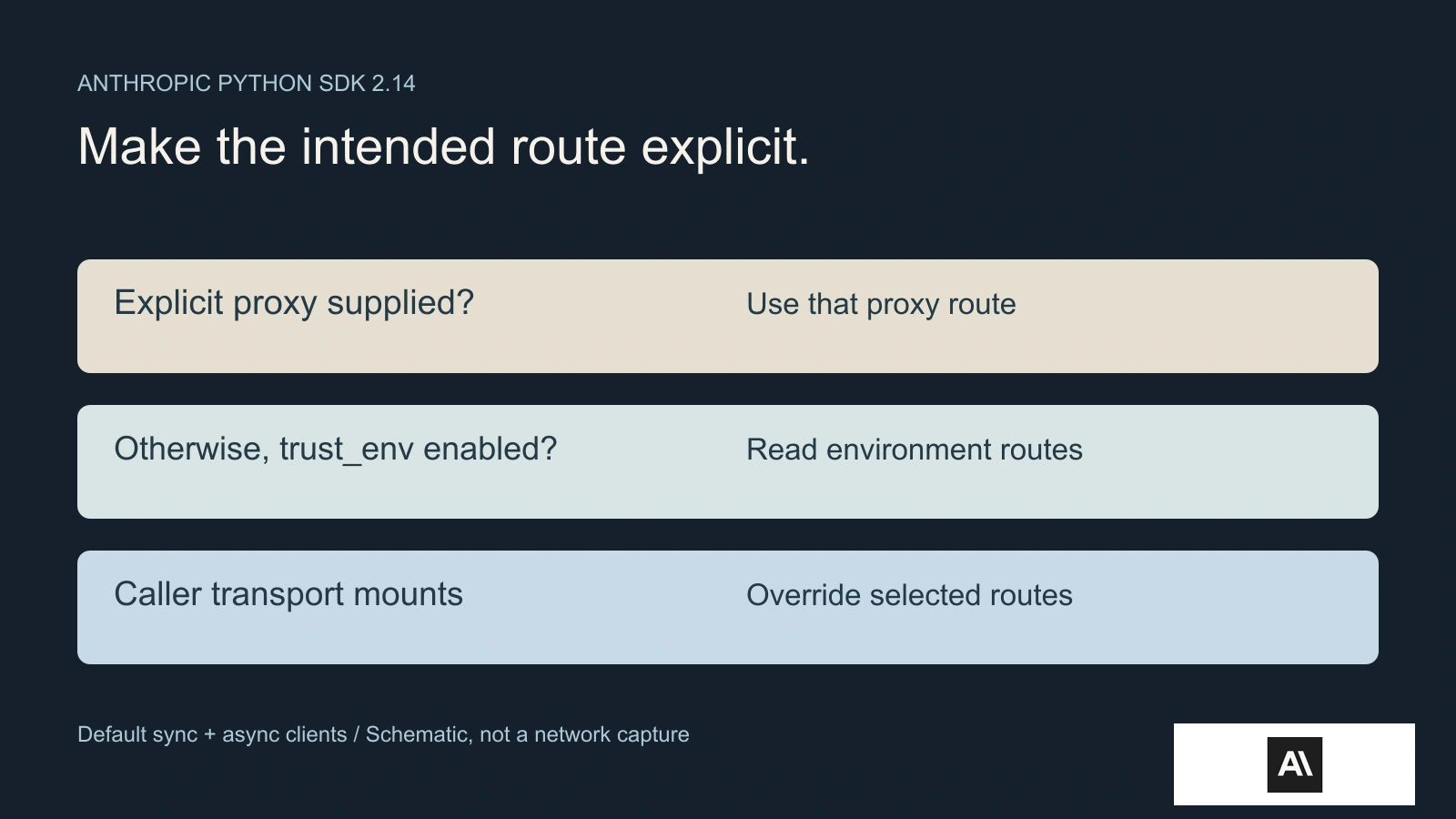
The tagged default-client implementation first checks for a non-null explicit proxy. It builds that route when supplied. Only otherwise, and when trust_env permits it, does it populate routes from environment variables. Caller-provided transport mounts are then applied with higher precedence.
The release notes identify the affected environment settings as HTTP_PROXY, HTTPS_PROXY, ALL_PROXY and NO_PROXY. Previously, these could override caller intent even when a proxy argument was present or environment trust was disabled. The new selection separates explicit configuration from inherited process settings.
A bypass should be explicit too
For a host that must bypass an explicit proxy, the release recommends a host-specific mount whose transport is None. That is a client-routing choice, not an authorization policy or a claim that bypassing an organization's proxy is appropriate. Whether a request should use a proxy remains a deployment decision.
The tagged regression tests parameterize both default client classes. Cases include environment-only routing, an environment exclusion, disabled environment trust, conflicting explicit and inherited proxies, and caller mounts. We read that coverage; we did not run it or contact a proxy.
The implementation also accepts custom HTTP transports. Findings about this default-client path should therefore not be generalized into proof that every application wrapping the SDK has identical routing behavior. An organization's service mesh, gateway or custom client can introduce additional decisions outside this change.
Why this is more than a connectivity fix
Our analysis: inherited environment configuration is convenient until it silently outranks an application's documented settings. Explicit precedence makes behavior easier to reason about, but it also exposes assumptions previously hidden by a bug. A successful API response alone cannot establish which route carried it or what that route retained.
The release also adds API types for Google-managed data controls and compliance review resources; those additions are separate from the proxy correction and do not establish an account's eligibility or compliance. The reviewed SDK is Apache 2.0-licensed. Our repository profile links upstream. No credentials, network configuration, installed SDK or service was changed during this reporting.
EXPLORE THE SOURCE
Projects in this story
GitHub repositories
- anthropics/anthropic-sdk-python ↗View project details
Original source review; no upstream tests, inference, training, benchmarks, installs, model weights or datasets downloaded. Research methods are not asserted to be newly available checkpoints.