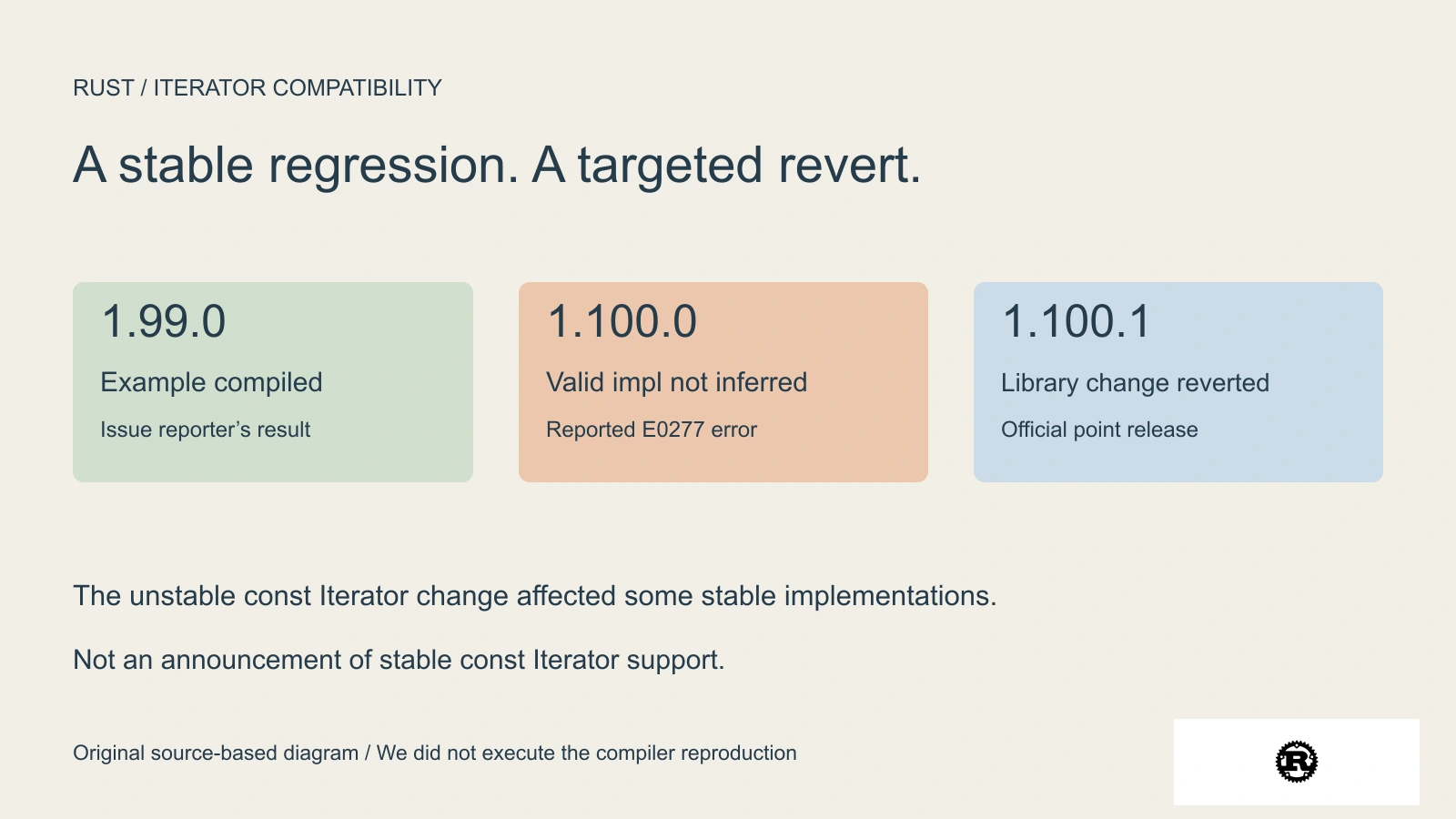

Rust 1.100.1, announced November 27 by the Rust Release Team, fixes a regression in which some types with valid Iterator implementations were no longer recognized as implementing that trait. The team says the problem came from a change to the unstable const version of Iterator in 1.100.0.
That is an important compatibility distinction. Stable users did not need to opt into the unstable feature to encounter the consequence. A change intended for one language capability affected how existing code was checked.
The failure looked like a missing trait bound
The linked issue report provides a dependency-free reproduction distilled from objc2 code. It defines iterator behavior through associated types and Deref, with additional iterator implementations depending on those relationships.
The reporter says the example compiled on 1.97.0, 1.98.0 and 1.99.0, but failed on 1.100.0. The diagnostic appeared on overridden nth and nth_back methods, while next and next_back were accepted. The error suggested adding further Iterator restrictions even though the intended implementation was already valid.
Those observations are the report's reproduction results, not compiler runs we performed. Its reported host was Apple Silicon macOS; that should not be interpreted as a guarantee that the underlying language issue affected only that platform.
A targeted revert, not a new stable feature
The release team's explanation is narrower than a general claim of improved type inference. Rust 1.100.1 reverts the problematic change to the unstable const Iterator implementation so existing stable code can again be recognized correctly.
In the tagged library source, nth again carries the non-const trait-method marker, and its default implementation advances the iterator before obtaining the next item. The fix is not an announcement that const Iterator has become a stable capability.
For a project that suddenly develops these diagnostics after a toolchain change, the compiler version is therefore relevant evidence. Rewriting trait bounds solely to satisfy an unexpected diagnostic can obscure the distinction between a source-code defect and a regression in the toolchain checking it.
Our analysis
The broader lesson is about compatibility testing around generic interfaces. A library change can be small in its own diff while affecting downstream implementations through associated types and method requirements. Testing only simple, direct iterator examples would not necessarily represent that interaction.
The point release gives affected projects a targeted correction; it does not establish that every build failure introduced alongside 1.100.0 has the same cause. Reports still need their own reproduction and version comparison rather than being assigned to this issue by resemblance.
Our existing Rust repository profile links the source. Rust's root distribution offers MIT or Apache 2.0 licensing, with component notices retained. We reviewed the official announcement, report and tagged library source without installing a compiler, building the example or running upstream tests.
EXPLORE THE SOURCE
Projects in this story
GitHub repositories
- rust-lang/rust ↗View project details
Original primary-source review; no weights/datasets downloaded, models or upstream tests executed, compiler/extension/cloud installed or workload benchmarked. Results are publisher/researcher claims, not independent measurements.