
Redis 8.12, released November 22 as a general-availability version, expands the server's data structures and expiry controls. Compressed bitmaps move into the core, large sorted sets gain a B+ tree encoding, and individual set members can receive their own expiration times.
These changes affect application design as well as storage. The release notes describe memory and speed improvements, but they do not establish a universal savings percentage for a reader's data.
Expiry can apply below the whole-key level
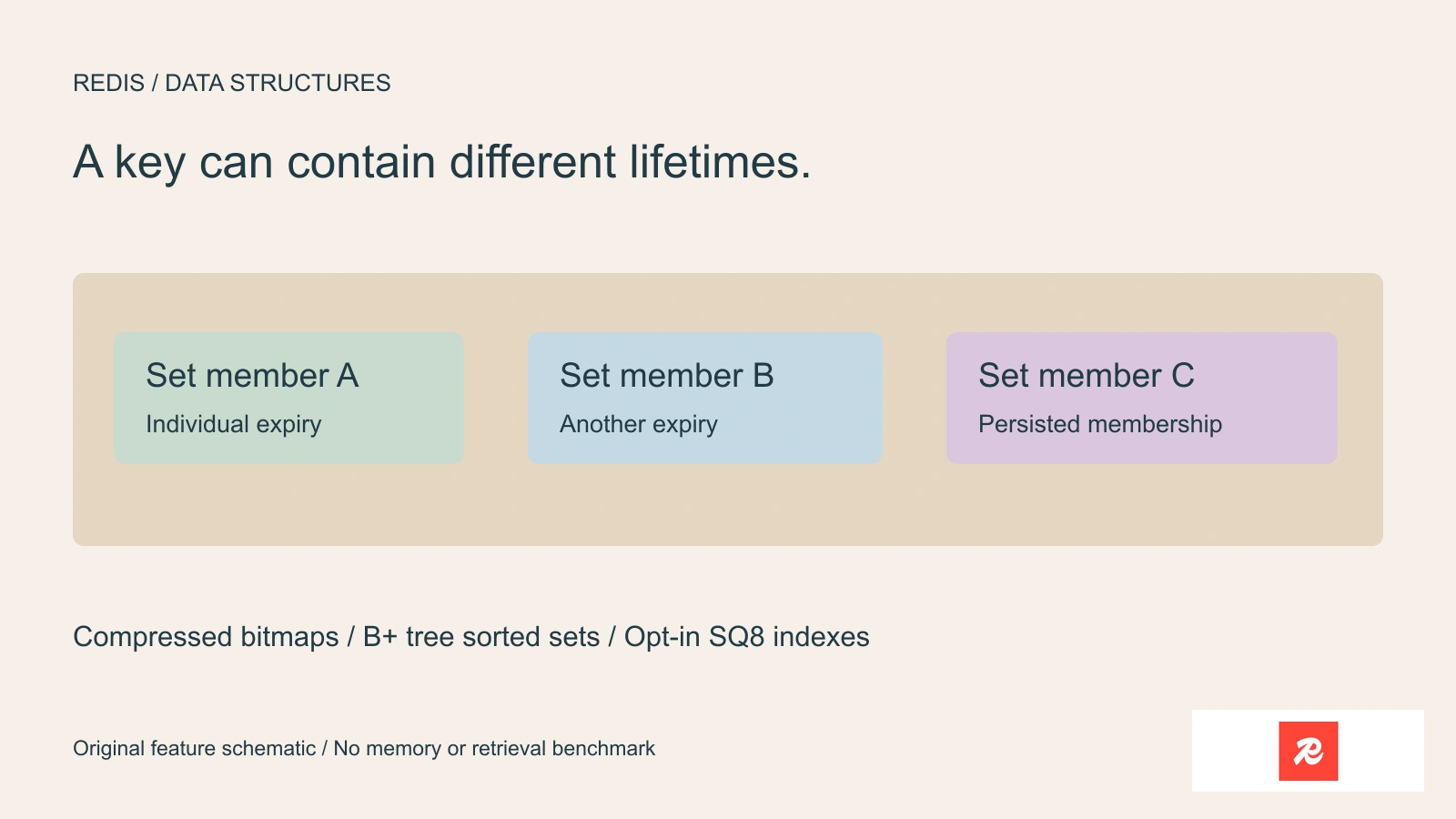
The new set-member command family includes relative and absolute expiry setters, remaining-lifetime and expiry-time queries, and a persistence operation. The tagged SEXPIRE command definition distinguishes missing members, unmet conditions, successful updates and members deleted because their expiry is already in the past.
This is more specific than expiring the entire set key. It gives an application another way to represent memberships whose useful lifetimes differ, although choosing the lifetime and handling concurrent updates remain application responsibilities.
New representations are not one blanket performance result
The maintainers credit the redis-roaring project's creator for the compressed-bitmap contribution. A new range command returns set-bit offsets, while the sorted-set change uses a B+ tree representation for large sets. Whether either helps depends on the shape of the data and the operations used.
The release also adds atomic sorted-set moves and extends count-min-sketch functionality. We have kept these separate from bitmap compression: support for several structures does not mean that all existing keys are transformed into the same representation or gain the same memory benefit.
For vector retrieval, SQ8 compression is opt-in for HNSW indexes. Query-engine changes include avoiding unnecessary document reindexing during some schema additions and additional hybrid-query score and timeout behavior. These are database features, not new embedding-model releases or independently measured retrieval-quality gains.
The exact version's license matters
The tagged license file offers a choice of RSALv2, SSPLv1 or AGPLv3 for Redis 8 code. The AGPLv3 option provides an open-source route, with its own obligations; the alternatives should not be labelled as the same permissive license. This is also distinct from the BSD terms associated with older Redis releases.
Our analysis
The interesting direction is giving developers more precise control over what a key contains and how long its components matter. Finer expiry and different storage representations can simplify some application designs, but the value comes from matching them to actual access patterns.
Our Redis repository profile links the exact project and makes the licensing choice visible. We reviewed the release, tagged source and command metadata without installing Redis, migrating data, running a benchmark or asserting a production memory reduction.
EXPLORE THE SOURCE
Projects in this story
GitHub repositories
- redis/redis ↗View project details
Original primary-source reporting. No upstream software installed, tests executed, datasets or weights downloaded, server settings changed, or performance independently measured.