
OpenHands Software Agent SDK 1.64.1, released November 25, fixes an operational mismatch: an agent server can appear idle while a parent run is waiting for useful delegated work. The update refreshes its activity signal during an active run rather than relying only on visible events.
Silence is not always inactivity
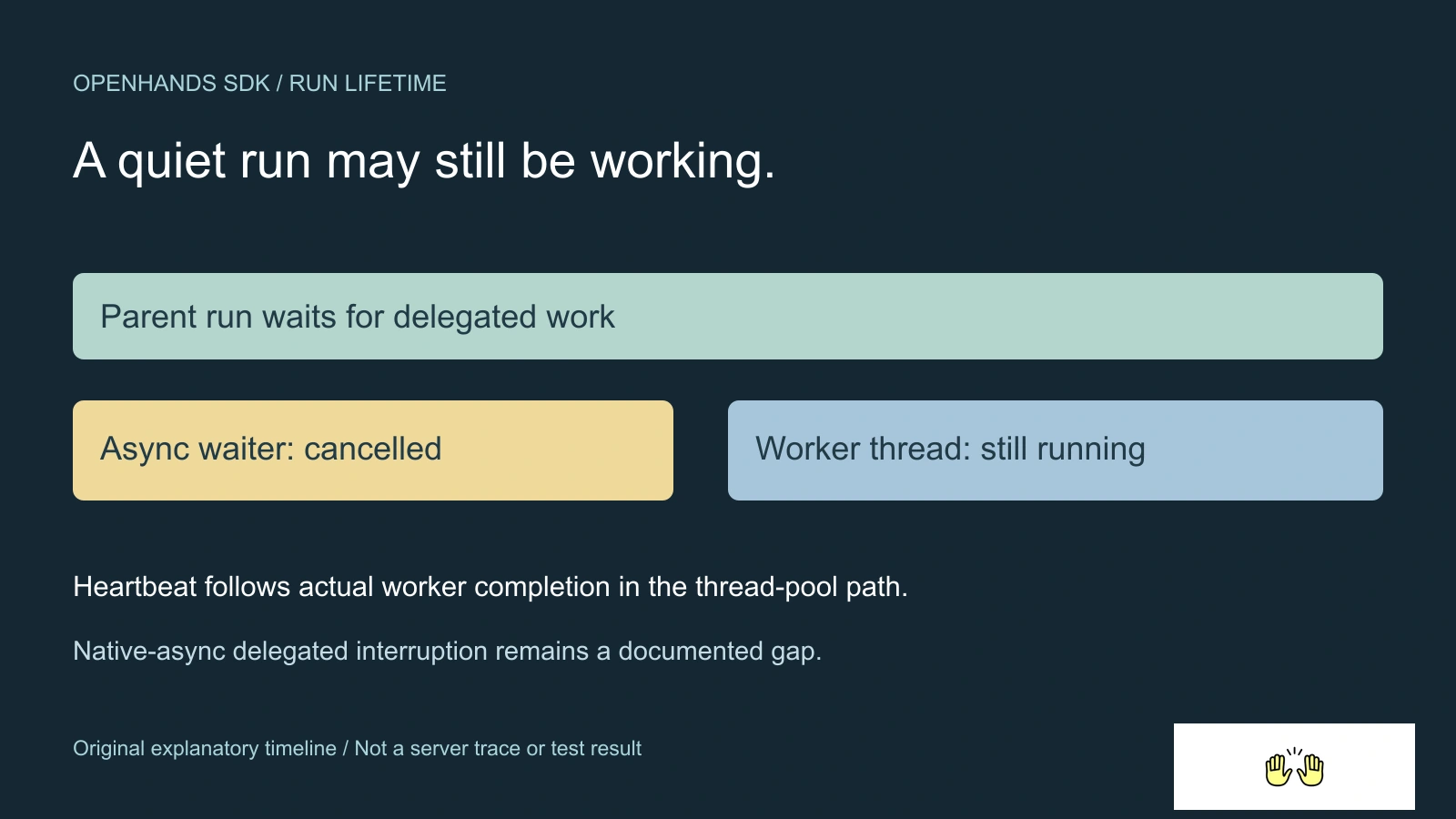
The included change describes a parent waiting for a Task child that has its own conversation and event stream. The parent may emit no durable events and receive no HTTP traffic during that wait. An idle-based runtime manager can therefore see an increasing idle time while work is still happening.
The tagged implementation adds a periodic run-level pulse using the existing activity-signal interval. It updates execution activity until a stop event is set. This is accounting for ongoing work, not making the child generate faster or disabling every possible infrastructure timeout.
The lifetime must follow the work
In the legacy thread-pool path, cancelling the asynchronous waiter does not necessarily stop its underlying worker. The heartbeat is tied to the worker future's completion callback, so the waiter ending does not by itself make still-running work appear idle.
A follow-up included in the release adds regression coverage for that cancellation case. It changes tests rather than introducing a second production mechanism. The maintainers describe checking that the heartbeat remains active while the worker runs and stops once it exits; those are their checks, not tests we executed.
The native async path has a different documented caveat. An interruption can stop its heartbeat while a Task or Delegate dispatch thread continues because its interrupt operation does not yet terminate that work. The source explicitly leaves that cancellation problem outside this fix. The release should not be presented as solving all orphaned-task or pause races.
Why this matters for operators
An active-run signal affects the tradeoff between suspending unused environments and interrupting a long task. Making the signal more faithful helps that decision, but it also makes correct cleanup important: a heartbeat that outlives real work would hide genuine idleness and could keep infrastructure allocated unnecessarily.
That is why the distinction between task completion, waiter cancellation and worker completion matters. They can look identical at a high level while requiring different cleanup behavior inside the server.
Our analysis
This is a useful reliability release precisely because its scope is narrow. It addresses one observable cause of incorrect idle reporting and supplies a clearly stated remaining gap. Operators should assess the behavior of their execution path and runtime manager instead of assuming a package version alone establishes a complete lifecycle guarantee.
Our new OpenHands SDK repository profile links the source separately from the larger OpenHands application. Its code is MIT licensed; model services and hosted runtimes retain their own terms. We inspected the exact tag, implementation and regression changes without installing the SDK, running its tests or creating cloud resources.
EXPLORE THE SOURCE
Projects in this story
GitHub repositories
- OpenHands/software-agent-sdk ↗View project details
Original primary-source review. No upstream tests, experiments, model inference, training, dataset or weight downloads, installations or cloud provisioning performed. Published results remain author/provider claims.