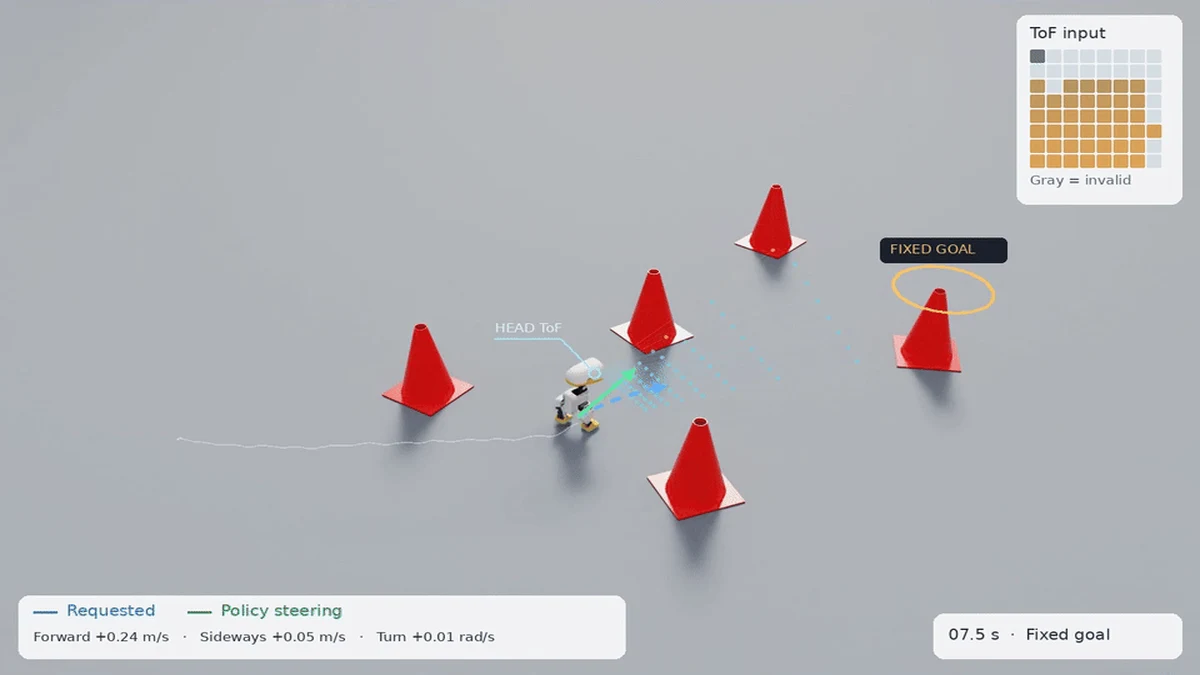
NVIDIA engineers Oluwaseun Doherty, Oyindamola Omotuyi, and Richard have published an end-to-end simulation-to-reality robotics guide detailing how to add local obstacle avoidance to the Microduck bipedal robot without retraining its core walking controller. Detailed in a technical walkthrough on Hugging Face, the workflow combines the open-source NVIDIA Isaac Lab framework with the Newton physics simulator to train, evaluate, and prepare a time-of-flight navigation policy for physical hardware.
Modular Sim2Real Scope and Fixed-Policy Design
Balancing a two-legged robot and steering it around cluttered environments are typically coupled problems, yet retraining locomotion from scratch whenever a new sensor or navigation objective is introduced increases compute cost and instability. NVIDIA's Microduck workflow avoids that coupling by locking the weights of an existing walking policy—sourced from the upstream IsaacContrib-Velocity-Rough-MicroDuck task with the backlash preset—and training an independent obstacle-avoidance controller on top of it.
In operation, a human operator provides directional intent through a paired gamepad, and the learned navigation controller intercepts and modifies those forward, lateral, and yaw velocity commands before forwarding them to the frozen walking policy. This separation lets robotics developers iterate on spatial perception and path adjustment using randomized OpenUSD courses—mixing geometric primitives and cones with pinned SimReady assets such as cardboard boxes, office bins, and bedside cabinets—while preserving verified bipedal balance behavior.
Decoupled Control Architecture and ToF Sensor Modeling
Within the experimental exp/microduck branch of Isaac Lab, the IsaacContrib-ObstacleAvoidance-Flat-MicroDuck task lives under isaaclab_tasks.contrib.microduck_obstacle, separating environment settings in obstacle_avoidance_env_cfg.py, sensor configuration in sensors.py, and Markov decision process definitions inside mdp/. Rather than feeding high-resolution RGB video, the system models the compact VL53L5CX time-of-flight sensor via MicroDuckToFCamera, which extends Newton's LegacyMultiMeshRayCasterCamera.
The simulated sensor mirrors the physical hardware's 8x8 depth grid, 45-degree field of view, 0.12-meter to 4-meter range, and 15 Hz update rate (1.0 / 15.0 seconds), mounted along the robot's head body path. While the ToF sensor samples at 15 Hz, the navigation policy adjusts velocity commands at 50 Hz using an asymmetric actor-critic setup trained with rsl_rl Proximal Policy Optimization (PPO). The actor consumes ToF history alongside onboard body and controller states available on a physical Microduck, whereas the critic accesses privileged simulation state solely during training. To bridge the sim-to-real gap, ToFRandomizationCfg injects mount pitch variations between -10.0 and 10.0 degrees, height offsets of plus or minus 0.02 meters, floor validity midpoint shifts up to 0.13 meters, a 0.5 probability of near-floor edge impairment, and zeroed depth clipping.
The reward function reinforces goal progression and safe arrivals while withholding command-following credit unless the robot maintains sufficient obstacle clearance. Penalties target high-speed approaches, abrupt command oscillations, collisions, and falls.
Developer Workflow, Parallel Training, and Deployment Pipeline
For open-source robotics practitioners, the release emphasizes reproducible environment management and scalable GPU parallelization. Developers clone the exp/microduck branch with Git LFS, resolve locked dependencies using uv sync --frozen, fetch pinned nvidia/simready-assets OpenUSD models from Hugging Face, and export the baseline walking checkpoint prior to navigation training.
At training time, the reference configuration runs 16,384 parallel environments for 1,500 PPO iterations on CUDA hardware, automatically shuffling, rotating, and mirroring obstacle layouts—including clear lanes, barriers, passages, and staggered rows—upon each episode reset. Recognizing that not every developer has access to datacenter-scale VRAM, the authors note that --num_envs can be scaled down; they also report training the same task on an NVIDIA DGX Spark system in roughly six hours using 4,096 parallel environments across 3,000 PPO updates.
Checkpoints save as model_<iteration>.pt files under logs/rsl_rl/microduck_obstacle_avoidance_tof_flat_backlash/. From there, engineers replay policies inside the Newton viewer on fresh random seeds to inspect emergent steering behavior before exporting the navigation network to ONNX for execution alongside the physical Microduck's backlash walking policy.
Hardware Prerequisites, Experimental Scope, and Caveats
Despite the streamlined software pipeline, deploying the workflow carries strict platform and hardware constraints. Simulation requires a Linux workstation with a compatible NVIDIA GPU and driver, while physical validation assumes an already-assembled Microduck running the exact matching backlash walking export, a calibrated VL53L5CX ToF sensor with recorded mount parameters, a paired gamepad, and a level obstacle area—leaving uneven terrain and outdoor elevation changes outside this flat-ground task's scope.
Several caveats also apply to the published material. The codebase resides on an experimental Isaac Lab branch rather than a finalized main-branch release, and while Isaac Lab itself is open-source, developers pulling pinned SimReady OpenUSD assets or pretrained checkpoints should verify individual dataset and model licensing terms before commercial redistribution. Finally, the guide explicitly avoids publishing autonomous benchmark tables or success-rate claims, and the available walkthrough documentation stops prior to detailing quantitative outcomes from physical Microduck trials—meaning real-world collision rates and hardware edge-case reliability remain unverified without independent testing.
Automated Vertex AI (gemini-4-hydrogen) primary-source report; reviewed 2026-11-24.


