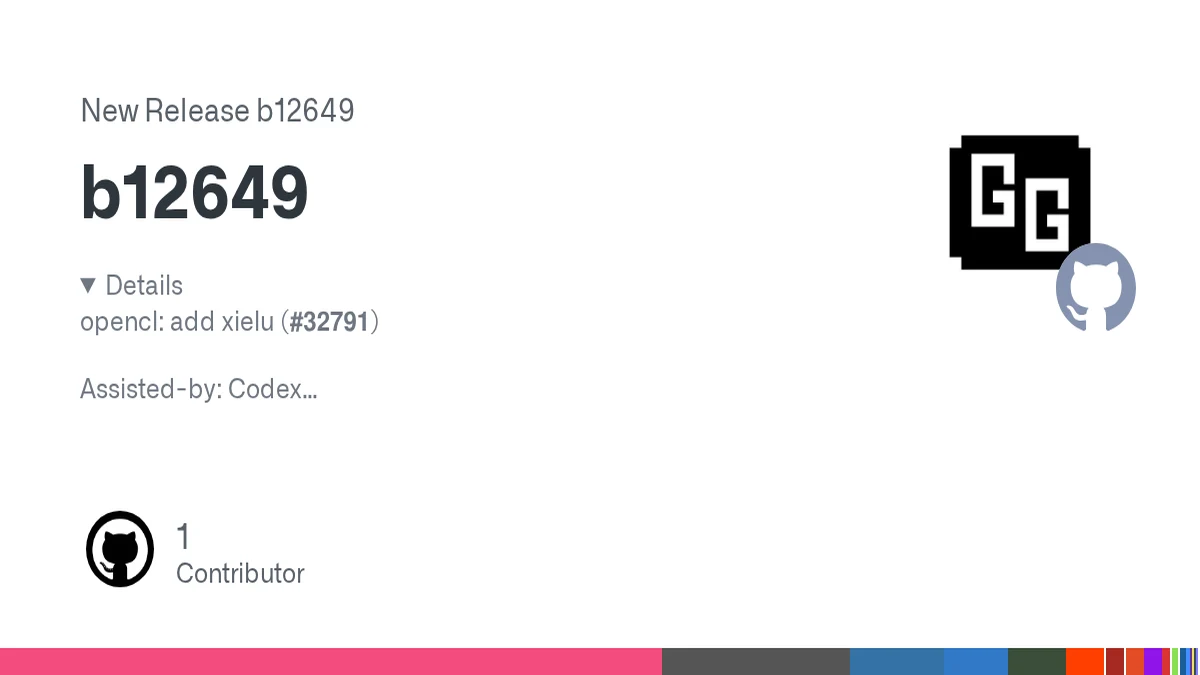
The open-source inference engine llama.cpp released build b12649 on November 23, 2026 at 06:26:55 UTC (late November 22 in America/Los_Angeles), introducing a focused update to its OpenCL backend. Published as a GitHub pre-release by automated workflows under commit 1f8baae, the tag centers on a single documented code change: opencl: add xielu (#32791).
While brief in its release notes, b12649 carries notable engineering and supply-chain signals for developers tracking local model execution. The commit note lists Assisted-by: Codex, points to the project portal at https://llama.app, and pairs a verified GitHub commit signature (GPG key ID B5690EEEBB952194) with published build attestations. For downstream maintainers and local inference users, the release illustrates how incremental backend operator coverage ships alongside a wide cross-platform binary matrix.
Core Announcement and Operational Scope
Release b12649 is scoped strictly around adding xielu support inside the OpenCL backend via pull request #32791. Unlike bundled feature milestones that combine quantization changes, frontend UI revisions, and multiple backend rewrites, this tag isolates a single backend capability addition within the continuous llama.cpp release cadence.
Within the project repository at the time of the release capture, open issue counts stood at 695 alongside roughly 1.9k open pull requests and 13 security and quality items, reflecting high ongoing contributor velocity. Marking b12649 as a pre-release signals that the tag captures an active integration point on the main development stream rather than a frozen stable branch.
Build Matrix, Hardware Targets, and Named Specs
Although the functional change targets OpenCL, the llama.cpp b12649 release page enumerates an extensive multi-architecture artifact matrix across desktop, server, mobile, and accelerator toolchains:
- Windows targets: Windows x64 and arm64 CPU builds; Windows arm64 with OpenCL Adreno; Windows x64 CUDA 12 (with CUDA 12.4 DLLs); Windows x64 and arm64 CUDA 13 (with CUDA 13.5 DLLs); Windows x64 and arm64 Vulkan; Windows x64 OpenVINO; Windows x64 SYCL; and Windows x64 ROCm 10.0.
- Linux targets: Ubuntu x64 and arm64 CPU; Ubuntu 24.04 s390x CPU; Ubuntu 26.04 s390x CPU and zDNN; Ubuntu x64 and arm64 Vulkan; Ubuntu x64 CUDA 12 (with CUDA 12.8 libraries); Ubuntu x64 and arm64 CUDA 13 (with CUDA 13.5 libraries); Ubuntu x64 ROCm 10.0; Ubuntu x64 OpenVINO; Ubuntu x64 SYCL FP32 and SYCL FP16; plus Linux arm64 builds targeting Snapdragon CPU, Adreno GPU, and Hexagon NPU.
- Apple and Android targets: macOS Apple Silicon (arm64), macOS Intel (x64), and iOS XCFramework, alongside Android arm64 CPU and Android arm64 Snapdragon (CPU, Adreno GPU, Hexagon NPU) packages.
Within that matrix, Windows arm64 (OpenCL Adreno) is the explicitly named OpenCL build artifact, making Qualcomm Adreno-equipped Windows on Arm hardware the most direct beneficiary of the prebuilt OpenCL binary pipeline. The release page also lists 40 UI assets and links build provenance to GitHub attestations URL 70965633.
Architecture Visibility and Verification Boundaries
From a strict technical-reporting standpoint, the release tag itself does not publish kernel source listings, memory-bandwidth profiles, or comparative latency benchmarks for the new xielu OpenCL path. No throughput numbers, model-perplexity checks, or device-level regression tables appear on the release page, and no independent testing is implied by the tag metadata.
What is verifiable directly from the primary record is build identity and cryptographic provenance. Commit 1f8baae was created on GitHub and signed with GitHub's verified signature (B5690EEEBB952194), while artifact attestations allow automated verification that packaged binaries correspond to the repository workflow run rather than unverified third-party rebuilds.
Developer and Runtime Workflow Impact
For developers integrating llama.cpp into local desktop apps or cross-platform agent runtimes, backend operator completeness is often the deciding factor between smooth GPU execution and silent CPU fallbacks. When an architecture relies on a specific activation or math primitive that one backend lacks, runtime graphs either fail validation or split execution across slower fallback paths.
Adding xielu to OpenCL closes that gap for teams targeting OpenCL-capable hardware—most visibly Windows arm64 systems using Adreno GPUs—without forcing those users toward CUDA, Vulkan, or SYCL stacks. At the same time, the inclusion of Assisted-by: Codex in the release commit highlights how maintainer-reviewed AI coding assistance is increasingly documented transparently inside mainstream open-source infrastructure commits.
Limitations, Disabled Targets, and Caveats
Engineers evaluating b12649 should account for clear operational caveats documented on the release page. First, the tag is a pre-release, meaning APIs, kernel behavior, and packaging defaults remain subject to rapid follow-on commits. Second, specific entries in the build list are explicitly marked disabled: macOS Apple Silicon (arm64, KleidiAI enabled) DISABLED and the entire openEuler: DISABLED group (covering x86 and aarch64 variants for 310p and 910b ACL Graph targets).
Additionally, the captured release page showed loading errors on tag comparisons and the 40-item UI assets list, and it does not inline the repository license terms or model-compatibility notes. Before adopting b12649 in production packaging, developers should inspect pull request #32791 directly, verify target license requirements in the upstream repository, and run hardware-specific validation on their intended OpenCL drivers.
EXPLORE THE SOURCE
Projects in this story
GitHub repositories
- ggml-org/llama.cpp ↗View project details
Automated Vertex AI (gemini-4-hydrogen) primary-source report; reviewed 2026-11-23.