
The November 19 langchain-core 1.8.4 release makes finish information available to consumers of message-finish events. The change helps distinguish a normal stop from outcomes such as an output limit, a refusal or a tool call.
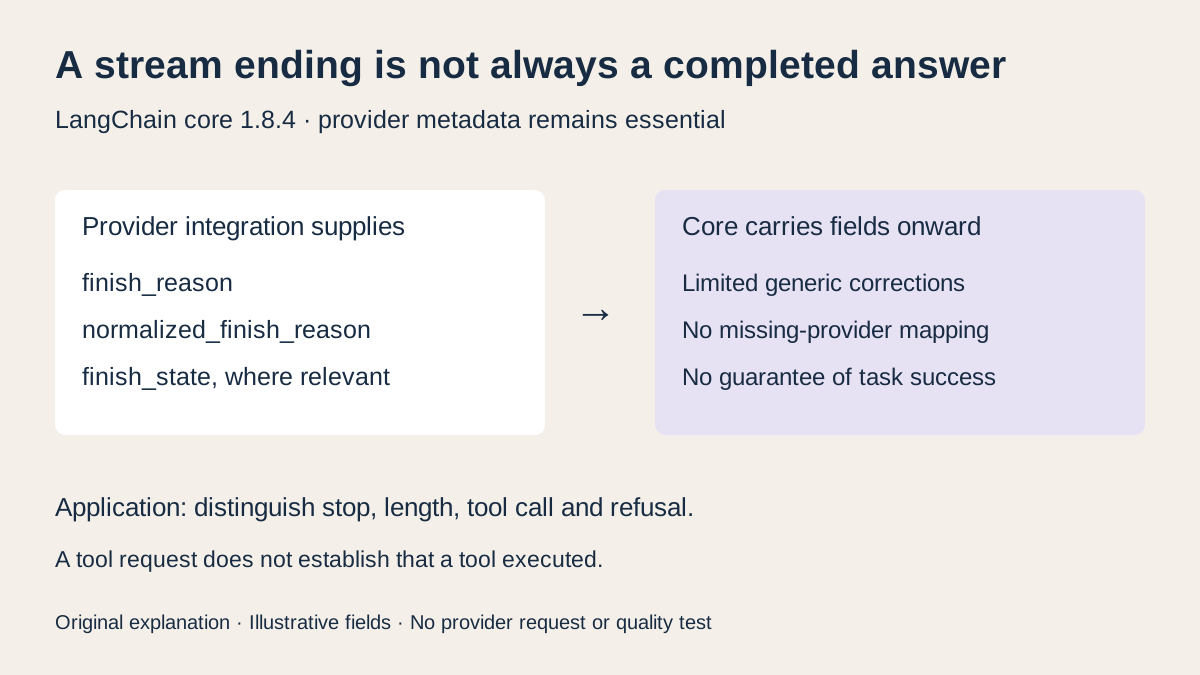
The important qualification is in the tagged implementation: provider integrations own the mapping from their raw formats. Core reads the fields they supply. An integration that supplies none does not acquire normalized finish information merely because core was upgraded.
Raw, normalized and continuation information are different
The upstream change describes a raw finish_reason, a best-effort normalized_finish_reason and an optional finish_state. The last field is relevant to supported continuation behavior, not a universal property of every provider.
Core also applies limited corrections when normalized information is present: a refusal block can change the normalized result to refusal, and a normalized stop on a message with tool calls becomes a tool-call result. The helper does not invent a normalization when none was provided.
Our analysis: the end of a stream is not necessarily success
A connection that finishes delivering data does not establish that the application received a complete answer. Output may have stopped at a limit, the model may have declined the request, or control may need to pass to a tool. Each can require a different next action.
That distinction is especially important when an application stores the response as completed work. Treating every ending alike can turn an incomplete result into an apparently successful record, leaving a later stage to discover the missing information.
A useful integration test therefore examines the ending metadata and the application’s decision together. Checking only the generated text would miss part of the contract. A readable partial answer is still partial, and a tool request is not evidence that the tool ran.
Check the installed integration, not only the repository headline
The pull request spans core and provider packages. Their release and dependency boundaries should be checked separately; this article does not claim that installing core 1.8.4 automatically installs every provider-side change. The tagged core package also declares a langchain-protocol minimum of 0.0.22.
Our LangChain repository profile links the MIT-licensed source. We reviewed the release, implementation and associated changes without upgrading an environment, calling a provider or running the project’s tests.
EXPLORE THE SOURCE
Projects in this story
GitHub repositories
- langchain-ai/langchain ↗View project details
Primary-source review and original editorial analysis. No software installation, model inference, paid service call, security validation or independent benchmark performed.