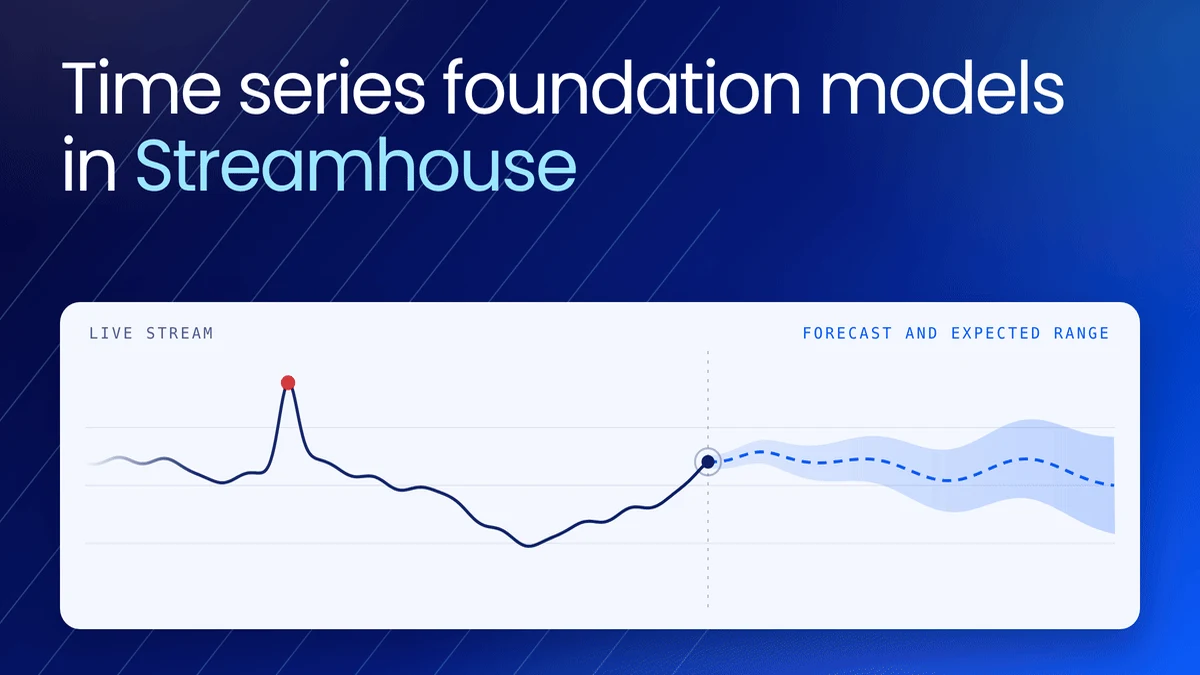
IBM Research and Confluent have detailed a native integration that embeds IBM time-series foundation models directly into Confluent's Apache Flink streaming workflows, allowing engineering teams to run forecasting, anomaly detection, and semantic signal analysis on standard CPUs without provisioning GPU clusters. Published on November 18, 2026 in an IBM Research technical post on Hugging Face, the release targets organizations that need predictive signals computed while operational events are still unfolding rather than after batch processing windows close.
Core Announcement and Operational Scope
According to the announcement, IBM's family of four time-series foundation models—which the authors report has surpassed 50 million downloads—now runs natively inside Confluent as built-in functions across both managed cloud and self-hosted environments. In Confluent Cloud, the models are delivered as fully managed capabilities requiring no separate deployment pipeline. For organizations running workloads in private data centers or hybrid environments, the same models execute within customer-managed infrastructure via Confluent Platform for Apache Flink.
Unlike large language models or vision transformers that typically require GPU acceleration for low-latency inference, IBM and Confluent emphasize that these compact time-series models execute on standard CPUs alongside existing streaming pipelines. By moving inference directly into the data stream, the joint architecture is aimed at manufacturing, retail, banking, and airline operations where delayed batch forecasts arrive too late to prevent stockouts, out-of-spec production runs, or anomalous payment activity.
Streamhouse Architecture and Named Components
At the architectural center of the integration is Confluent's Streamhouse model, built on the Confluent Data Streaming Platform's five core capabilities: connect, stream, process, govern, and query. As orders, payments, shipments, and machine readings enter the platform continuously, Apache Flink transforms and enriches incoming records via SQL, while Lightning Tables provide low-latency access to current operational state for downstream applications, analytics, and AI agents.
Within this intelligence layer, time-series foundation models operate alongside large language models, statistical methods, and specialized machine learning systems under unified orchestration. Rather than requiring data science teams to train and maintain an isolated model for every individual metric or store SKU, pretrained foundation models supply a shared baseline across diverse numerical sequences. Teams can invoke forecasting and anomaly detection directly through SQL functions—including the built-in AI_DETECT_ANOMALIES function—and route outputs back alongside the triggering events. Where domain specifics demand adaptation, organizations can fine-tune the models or pair predictions with deterministic business rules.
Real-World Integration and Workflow Impact
To illustrate how developers and operations teams apply streaming inference, the IBM Research post highlights several enterprise scenarios. In a manufacturing example centered on ice cream production quality, where product overrun depends on the air whipped into the mix, a pretrained TTM model ingests SCADA telemetry and quality assurance lab readings every 10 minutes. It forecasts the share of tubs expected to remain in specification four hours ahead, complete with a confidence range, and scores candidate adjustments to freezer draw temperature and airflow before operators approve setpoint changes or trigger automated adjustments within predefined guardrails.
In retail operations, the AI_DETECT_ANOMALIES function replaces brittle static thresholds across thousands of products and hundreds of stores. By generating an expected range from each series' recent history at a team-selected confidence level, the pipeline flags subtle drops in demand alongside weekend spikes and joins those signals with inventory records to suggest shelf checks or restocking. The same pattern extends to API telemetry, meter readings, machine sensors, and payment volumes, while overview sections also point to hourly SKU-level supply chain planning, per-card fraud baselining, trading volume forecasting, and semantic signal search.
Deployment Caveats, Licensing, and Missing Benchmarks
For open-source engineers evaluating the stack, several technical boundaries and disclosures remain important. Although IBM's time-series models carry substantial community download figures on Hugging Face and run inside Apache Flink pipelines, the Hugging Face article does not specify exact model parameter counts, memory footprints per CPU core, or end-to-end throughput and latency benchmarks. Similarly, the post does not break down which underlying model weights carry permissive open-source licenses versus proprietary runtime packaging inside Confluent Cloud and Confluent Platform.
Operational behavior also depends heavily on pipeline design. IBM and Confluent note that prediction refreshes are subject to each model's input requirements and the surrounding Flink pipeline configuration, meaning teams must still manage windowing, state retention, and data quality across upstream SCADA, point-of-sale, or telemetry feeds. Moreover, the published enterprise scenarios are presented as illustrative architectural patterns rather than audited production case studies with verified return-on-investment figures, leaving engineers to validate accuracy and CPU resource utilization against their own workloads before automating live control loops.
Automated Vertex AI (gemini-4-hydrogen) primary-source report; reviewed 2026-11-19.



