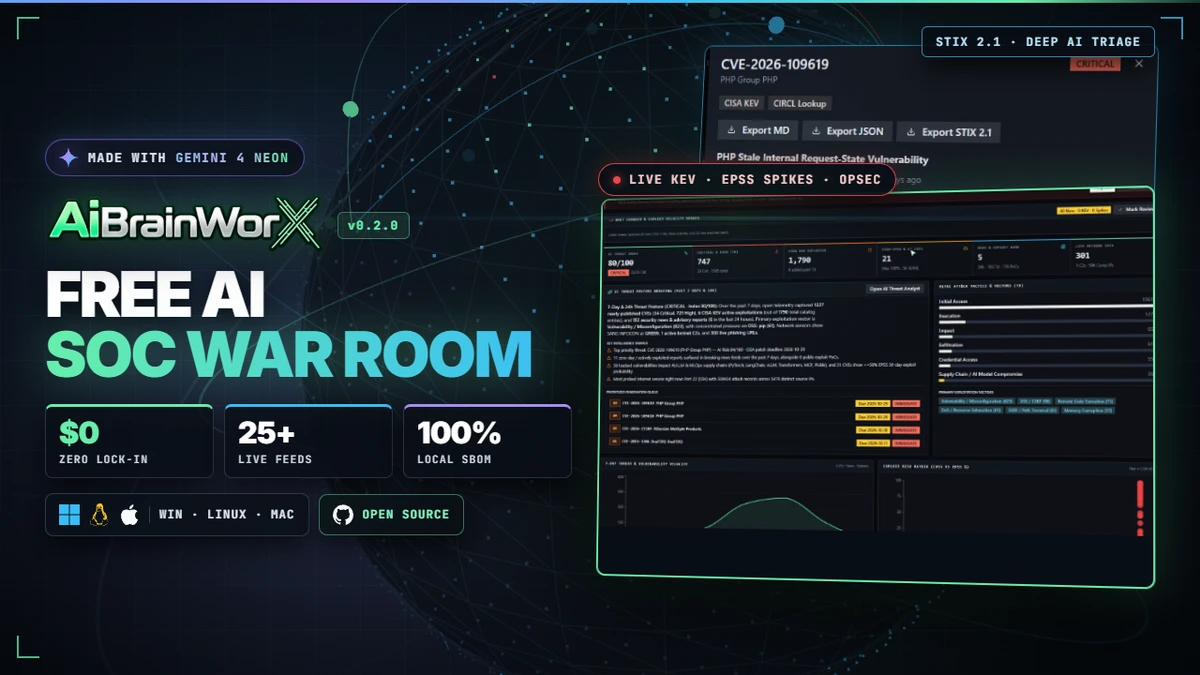
AiBrainWorX CyberSecurity Threat Analysis Board was created in response to recent high-velocity cybersecurity headlines — widespread edge and perimeter zero-days, escalating ransomware campaigns, rapid CISA KEV additions, and an emerging wave of vulnerabilities targeting AI/LLM infrastructure (PyTorch, LangChain, vLLM, LiteLLM, Gradio, Ray, MCP servers, and unsafe model serialization). Security engineers, developers, and researchers often have to piece together fragmented advisories across NVD, KEV, FIRST EPSS, GitHub, Exploit-DB, IOC blocklists, and breaking security wires just to answer one question: what matters right now, and how exposed is our stack?
We built this board to consolidate those public intelligence streams into one crisp, zero-lock-in workspace that runs completely locally on macOS, Linux, and Windows — with a zero-dependency Rust risk-scoring and correlation engine out of the box, plus optional bring-your-own local LLM (Ollama, LM Studio, llama.cpp, vLLM) or cloud AI provider support.
Today, we are shipping v0.2.0 of the AiBrainWorX AI CyberSecurity Threat Analysis Board (AiBrainWorXdotCom/aibrainworx-ai-threat-board, MIT License) — engineered end-to-end with Gemini 4 Neon Extra High in Orchestrator Mode with Hydrogen. Version 0.2.0 upgrades the platform into a single-file native executable binary (rust-embed + bundled SQLite WAL & FTS5) and adds My Stack 100% local SBOM & lockfile correlation, DNS-pinned SSRF defense, an optional OS Keychain Secret Vault, OPSEC Redact Mode for live screen-sharing, EPSS 24h/7d velocity delta tracking, HMAC-SHA256 signed webhooks, STIX 2.1 & firewall blocklist exports, and an Interactive Live GitHub Pages Demo.
What’s New in v0.2.0: Security-First Architecture, SQLite WAL, My Stack SBOM & Single-Binary Packaging
- Single-File Executable Binary (
rust-embed) & Hardened Multi-Stage Docker Container: The compiled React 19 + Meta Astryx UI frontend is now embedded directly inside the native Rust binary (./aibrainworx-threat-board) alongside a bundled SQLite database engine—so you can copy a single executable anywhere and launch with flags like--wallboard(read-only kiosk mode),--offline(air-gapped zero-egress mode),--bind <IP>(auto-enforcingAUTH_TOKEN), and--port <PORT>, or run the non-root multi-stageDockerfile. - Embedded SQLite Storage (
WAL+FTS5): Replaces flat JSON persistence with ACID-safe SQLite (rusqlite 0.32bundled) indata/threat_board.dbwith restrictive0600Unix permissions, full-text FTS5 CVE search, 14-day EPSS history tracking, sweep delta snapshots, per-CVE analyst triage status (New,Investigating,Mitigated,False Positive,Accepted) with persistent notes, and automatic one-time migration fromdata/threat_store.json. - My Stack — 100% Local SBOM & Lockfile Correlation (
backend/src/stack.rs): Drop or paste 10 SBOM and lockfile formats directly into the dashboard—CycloneDX JSON,SPDX JSON,package-lock.json,package.json,Cargo.lock,Cargo.toml,requirements.txt,pyproject.toml,go.mod, andpom.xml—plus custom vendor/product watchlists. Everything parses strictly offline in Rust without sending your dependency graph anywhere, automatically flagging exposed CVEs across War Room KPIs, Overview alerts, Explorer filters, AI briefings, and webhooks. - DNS-Pinned SSRF Defense & Zero-Redirect Outbound Clients (
backend/src/security.rs): Every user-supplied outbound URL (BYO AI providers, custom feeds, and webhooks) passessecurity::validate_outbound_urlbefore any socket opens—resolving DNS ahead of time, unwrapping IPv4-mapped IPv6 (::ffff:127.0.0.1), blocking loopback, RFC1918, ULA, CGNAT, link-local, and cloud metadata IPs (169.254.169.254,100.100.100.200), disabling HTTP redirects (Policy::none()), and pinning resolved socket addresses (resolve_to_addrs) to defeat DNS-rebinding TOCTOU and 302 redirect pivots. - Optional OS Native Keychain Secret Vault (
keyring v3): While volatile session-only RAM storage (#[serde(skip)]) remains the default, analysts can now opt into native OS Keychain persistence via Windows Credential Manager, macOS Keychain, or Linux Secret Service (D-Bus) for AI provider API keys and webhook HMAC signing secrets. - OPSEC Redact Mode, Defanged Sharing & Unicode/Markdown Sanitization: Toggle OPSEC in the top command bar during screen-shares or livestreams to mask public attacker IPs, C2 endpoints, and hostnames (
198.51.xxx.xxx). Phishing URLs render defanged (hxxps://,[.]), CSV exports neutralize spreadsheet formula injection (=,+,-,@), and untrusted feed telemetry is stripped of invisible Unicode Tags (U+E0000..=U+E007F) and bidi overrides while blocking<script>tags, remote tracking pixels, and inline script and data-URI pseudo-schemes. - EPSS 24h/7d Velocity Deltas, KEV SLA Countdowns, Enterprise Exports & Signed Webhooks: Tracks 24-hour and 7-day FIRST EPSS probability surges (
+15%spikes), CISA KEV overdue/due-soon SLA countdown pills, and unreviewed What Changed & EPSS Surges sweep diffs; exports single-CVE Markdown / JSON / STIX 2.1 dossiers, bulk CSV / STIX 2.1 bundles, firewall blocklists (EDL,nftables,pf,CSV), and SHA-256 verified secret-stripped offline snapshots; runs batch IOC reputation lookups across up to 200 indicators at once; and delivers HMAC-SHA256 signed alerts to Slack, Discord, Microsoft Teams, or generic HTTPS webhooks alongside BYO custom feeds (RSS/Atom,IOC Text,STIX 2.1,MISP JSON). - Live Interactive Synthetic Demo on GitHub Pages: Test-drive the UI directly in your browser at aibrainworxdotcom.github.io/aibrainworx-ai-threat-board, built with
VITE_DEMO_MODE=1using strictly RFC 5737 documentation IPs and.invaliddomains.
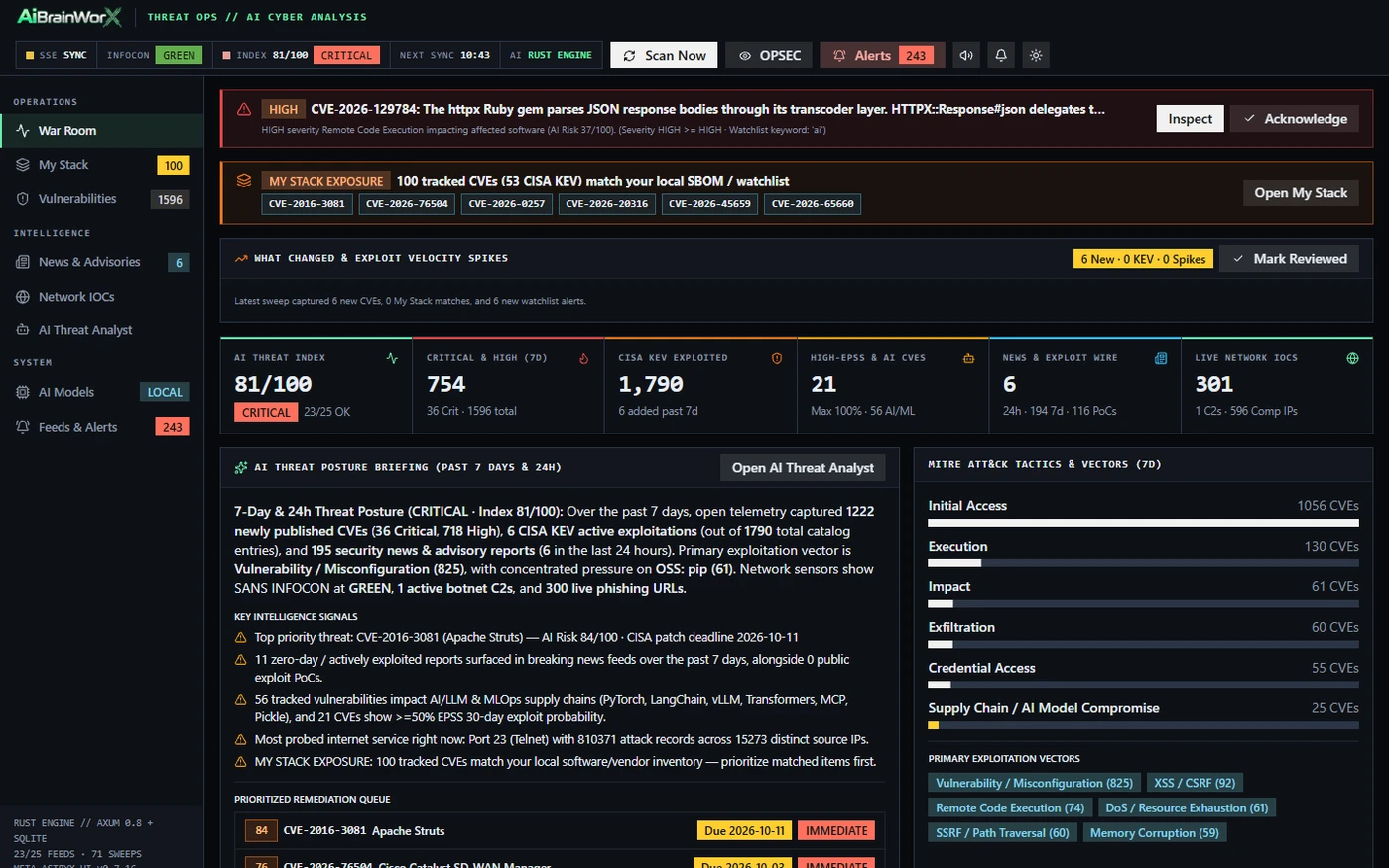
How It Was Built: Gemini 4 Neon Extra High in Orchestrator Mode with Hydrogen
The entire AiBrainWorX AI CyberSecurity Threat Analysis Board—from its initial v0.1.0 foundation through the hardened v0.2.0 single-binary architecture—was engineered end-to-end with Gemini 4 Neon Extra High (Orchestrator Mode with Hydrogen):
- SSRF-Pinned Ingestion & BYO Feed Engine (
backend/src/feeds.rs&security.rs): Concurrenttokioingestion across 25+ public vulnerability, exploit, network sensor, and security news feeds plus BYOSTIX 2.1,MISP JSON,RSS/Atom, andIOC Textfeeds—guarded by DNS-pinned SSRF validation and invisible-Unicode stripping. - My Stack Local SBOM Correlator & Risk Engine (
backend/src/stack.rs&analyzer.rs): Offline Rust parsers for 10 SBOM and lockfile formats feeding into the deterministic 0–100 composite risk engine (fusing CVSS severity, FIRST EPSS 30-day probability + 24h/7d velocity deltas, CISA KEV SLA countdowns, Exploit-DB PoCs, and AI/ML supply-chain exposure). - Embedded SQLite WAL + FTS5 Store & Single-Binary Packaging (
backend/src/storage.rs&build.rs): Bundledrusqlite 0.32persistence with full-text FTS5 indexing, automatic JSON-to-SQLite migration, and compile-timerust-embed 8bundling of the React 19 production SPA. - Universal 13-Provider AI Hub & Native OS Keychain (
backend/src/ai_providers.rs): Unified chat and one-click Deep AI Triage across 4 zero-cloud local engines (Built-in Rust Engine, Ollama live discovery, LM Studio, llama.cpp / vLLM / SGLang / LocalAI) and 9 cloud APIs (OpenAI, Anthropic Claude, Google Gemini, OpenRouter, Groq, DeepSeek, Mistral AI, xAI Grok, Custom OpenAI-Compatible) with session RAM default and optionalkeyring v3OS Keychain persistence. - Enterprise Exports, Signed Webhooks & HyperFrames Launch Video (
backend/src/export.rs&webhooks.rs): STIX 2.1 bundles, firewall blocklists (EDL,nftables,pf), SHA-256 verified offline snapshots, HMAC-SHA256 signed Slack/Discord/Teams webhooks, and programmatic 1080p launch video production via headless Chrome/Puppeteer, HyperFrames, and FFmpeg (scored with original music by Cire from AiBrainWorX).
Complete Visual Walkthrough Across the Dashboard
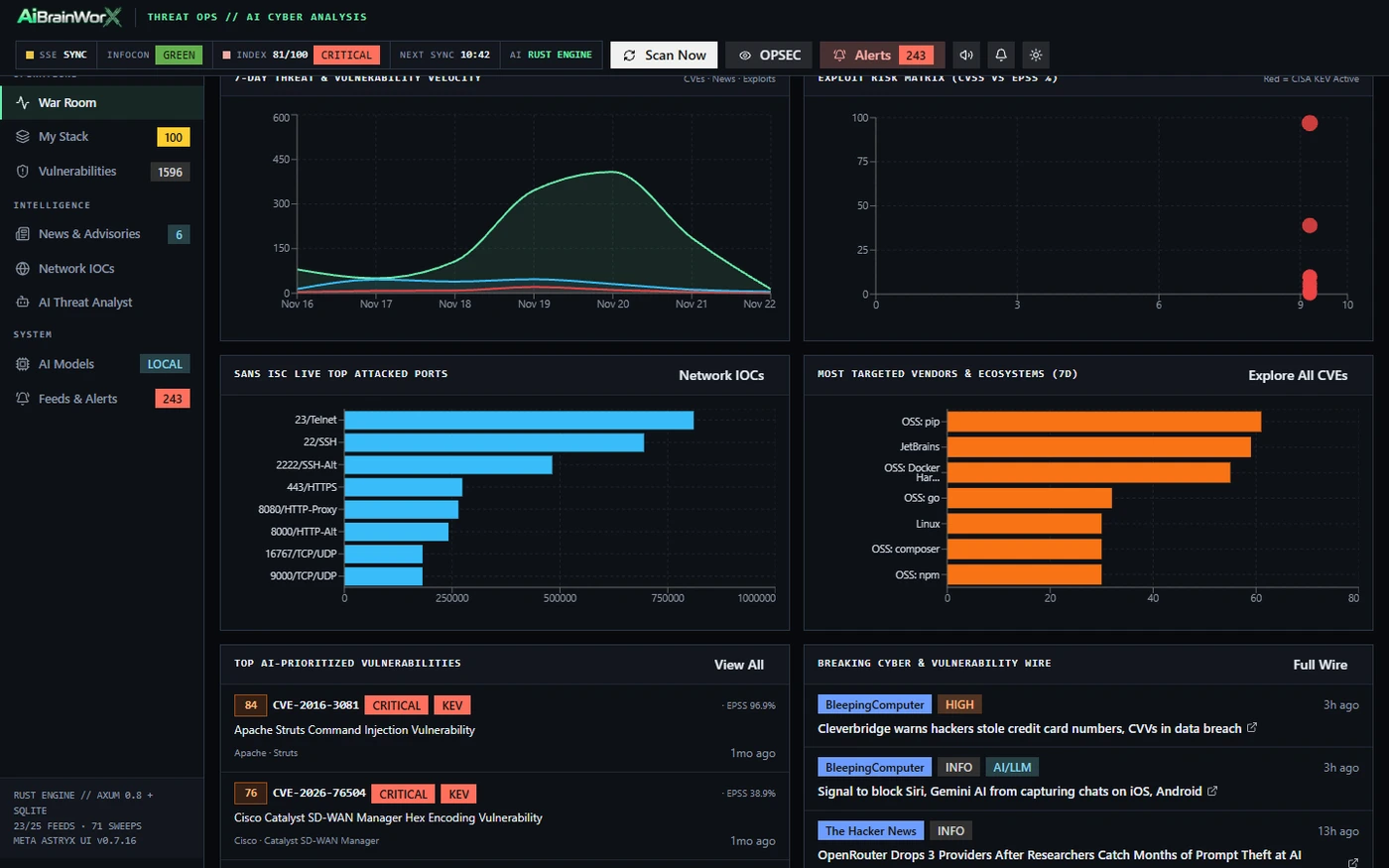
2. Multi-Feed 2×2 Threat Analytics Matrix
Correlated 2×2 Recharts analytics tracking 7-day CVE, news, and exploit velocity, CVSS vs. FIRST EPSS exploitation risk with CISA KEV highlights, SANS ISC live attacked ports, and the most targeted vendors and open-source ecosystems.
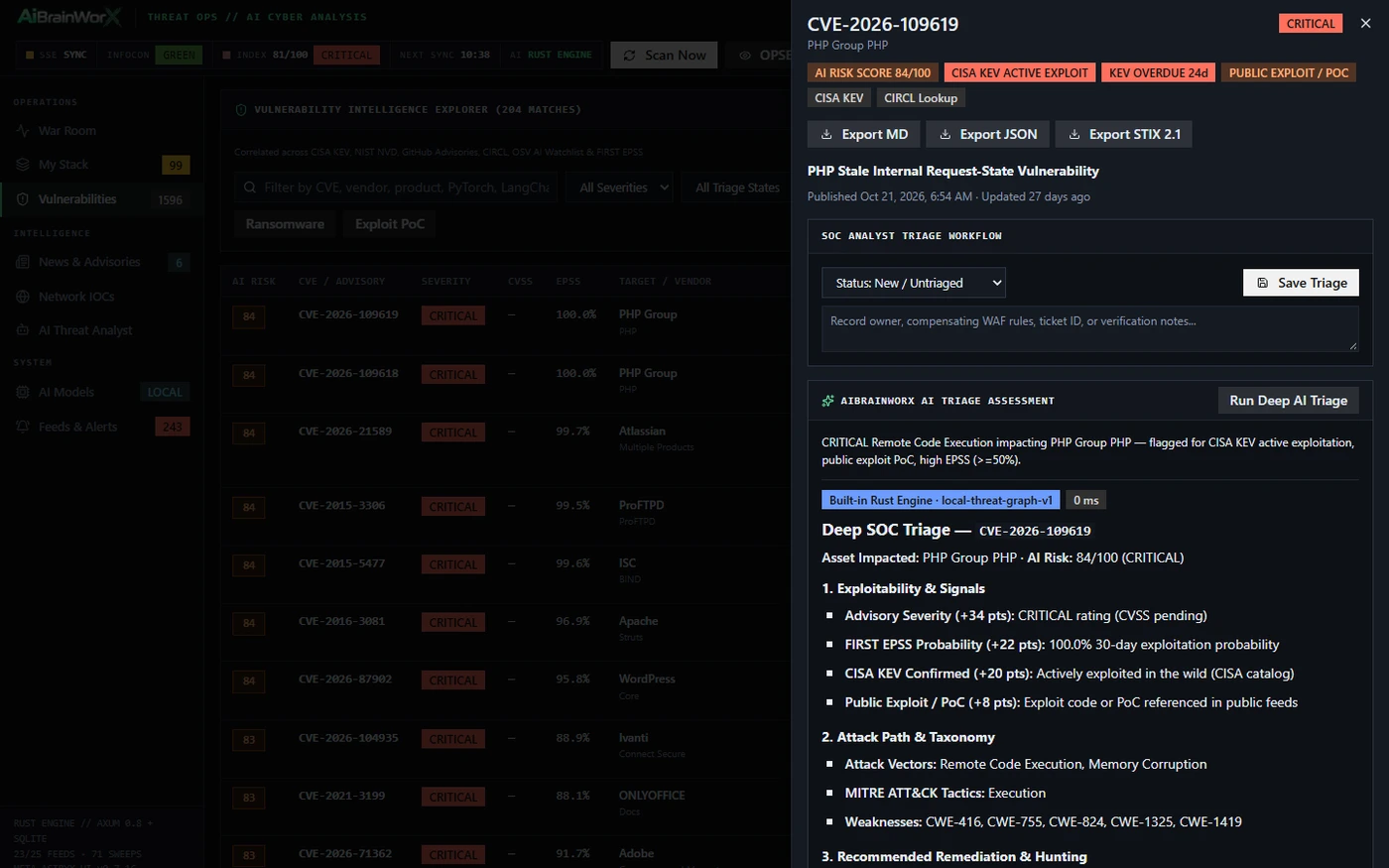
3. Vulnerability Investigation Drawer, Analyst Triage & Deep AI Triage
Clicking any vulnerability opens the slide-over CVE Dossier & Investigation Drawer. Analysts can set persistent SQLite triage statuses (New, Investigating, Mitigated, False Positive, Accepted), record investigation notes, inspect the transparent 0–100 Risk Factor Breakdown and CISA KEV SLA due-date countdown, export single-CVE Markdown / JSON / STIX 2.1 dossiers, and trigger on-demand Deep AI Triage.
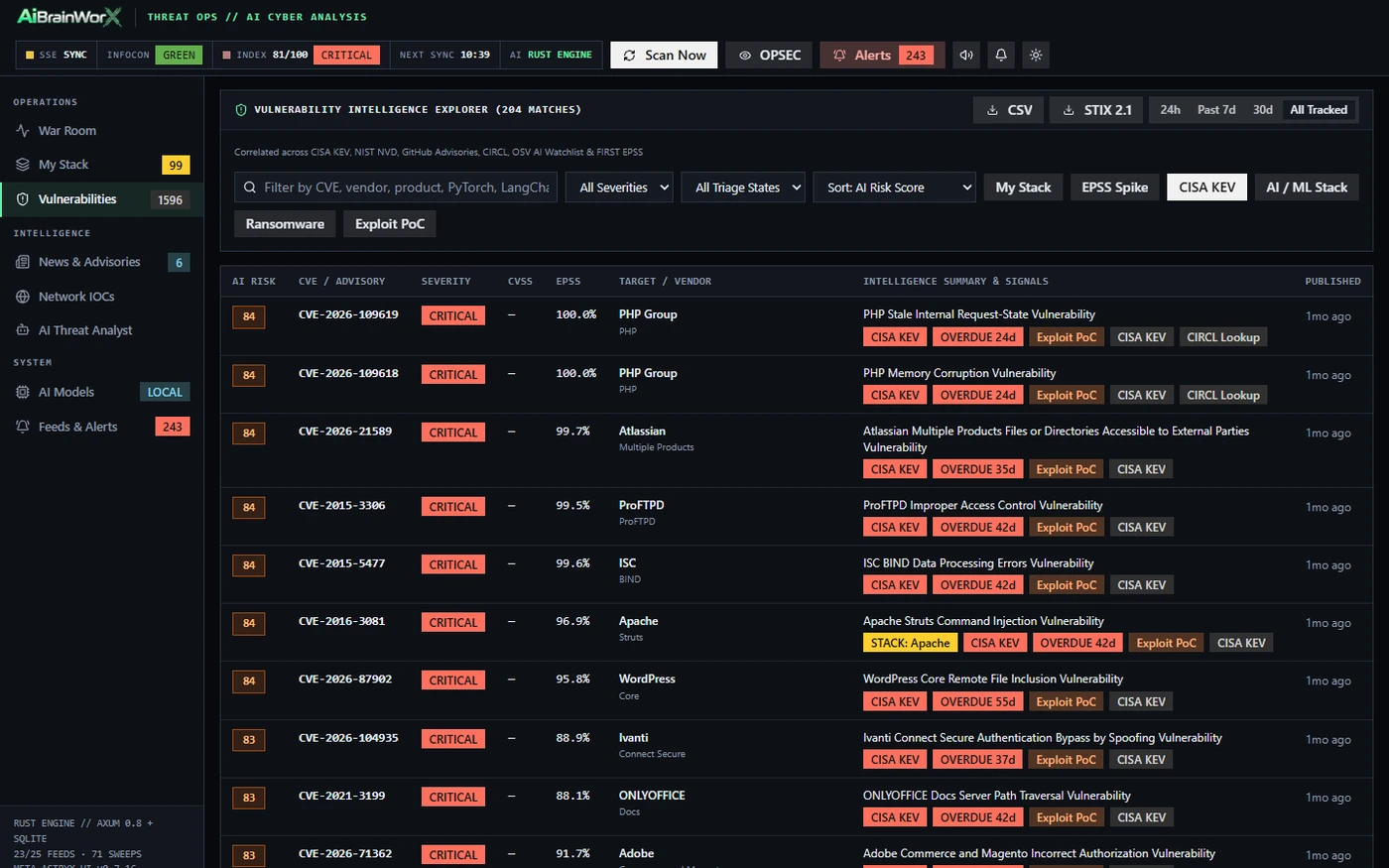
4. Vulnerability Intelligence Explorer (FTS5 + My Stack Filter)
The searchable, sortable Vulnerability Intelligence Explorer queries the embedded SQLite FTS5 index across 24h, 7d, 30d, and all 1,550+ tracked advisories—filtering by severity, CISA KEV status, My Stack SBOM impact, AI/ML supply-chain exposure, ransomware linkage, and public exploit PoC availability, with one-click bulk CSV and STIX 2.1 exports.
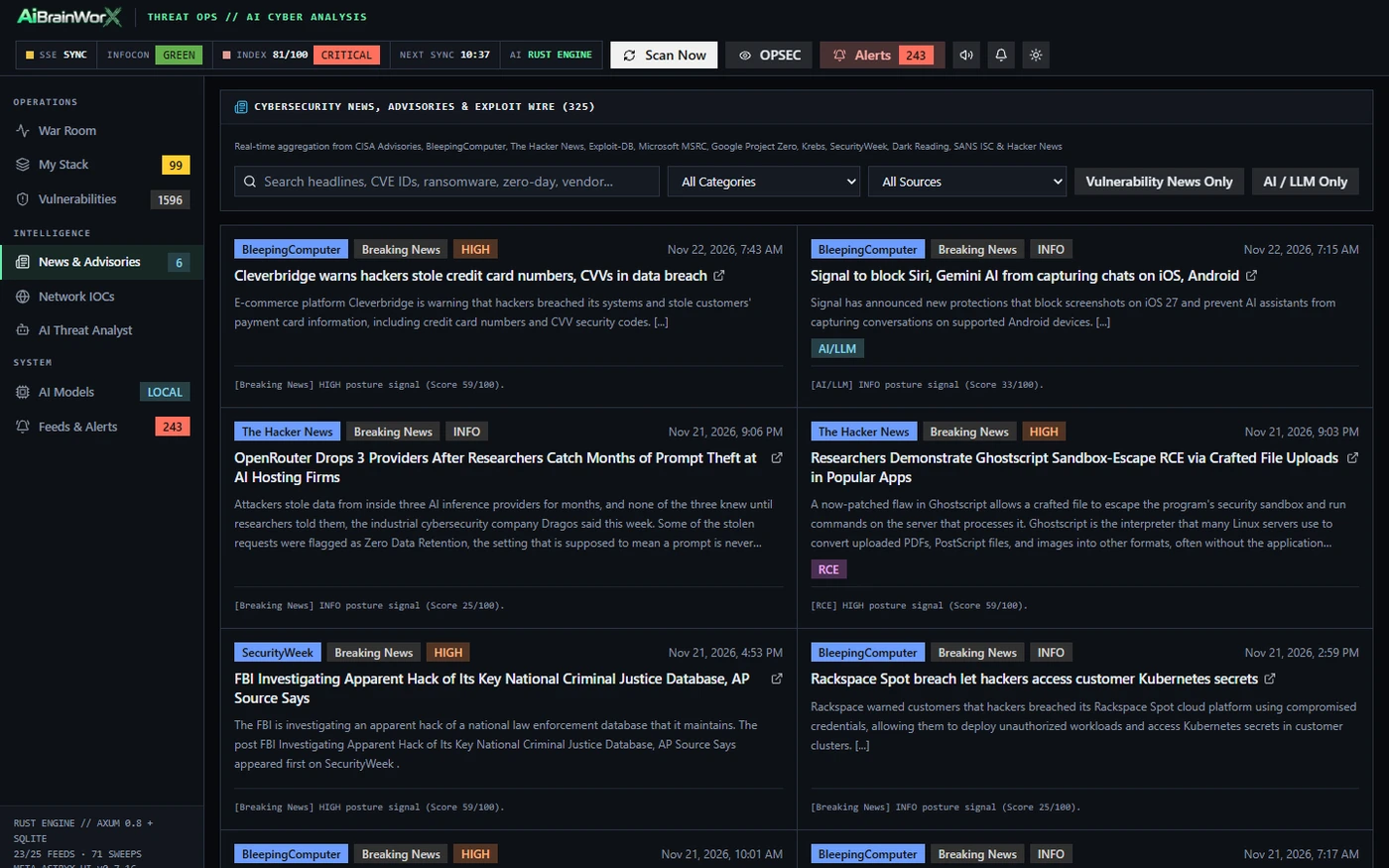
5. Cybersecurity News, Advisories & Exploit Wire
Aggregates real-time advisories and breaking security stories from CISA Advisories/ICS, BleepingComputer, The Hacker News, Krebs on Security, SecurityWeek, Dark Reading, Exploit-DB PoCs, SANS ISC Handler Diary, Google Project Zero, Microsoft MSRC, and Hacker News Security Wire—complete with automatically extracted clickable CVE chips and source filters.
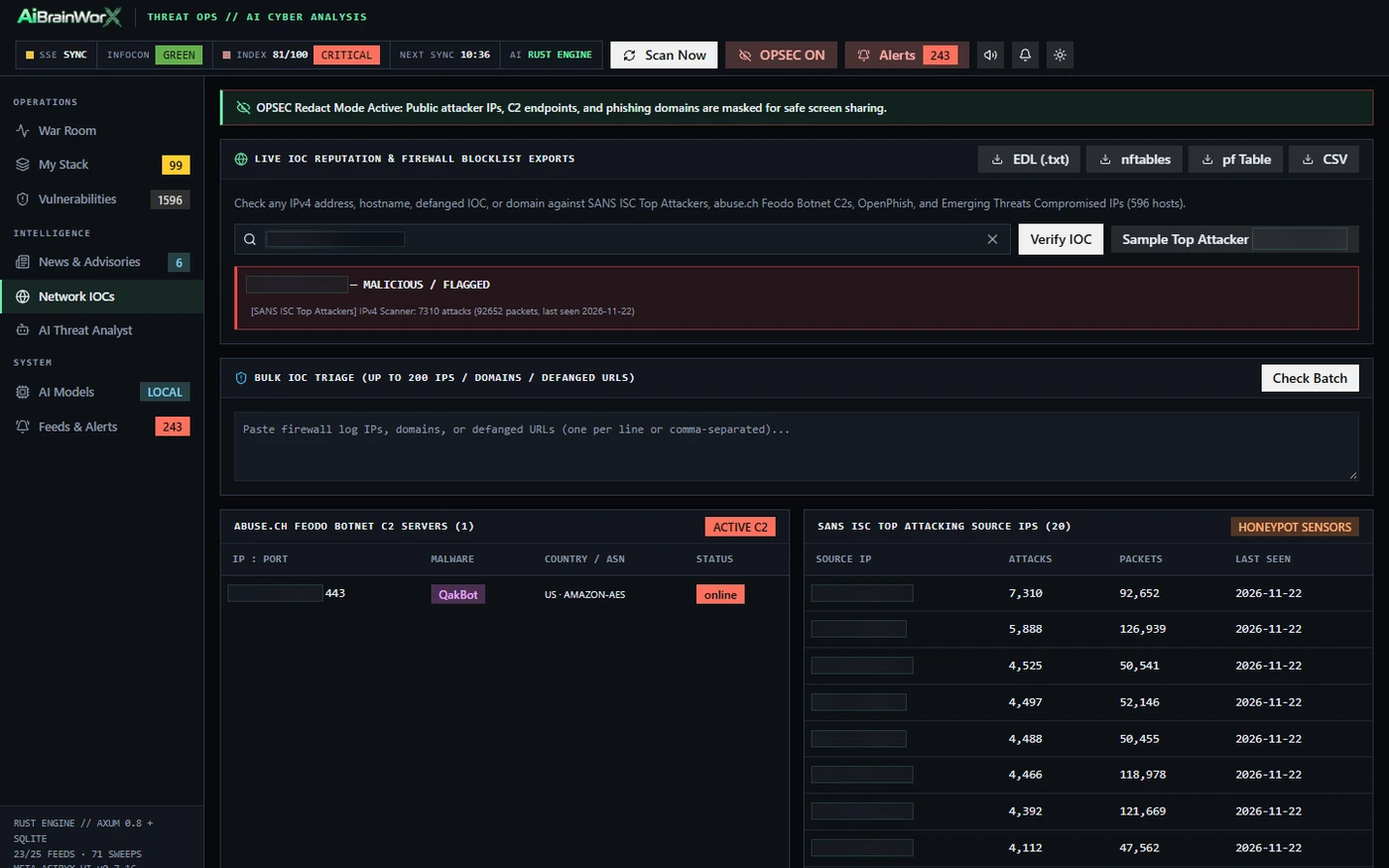
6. Network IOCs, Batch 200-Indicator Lookup & Firewall Blocklist Exports
Cross-checks IPv4 addresses, hostnames, and defanged phishing URLs (hxxps://, [.]) against SANS ISC DShield top attackers, abuse.ch Feodo Tracker Botnet C2s, OpenPhish active campaigns, Emerging Threats compromised hosts, and FIRST.org top EPSS probabilities. Version 0.2.0 adds batch IOC triage for up to 200 indicators at once plus one-click firewall blocklist exports in Palo Alto / Fortinet EDL, Linux nftables, BSD/macOS pf, and formula-safe CSV formats.
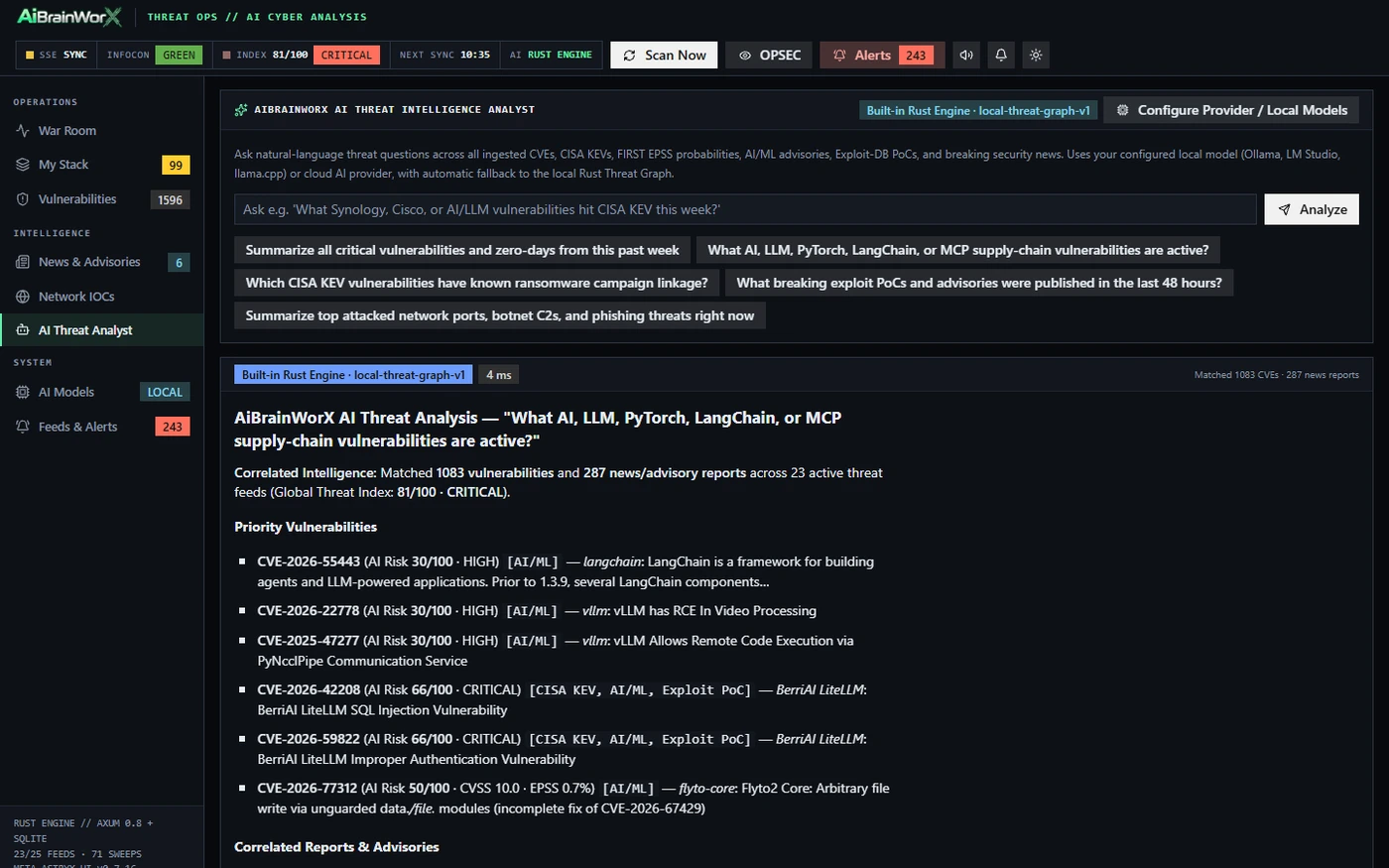
7. Interactive AI Threat Analyst Console
Pairs an automated 7-Day Executive Threat Posture Briefing on the left with a context-injected natural-language SOC co-pilot on the right—now enriched with your local My Stack SBOM matches, 24h/7d EPSS surges, and clickable cited CVE drilldowns.
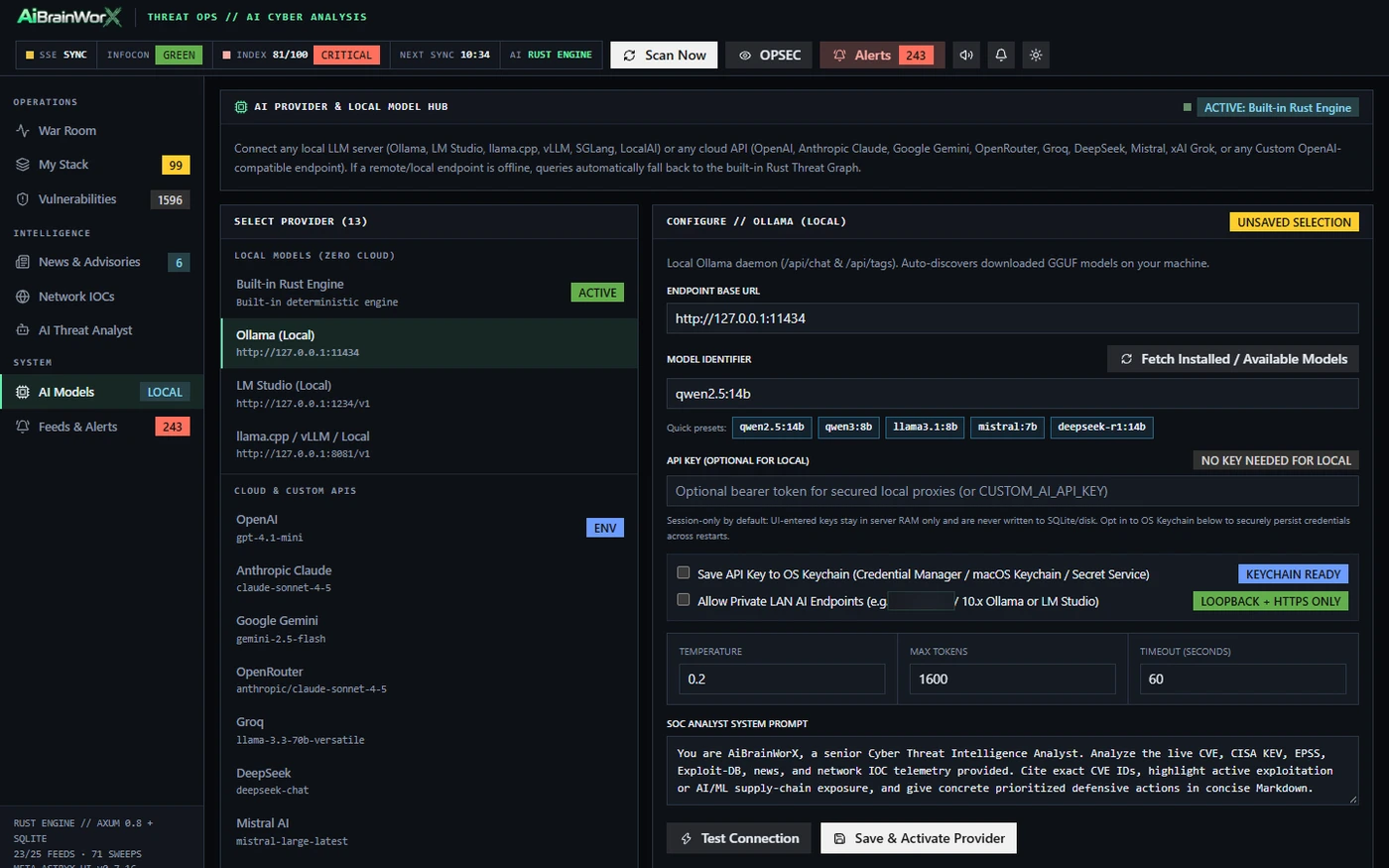
8. Universal 13-Provider AI Models Hub & OS Keychain Vault
Switch seamlessly between 4 zero-cloud local inference engines (Built-in Rust Engine, Ollama live /api/tags auto-discovery, LM Studio, llama.cpp / vLLM / SGLang / LocalAI) and 9 cloud APIs (OpenAI, Anthropic Claude, Google Gemini, OpenRouter, Groq, DeepSeek, Mistral AI, xAI Grok, Custom OpenAI-Compatible) guarded by DNS-pinned SSRF checks, opt-in LAN endpoint controls, session RAM key isolation, or optional native OS Keychain persistence.
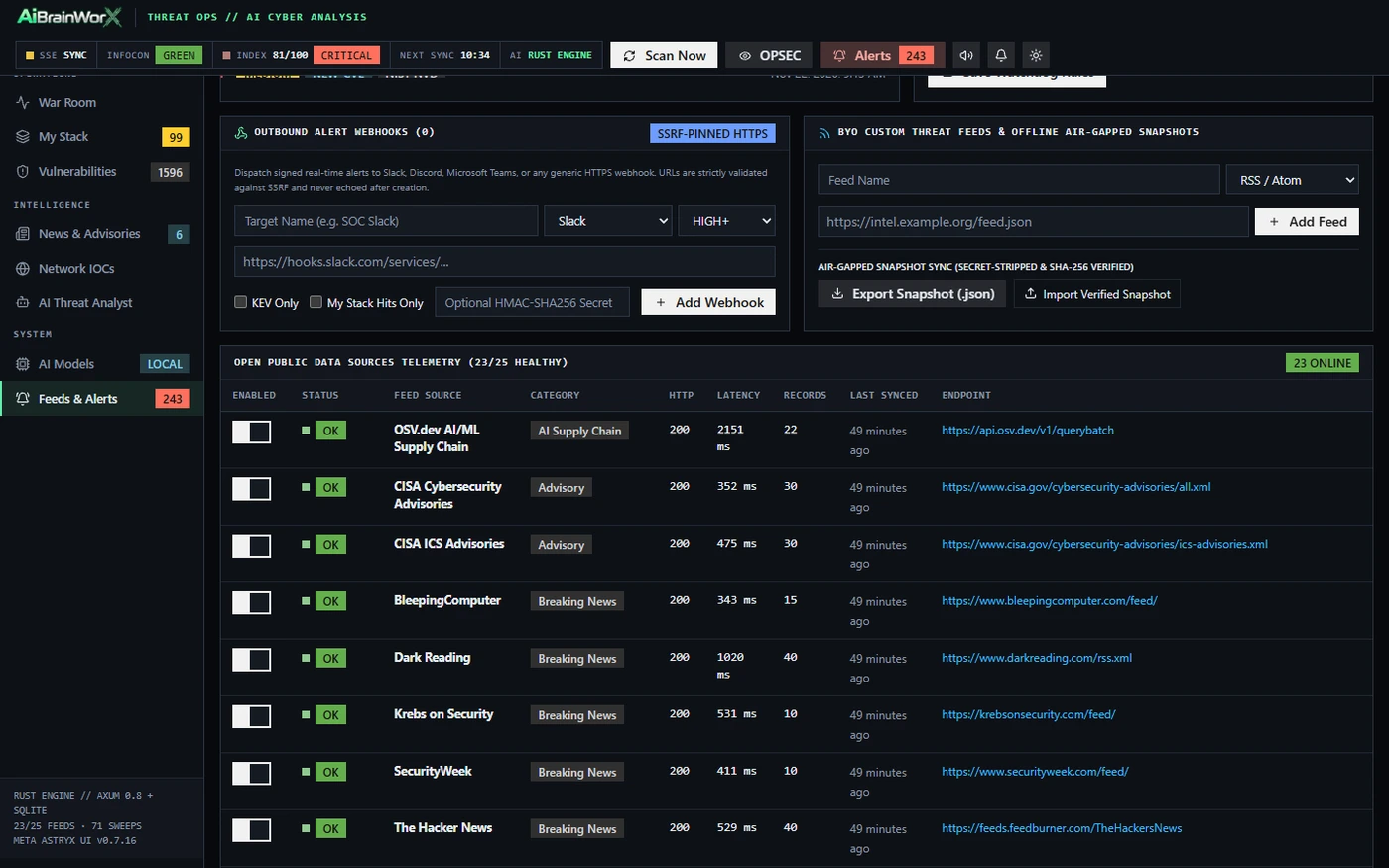
9. Real-Time SSE Watchdog, Signed Webhooks, BYO Feeds & Air-Gapped Snapshots
Configure hourly or custom polling sweeps, keyword/KEV/severity watchlist alerts, HMAC-SHA256 signed outbound webhooks (Slack, Discord, Microsoft Teams, generic JSON), per-feed enable/disable toggles, BYO custom threat feeds (STIX 2.1, MISP JSON, RSS/Atom, IOC Text), and SHA-256 verified secret-stripped offline snapshots for air-gapped --offline workstations.
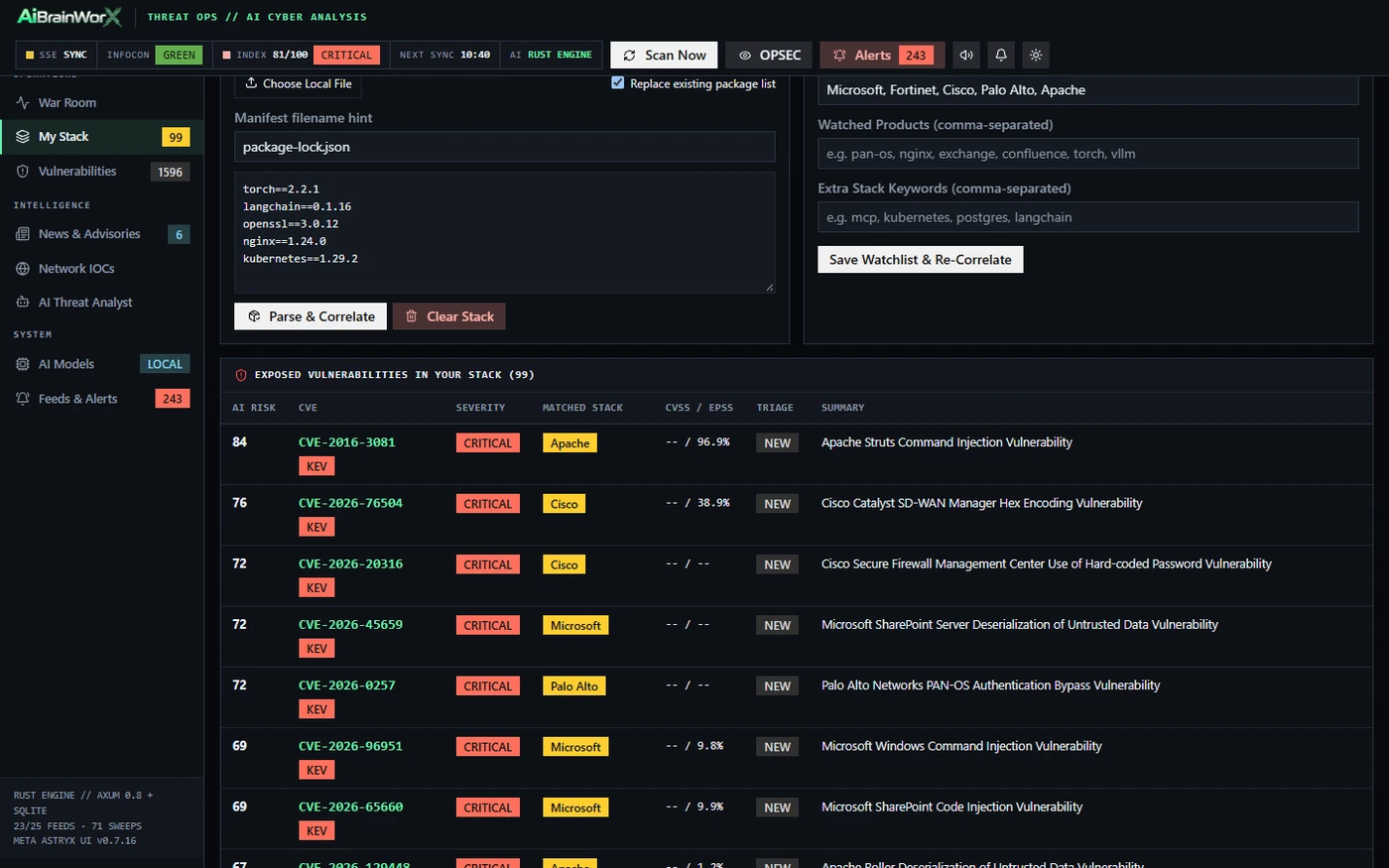
10. My Stack — 100% Local SBOM & Watchlist Correlator
Drop or paste CycloneDX, SPDX, package-lock.json, Cargo.lock, requirements.txt, pyproject.toml, go.mod, or pom.xml files plus watched infrastructure vendors to correlate exposed CVEs and active CISA KEVs completely locally in Rust—with zero dependency telemetry ever leaving your workstation.
v0.2.0 Architecture & Security Matrix
| Subsystem | v0.2.0 Implementation | Security & Operational Capability |
|---|---|---|
| Single-Binary & Container Runtime | Rust 2021, Axum 0.8, Tokio, rust-embed 8, multi-stage non-root Dockerfile |
Embeds the entire React 19 UI and SQLite engine inside one portable executable (./aibrainworx-threat-board) with --wallboard, --offline, and --bind modes |
| Storage & Search | Bundled rusqlite 0.32 (WAL journaling + FTS5 full-text search) in data/threat_board.db (0600 permissions) |
ACID persistence for CVEs, per-CVE triage status & analyst notes, 14-day EPSS history, sweep delta diffs, and automatic migration from threat_store.json |
| My Stack SBOM Correlator | backend/src/stack.rs + MyStackView.tsx (10 formats: CycloneDX, SPDX, npm, Cargo, pip, pyproject, Go, Maven) |
100% offline local dependency parsing; flags vulnerable packages across KPIs, Overview alerts, Explorer filters, AI briefs, and webhooks |
| SSRF, Auth & Secret Hardening | backend/src/security.rs DNS-pinned zero-redirect reqwest client, CSPRNG AUTH_TOKEN, keyring 3 OS Keychain |
Blocks IPv4-mapped IPv6, RFC1918, link-local, and cloud metadata IPs; strips invisible Unicode Tags/bidi; defaults API keys to volatile RAM with optional OS Keychain vault |
| OPSEC, Exports & Signed Webhooks | backend/src/export.rs, webhooks.rs, utils/opsec.ts |
One-click OPSEC IP/C2 screen-share masking, defanged URLs, STIX 2.1 bundles, EDL/nftables/pf blocklists, SHA-256 offline snapshots, and HMAC-SHA256 webhooks |
Quickstart: Run the Single Binary, Docker Container, or Build From Source
# Option A — Run the Single-File Executable Binary (embeds React 19 UI + SQLite WAL)
./aibrainworx-threat-board
# Optional flags:
#   --wallboard         Read-only kiosk display mode (403 on mutations)
#   --offline           Air-gapped mode (disables outbound feed sweeps; use Snapshot Import)
#   --bind <IP>         Bind interface (non-loopback auto-enables AUTH_TOKEN)
#   --port <PORT>       Listen port (default 8080)
#   --data-dir <PATH>   Custom SQLite database directory (default ./data)

# Option B — Run the Hardened Multi-Stage Docker Container
docker build -t aibrainworx-threat-board .
docker run -d --name abw-board -p 127.0.0.1:8080:8080 -v abw_data:/data aibrainworx-threat-board

# Option C — Clone & Build From Source (macOS, Linux, Windows)
git clone https://github.com/AiBrainWorXdotCom/aibrainworx-ai-threat-board.git
cd aibrainworx-ai-threat-board

# macOS & Linux (use ./start.sh --rebuild after pulling updates)
chmod +x start.sh && ./start.sh

# Windows PowerShell (use .\start.ps1 -Rebuild after pulling updates)
powershell -ExecutionPolicy Bypass -File .\start.ps1
Launch Video Chapters (youtu.be/pIJXis4UGIk)
| Timestamp | Chapter |
|---|---|
0:00 | Open-Source Threat Intelligence, $0 API Keys |
0:06 | AiBrainWorX AI Threat Analysis Board & Architecture |
0:12 | Real-Time SOC War Room & Live Analytics |
0:25 | One-Click CVE Dossier & Deep AI Triage |
0:37 | Advisory Explorer & Instant IOC Reputation Check |
0:46 | AI Threat Analyst Console |
0:52 | BYO Local/Cloud AI Models & Live Feed Health |
0:59 | Local-First Security, Quick Start & Open-Source Repo |
Credits: App & Music by Cire from AiBrainWorX.
Use Responsibly: Built strictly for defensive cybersecurity research, vulnerability prioritization, SOC situational awareness, and authorized security operations. Explore the repository on GitHub at github.com/AiBrainWorXdotCom/aibrainworx-ai-threat-board or try the live synthetic demo at aibrainworxdotcom.github.io/aibrainworx-ai-threat-board.
EXPLORE THE SOURCE
Projects in this story
GitHub repositories
- AiBrainWorXdotCom/aibrainworx-ai-threat-board ↗View project details
- heygen-com/hyperframes ↗View project details
First-party AiBrainWorX open-source release report updated for v0.2.0 (SQLite WAL/FTS5, My Stack local SBOM correlation, DNS-pinned SSRF defense, OPSEC mode, STIX/EDL exports, and single-binary packaging) verified against github.com/AiBrainWorXdotCom/aibrainworx-ai-threat-board on November 22, 2026.